


 Francais
 Deutsch
 Italiano
Refine Your Search
V2 stock footage and images
- Showing 9361 to 9366 of 9858 results more
more Hide
Hide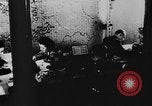
Antiaircraft damage allied aircraft tracked by air control center officers in Berlin, Germany during World War II.
Allied aircraft tracked and damaged in Berlin, Germany during World War 2. Soldiers and officers at Berlin's Air Control Center. The officers track the arrival in the skies of British and American allied aircraft. Search lights light up the skies overhead. German Anti-aircraft fire downs Allied enemy aircraft at night. The damaged allied aircraft and dead pilots on ground.
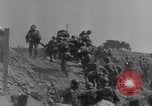
U.S. Army 3rd Division advancing through Southern France, during Operation Dragoon in World War II
Allied Invasion of Southern France during Operation Dragoon of World War 2, in 1944. The U.S. Army 3rd division,takes some time out while en route to Brignoles, France. Troops seen eating from their mess kits and some resting, with their boots off. American infantry later enter the town of Brignoles, following its liberation by their 15th Regiment. A few local citizens watch. Wounded American soldiers are treated at an emergency aid station set up on a street in the town. The infantry pass through the town on their advance to the west. An M10 tank destroyer accompanies the infantry moving through the town.
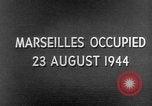
Docks, warehouses and port facilities damaged during the Liberation of Marseilles, France following Operation Dragoon
Allied Invasion of Marseilles, Southern France following Operation Dragoon during World War 2. French forces enter Marseilles and engage any remaining Germans. French Algerian soldiers of the 3rd Algerian Division in firing positions. French Algerian soldiers walk into Fort Saint Nicolas. Body of executed civilian man in Fort Saint Nicolas with his hands tied behind his back. Dead and wounded soldiers. Street defenses set up by German soldiers are seen abandoned, including artillery gun emplacements and machine gun nests. Views of rubble at docks, warehouses and port facilities that had been deliberately destroyed by retreating German forces. Part of ship with swastika visible just above water line. Bomb damaged hangers and aircraft at airport. Wrecked French planes with German markings. Liberated French civilians in Marseilles cheer Algerian troops. General Joseph de Goislard de Monsabert walking down street during parade as civilians cheer. Mosabert is congratulated by General Jean de Lattre de Tassigny and French politician André Diethelm who is described as French minister of war by the narrator.
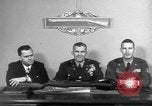
U.S. Army Colonel William W Quinn interviews World War II correspondents on combat unit publicity in the United States.
Colonel Quinn interviews World War II correspondents in the United States. Colonel United States Army William Wilson Quinn introduces 2 war correspondents Doug Larson of Scripps Howard and Sergeant Francis Porter of the United States Army during interview. They all seated at desk. Colonel states: Publicity of combat unit by press increases combat effectiveness and unit efficiency because Individuals are recognized, individuals are placed under spot light and results are enhanced. War correspondents state their points. Colonel questions about the commanders reluctance to publicity and their liking to follow specific units. Correspondents answer and state their points to these questions.
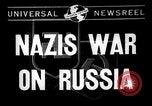
Events on the Eastern front early in World War II; Nazi Germany battles Russia
Goosestepping German troops on the march and German Panzer I tanks moving in formation across a field in World War 2. A formation of German Fieseler Fi 156 Storch airplanes in flight overhead, accompanied by two He-111 bombers. German paratroopers jumping from Ju-52 aircraft. Grand Admiral Erich Johann Albert Raeder head of the German Navy, making a statement. Bucolic scenes of European farm country and grape vineyards, with local people harvesting crops and grapes. Soviet troops marching on parade to a military band on the sidelines in Red Square, Moscow, soviet Union. Soviet motorcycle soldiers armed with light machine guns. Soviet T-26 light tanks in formation. Glimpse of Red Square, with St. Basil's Cathedral and other famous buildings. Soviet troops crossing a river on inflated boats. A long column of T-26 tanks moving along a dirt road. Sky filled with variety of Soviet warplanes, including four-engine bombers (with fixed landing gear) to bi-wing aircraft. Soviet paratroopers jumping from a Tupolev ANT-6 bomber. They climb out on the huge corrugated wing and slide off. View out past the tail of an ANT-6 bomber. Soviet Union and Japan conclude a neutrality pact. Views of the pact being signed by Foreign Minister Vyacheslav Mikhailovich Molotov for the Soviet Union and by Japanese Foreign Minister Matsuoka and Ambassador Yoshitsugu, for the Japanese, in Moscow on April 13, 1941. Joseph Stalin is observing in the center of the scene.
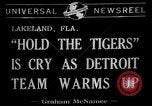
Detroit Tigers practice at baseball spring training, Lakeland Florida, March 1941
The defending champion of baseball's American League, the Detroit Tigers, practice at spring training in Lakeland Florida, March 1941. Players warm up throwing arms, with pitchers Bobo Newsom (#12) and Schoolboy Rowe (#14) in foreground. Close up of manager Del Baker talking. Player slides into sliding pit. Shots of pitcher Tommy Bridges (#10) warming up; outfielder Barney McCosky (#21) hitting a ball and running to first base; Hall of Fame second baseman Charlie Gehringer (#2), hitting a ball and running to first;, Hall of Fame first baseman Hank Greenberg (#5) posing for the camera with bat; pitcher Newsom warming up; and Greenberg hitting a ball and running to first.
CRITICALPAST.COM: About Us | Contact Us | FAQs - How to Order | License Agreement | My Account | My Lightboxes | Shopping Cart | Advanced Search | Featured Collections | Website Terms & Conditions | Privacy Policy ©2026 CriticalPast LLC.
License Agreement |
Terms & Conditions |
Privacy Policy
©2026 CriticalPast LLC.