


 Francais
 Deutsch
 Italiano
Refine Your Search
V2 stock footage and images
- Showing 9397 to 9402 of 9858 results more
more Hide
Hide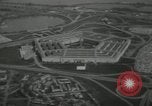
U.S. Army Secretary Wilbur M. Brucker calls a conference for the senior commanders of all U.S. Army components in the U.S.
U.S. Army components in the United States. Aerial view of the Pentagon armed forces installation in Arlington, Virginia, just outside of Washington DC, and ground level views of the Pentagon from nearby roads such as the Shirley Highway (Interstate 395) and possibly the George Washington Memorial Parkway. A sign board in the Pentagon reads ' Department of Defense'. View of Secretary of the Army Wilbur M. Brucker. Two newspaper headlines about the Cold War, space race, and the space satellite programs of the Soviet Union. U.S. Army soldiers at attention during inspection in their barracks. Men of U.S. Army National Guard and Reserve Units march across a field. A formation of many L-2 observation planes flies very low over the marching troops. Close up views of faces of U.S. Army soldiers. They perform calisthenics exercise drills during their physical training and stand in formation.
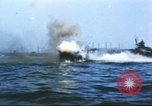
Color scenes of WWII including Pearl Harbor, D-Day, and Pacific campaign.
Montage of scenes dealing with Japanese attack on Pearl Harbor in World War 2. Bombs exploding and ships on fire; Japanese airplane diving from formation; a jeep driving past a burning airplane; hangars burning; Sailors firing anti-aircraft guns from an American ship; A New Orleans class American Cruiser firing her 8-inch guns; A South Dakota Class battleship firing her 16-inch guns; Group of American M3 Stuart light tanks in a field; U.S. Aviation Cadets marching between rows of Boeing Stearman Model 75 training biplanes; American soldiers marching in huge formations; Paratroopers in training jumps from towers; U.S. soldiers climbing down netting on side of troop transport ships to board small landing ships in the Pacific.; Marines in a landing craft carrying a large American flag; Landing craft in an amphious assault; Troops coming ashore from a Higgins boat, during training; An amphibious invasion task force at dusk; Troops wading ashore during the invasion of France in World War II, with barrage balloons aloft and support ships offshore. Staged scene of soldier on transport ship using flash light to read letter from home. Capital warships firing heavy guns and soldiers descending rope nets to enter landing craft. Soldiers landing on shore from Higgins Boats during training, and then on the shores of Normandy during the D-day invasion. American tank crew on an M26 Pershing tank. Major General George Patton with 1st Armored Division patch on his uniform sleeve. General George Marshall. General Dwight D. Eisenhower decorating an officer. Lieutenant General Henry (Hap) Arnold. Paratroopers jumping en masse from C-47 transport planes. German forces retreating in trucks along a road. Japanese General Yoshijirō Umezu, Chief of the Army General Staff, signing Surrender document aboard the USS Missouri, ending World War II, in the pacific. Glimpse of troop ship arriving in a U.S. harbor. View of U.S. military cemetery. Scene shifts to John Charles Daly, speaking in front of wall with names of Medal of Honor recipients, in the Hall of Heroes at the Pentagon, Arlington, Virginia, in 1968.
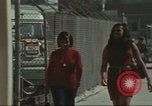
16mm motion picture film, quad videotape, and records at the American Forces Radio and Television Station in Los Angeles, California.
American Forces Radio and Television Station facility in Los Angeles, California. Women walks on sidewalk in Los Angeles. Women enter AFRTS building in Los Angeles. Man in 16mm film library packs 16mm motion picture films into boxes. Officer runs a kinescope machine to record video onto 16mm motion picture film. Officer operates 2" quad videotape recorder to record television program. African-American man packs record albums into boxes and tapes box shut.
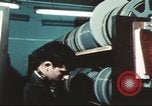
Operation of an American Forces Radio and Television Station.
Work of members at a American Forces Radio and Television Station in the United States. A man examine 16mm motion picture film before a program telecast. Station technicians playback 2-inch Quad reel-to-reel videotapes. Closeup of a monitor displaying a sports event. Closeup of waveform monitor. Men undertake technical maintenance of the television broadcast station. Transmitter is adjusted by one technician. A maintenance man examines a transmission dish.
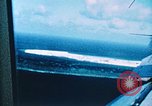
President Richard Nixon awaits the arrival of Apollo 11 astronauts aboard USS Hornet (CV-12) in the Pacific Ocean.
A splashdown point for Apollo 11 Command/Service Module (CSM) in the Pacific Ocean. Aerial views of a base with trailers and people gathered. The President's aircraft can be seen parked. USS Arlington (AGMR-2) underway. It is bristling with countless antennas and posts erected on the flight deck, and is providing communications support for the Apollo 11 recovery. Navy officers on the deck of USS Arlington. Sailors are lined up in a square formation surrounding center of deck. Astronaut Frank Borman, who commanded the Apollo 8 mission, is seen on deck. A U.S. Navy Sikorsky Sea King SH-3D helicopter hovering over USS Arlington. Aboard prime recovery ship USS Hornet (CVS-12), U.S. President Richard Nixon awaits the arrival of astronauts. The President stands in front of a Mobile Quarantine Unit, where NASA Associate Administrator for Manned Space Programs, George Mueller, explains the Biological Isolation Garment being modeled. Nixon feels the texture of the suit.
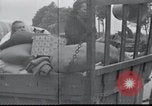
German tanks advance along a road in Marquion, France, and refugees flee, during World War II.
Germany invades France, during World War II. German troops invade French town of Marquion, in the Pas-de-Calais department in the Hauts-de-France region. Horse-drawn carriages loaded with French refugee families and belongings move along a road. Street signs on road number 15 point toward Sauchy-Lestrée 2 km away, and Avrincourt, 12 km away. A chalk drawn arrow points toward Arras. French families evacuate using bicycles, baby carriages, and wagons. German troops arrive on motorcycles. Numerous German Pz.I, Pz.II, Pz.III and Pz.IV tanks pass through the village. Smoke rises from a burning building.
CRITICALPAST.COM: About Us | Contact Us | FAQs - How to Order | License Agreement | My Account | My Lightboxes | Shopping Cart | Advanced Search | Featured Collections | Website Terms & Conditions | Privacy Policy ©2026 CriticalPast LLC.
License Agreement |
Terms & Conditions |
Privacy Policy
©2026 CriticalPast LLC.