


 Francais
 Deutsch
 Italiano
Refine Your Search
V2 stock footage and images
- Showing 9493 to 9498 of 9857 results more
more Hide
Hide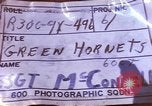
Smoke rises from explosions after rockets are fired from a U.S. Army UH-1B Iroquois helicopter in Naha Trang, Vietnam.
The film covers missions of U.S. Army UH-1B Iroquois helicopters equipped with 7.62 mm mini guns and 2.75 inch target spotting rockets in Nha Trang, Vietnam during the Vietnam War. A UH-1B helicopter makes a low pass over a jungle. A mini gun being fired from the helicopter in flight. The helicopter fires rockets. Smoke rises from explosions on the ground.
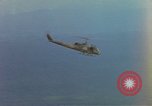
A U.S. Army UH-1B Iroquois helicopter approaches a clearing in a jungle near Naha Trang, Vietnam during the Vietnam War.
A film covers missions of U.S. Army UH-1B Iroquois helicopters equipped with 7.62 mm mini guns and 2.75 inch target spotting rockets in Nha Trang, Vietnam during the Vietnam War. A UH-1B helicopter makes a low pass over a jungle. Aerial views of the helicopter approaching a clearing in a jungle, and being joined by two more UH-1B helicopters. A UH-1B hovering over the clearing after other helicopter leaves.
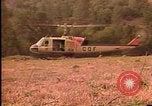
California State Department of Forestry using aircraft to fight fires in 1987.
California State Department of Forestry helicopter displaying "CDF" on its fuselage sits in a field with engine running. Scene shifts to view from ground as helicopter empties liquid from large bucket suspended underneath. Views of the chopper emptying buckets full of liquid to fight fire. Flames seen amongst trees in forest. A DC-6 firefighting tanker aircraft flies low over a fire and dumps orange liquid on the scene. the entire area is obscured by smoke. Through the smoke, a C-130 tanker aircraft flies in and drops its load of orangeliquid. An S-2T Air Tanker is seen dropping its firefighting liquid over the fire. Close view of a C-130 firefighting tanker with orange fluid being released through its open bottom doors.
U.S. team leads against Spain during a Team handball game at the 1972 Summer Olympics in Munich, Germany.
The United States and Spain compete in Team Handball, during the Summer Olympics of 1972 held in Munich, Germany. Scenes of the game underway, with the U.S. team (White) in possession of the ball and attempting to score. A scoreboard displays the score, ESP vs. USA, tied at 0-0. Then, the U.S. team scores, and the scoreboard shows 0-1. The Spanish team (Red) takes the offensive and presses the U.S. defenders, who foul a Spanish striker and lose the penalty throw, making the score even at 1-1 (scoreboard not seen). In their next possession, the U.S. team again scores and the fleeting image of scoreboard shows: 1-2.
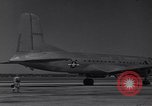
Cargo being loaded by winch in side door and jeep being loaded by elevator in a C-74 aircraft at Wright Field, Dayton, Ohio
U.S. Air Force C-74 Globemaster cargo aircraft at Wright Field in Dayton, Ohio. A C-74 Globemaster parked at Wright Field. Several ground crew stand in wheel well under No.3 engine of the aircraft. A ground crewman works on the tail of the C-74 aircraft, which displays the identification number: 265402 . No. 2 engine and open side door of the aircraft. A loadmaster stands in the open doorway with cable winch control in his hand. Man on ground secures cargo which loadmaster then raises with electrical winch .A jeep being loaded using platform elevator at underside of the C-74 Globemaster. Cargo hold of the aircraft with jeep being lifted up by elevator. Loadmaster secures elevator platform and then closes bottom cargo doors. Jeep is driven several feet forward inside the cargo compartment.
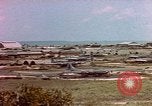
U.S. Army Air Force B-29 Superfortress bomber airplanes parked at airfield Isley Field, Saipan, during World War II
U.S. Army Air Force (USAAF) aircraft at Isley Field, Saipan, Mariana Islands, during World War 2. U.S. Army Air Force B-29 Superfortress bomber aircraft parked on aprons at airfield in Guam. Tail Code "A" of the 497th Bomb Group (73rd Bomb Wing) can be seen on one of the B-29s. A formation of USAAF P-51 Mustang fighter aircraft, in flight. U.S. airmen pull through propeller on number 4 engine of a B-29 to assure against hydraulic lock before starting the engine. B-29 parked next to this one displays "Square M" tail code of the 19th Bomb Group (314th Bomb Wing) stationed on Guam.
CRITICALPAST.COM: About Us | Contact Us | FAQs - How to Order | License Agreement | My Account | My Lightboxes | Shopping Cart | Advanced Search | Featured Collections | Website Terms & Conditions | Privacy Policy ©2026 CriticalPast LLC.
License Agreement |
Terms & Conditions |
Privacy Policy
©2026 CriticalPast LLC.