


 Francais
 Deutsch
 Italiano
Refine Your Search
V2 stock footage and images
- Showing 9673 to 9678 of 9857 results more
more Hide
Hide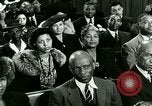
Film illustrating participation of African Americans in U.S. history from Colonial times to after the Civil War
Opening scene shows African American congregation in church, during World War 2, listening to their preacher speak about liberty. Closeup of the Minister speaking. As he refers to the seed of Liberty taking root in Boston, a plaque on the gate of the Granary Burial Ground of 1660 is shown reading: "Within this ground are buried the victims of the Boston Massacre, March 5, 1770." The gate swings open revealing the cemetery. Next, an illustration of British Redcoats shooting into a crowd on that occasion is shown. Closeup of the illustration shows an African American, named Crispus Attucks, falling as the first victim of the gunfire. A monument to him on Boston Common, is then shown. Closeup of the monument. Excerpt from a film about the Revolutionary War shows reenactment of the battle off Concord. The 221-foot granite obelisk at Bunker Hill, Boston, is seen, marking the site of the first major battle of the American Revolutionary War. A musket is seen with a sign attached reading: "Gun belonged to Peter Salem, a colored man who carried it at Lexington, Concord, and Bunker Hill, and with it shot Maj. Pitcairn." (Refers to Major John Pitcairn, a Scottish Marine officer, killed at the battle of Bunker Hill.) Illustration and painting of Peter Salem with his musket in the company of other patriots, is shown, as well as a glimpse of a mass reenactment of the battle of Bunker Hill. Next is seen the famous 1851 oil-on-canvas painting of Washington Crossing the Delaware, by the German American artist Emanuel Gottlieb Leutze. Closeup of one oarsman, identified as African American, Prince Whipple. Film Reenactment of the ragtag American army at Valley Forge in the snow, shows their suffering. Among them is an actor in the role of African American, Salem Poor, who had purchased his freedom from slavery and fought with Washington's army. A bell ringing and the American flag of 13 stars signifying the 1776 Victory. Film reenactments of pioneers including whites and African Americans working together, felling trees and building forts and barns, and the like. Scene shifts to a man of war ship under sail firing a salvo from its cannons. This is followed by illustrations of Commodore Perry in the battle of Lake Erie, during the War of 1812. In a dory with Perry is a black man named Tyler Thompson. War ships exchange gunfire. Narrator cites Perry's famous words of victory: "We have met the enemy and they are ours." Scene shifts to a painting of American general Andrew Jackson and his troops, at the Battle of New Orleans, in 1815. A battle reenactment shows a black American soldier participating. Postwar view of American ship building activity. View of a large sailing vessel. Cannon fire ushers in the Civil War in 1861 as Confederates fire on Fort Sumter. Images of combat are overlaid by the statue of Abraham Lincoln in his memorial at Washington, DC. Next, settlers are seen heading West in a wagon train. Camera focuses on a black couple who are part of the wagon train. White and African American men work side-by-side building a railroad. An early steam locomotive races along the tracks. .
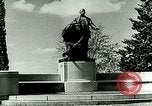
Contributions of African Americans in various fields in the United States.
(See also clip 65675078146 from different film transfer). Famous African American men and women citizens in the United States. Clip opens with of Booker T. Washington at Tuskegee University. Scene in a laboratory with African American scientist and inventor George Washington Carver, as an elderly man, working with another scientist in the laboratory. African American judge of New York city court. African American explorer Matthew Henson is seen looking at a globe (he was with Admiral Peary planting the American flag at the North Pole in 1909), and an unnamed African American surgeon at work in an operating room in New York. Next scene shows famous "father of the blues" musician and composer W.C. Handy (William Christoper Handy) smiling. Next is seen the financier and publisher of the Amsterdam News, Dr. C.B. Powell (Clilan Powell) greeting three uniformed African American women during a World War 2 war bond drive, and handing them a check (close up is shown) for 25,000 dollars, dated January 4, 1942, for the war bond drive. It is from the account of the Victory Mutual Life Insurance Company which Dr. Powell also owned. The check is signed by C.B Powell and Philip M.H. Savory (Dr. Savory was co-owner of the New York Amsterdam News). The next scene shows Elise Johnson McDougald, better known as Gertrude Elise Ayer, who was the first black full-time public school principal after the consolidation of New York City schools in 1898. She was also a noted woman writer during the Harlem Renaissance. She is seated in her office at her desk, likely in P.S. 119 in Harlem, since this is approximately year 1945 and she was at P.S 119 at that time. Her name plaque is visible on the front center of the desk. Principal Ayer smiles as a woman delivers a document to her. Next is seen the African American historian, author, and professor, Lawrence D. Reddick, serving in his role as the curator of the Schomburg Collection of African American Literature. In an art studio is seen the famous African American sculptor and painter Charles Alston, at work on a sculpture. Next scene shows the famous African American contralto singer, Marian Anderson, receiving a bouquet of flowers and smiling after a performance. This transitions to a view of African American orchestra conductor Dean Dixon leading an orchestra in a performance of Beethoven's 9th Symphony. Several views of different sections of the orchestra performing under Dixon's direction. Clip closes with brief shots of campuses of several historically black colleges and universities in the United States like Howard University, Hampton, Tuskegee, Fisk, Prairie View. An American college football game underway at the stadium of one of the colleges.
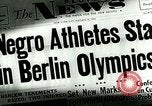
African American athletes make their mark at the 1936 Summer Olympic Games in Berlin, Germany
Opening scene shows stadium filled with spectators for the 1936 Summer Olympic Games in Berlin, Germany. View from behind six sprinters ready to start the 100 meter dash. Front view closeups of African American runners, Jesse Owens and Ralph Harold Metcalfe Sr. Official fires gun for the start, and the runners are off. Camera tracking the runners shows Jesse Owens well ahead of all the rest, at first, but Metcalfe soon catches up with him. Crowd roaring and cheering in the stadium. Scoreboard shows Owens first, Metcalfe, second, and Osendarp (of Holland) third, separated each by only one tenth of a second. The American National Anthem can be heard in the background. The next event is the men's high jump. Sign shows the bar initially set at 1.97 meters height. The first competitor is Gustav Weinkötz of Germany. He fails to clear the bar. Next is Hiroshi Tanaka of Japan, who also fails to clear. Bar is reset to 2.03 meters (6 feet-8 inches). African American, Cornelius Johnson makes the next attempt. He successfully clears the bar and the crowd roars its approval. (He had set a new olympic record.) Three American flags flying over the stadium as the U.S. National Anthem is again heard being played.
New recruits, including African Americans, commence training in the U.S. Army during World War II
Views of damage in the aftermath of the Japanese attack on Pearl Harbor, December 7, 1941. Scene shifts to African American pastor in pulpit of a church speaking about U.S. armed forces. A woman in the congregation whose son is serving in the Infantry, points to a flag filled with blue stars for service members from the church. She reads letter from her son telling her he has been selected for Officer Candidates School. View of new recruits in a railroad depot. African American recruit pauses to say goodbye to his mother, but is moved along by a uniformed Army officer. Closeup of locomotive wheels turning. Glimpse of barracks in an Army base. Recruits leaving railroad train and entering a snow-covered building. Army sergeants organizing the new recruits inside the building. An army spokesman welcomes them to the training camp. Recruits being interviewed about their past training and experiences. Closeup of a Sergeant inquiring about the kind of machine tools a recruit had worked with. Recruits assembled in a base auditorium where they hear from a Chaplain and an officer who demonstrates how to salute. (World War II; WW II; World War 2; World War Two)
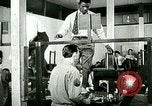
African American recruits in U.S. Army are issued uniforms and begin basic training in World War II
African American recruit sits in a chair with feet on a measuring device. A sergeant gives him a pair of shoes. But before he wears them the Sergeant tells him to stand, in the measuring device, holding two 20 pound weights. He then tells him to put on the shoes and go into the next room, where other African American recruits are lined up. They are instructed to remove all civilian clothes and begin dressing in army clothing. Next, completely dressed in their army uniforms, the recruits carrying duffel bags as they leave the snow-covered camp to board a train. Views of steam locomotives pulling trains in various places in the country. A convoy of army trucks carrying the new soldiers into a military base. The trucks park side-by-side in a line and the soldiers jump out with their gear to begin their basic training. A sergeant instructing the new soldiers on how to make a bed and other responsibilities. The new African American soldiers assembled in formation outside their barracks, on the snow, practicing close order drill, and making mistakes in the process. Next they are seen in a cross country march, carrying rifles. they take a 10-minute break. Soldiers in an infirmary, being visited by army doctors and African American nurses. Newly recruited soldiers being tended in an army dental clinic by African American dentists and hygienists. Soldiers shooting rifles on a firing range. Targets moving up and down on the range. Soldiers participating in sports, including football, baseball, boxing, and ping pong. A woman in the base library reading poetry aloud from a book entitled: "An Anthology of American African American Literature." African American members of the Women's Army Corps (WAC) are seen at another base, engaged in close order drill. Next these WACs are seen driving and riding in jeeps over rough terrain. A soldier shines his shoes, on Saturday night. African American soldiers and women dancing to music from an orchestra. The soldiers performing calisthenics in the open air. Rifles are held in some of the exercises. (World War II; WW II; World War 2; World War Two)
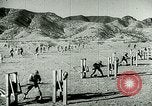
African American soldiers training during World War II, including some earning commissions as Officers
In opening scene, African American soldiers perform bayonet training at an Army Base in the desert. Then they run out of a trench in practice attack. Next, the troops are seen assembled in an outdoor stadium, where religiious services are being held. An African American Army Chaplain tells them of increased Officer Candidate opportunities. A group of Officer candidates is seen that includes a number of African American soldiers. Candidates are seen graduationg and receiving their commissions. A parade of ROTC (Reserve officers' training Corps) cadets is seen including mostly African Americans. Views of cadets at the U.S. Military Academy, in West Point, New York, receiving graduation diplomas. An African American graduate is among them. Scene shifts to an African American woman in a church, reading a letter from her son who has just been commissioned as an Army Officer. Glimpse of the congregation's pastor thanking her for sharing her letter. (World War II; WW II; World War 2; World War Two)
CRITICALPAST.COM: About Us | Contact Us | FAQs - How to Order | License Agreement | My Account | My Lightboxes | Shopping Cart | Advanced Search | Featured Collections | Website Terms & Conditions | Privacy Policy ©2026 CriticalPast LLC.
License Agreement |
Terms & Conditions |
Privacy Policy
©2026 CriticalPast LLC.