


 Francais
 Deutsch
 Italiano
Refine Your Search
V2 stock footage and images
- Showing 9817 to 9822 of 9858 results more
more Hide
Hide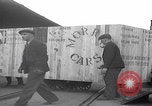
Post-war British industry: Crates and shipping containers containing export cars at dock in the United Kingdom
Post-war revival of British industry and exports after World War 2. Nuffield Exports cars seen in United Kingdom. Dock workers adjusts a wagon carrying a Nuffield Exports automobile crate. The crate bears labels that read “Morris Cars”, “Nuffield Exports” and “RG Colombo”. Men push the wagon with crate. Container label on the side reads “The British Motor Industry delivers the goods”. Crate lifts cargo next to a shipping container that reads “Austin Cars for the world” and “Auckland”. A dockside railroad car moves past container. Shipping container labeled “Britain delivers the goods” on dock.
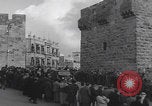
A Roman Catholic prelate leaves his car and walks to Church of the Nativity during visit to Jerusalem
A parade of vehicles through streets of Jerusalem, Palestine, during World War 2 timeframe. Crowds of men gathered at Jaffa Gate to watch the arrival of vehicles. Honor guards in horses escort the vehicles. The vehicles come to a halt near the crowds. A Roman Catholic prelate leaves his car. The prelate is accompanied by government officials. Crowds watching from balconies, minaret, and on top of buildings. The prelate and government officials stopper and in prayer. Crowds gather outside the Church of the Nativity.
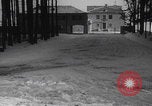
German scientists setting up radio directional finding network machines
A snow-covered road leading to a German Aeronautical test station in the late 1930s, before World War 2. Pine trees surround both sides of the road. Camera shows the gate and front door of the test station. The Nazi Swastika adorns top of front door. An almost empty room with a bust statue on display. A hangar or warehouse-like building inside the test station. German scientists setting up radio machines. A scientist wearing headphones adjusts dial control of machine. Another scientist stands on top of the radio directional finding network.
German pilot uses radio directional finding equipment aboard a Junkers Ju 52 aircraft
Shortly before World War 2: Animation showing an aircraft emitting radio waves towards German cities of Berlin and Leipzig. A man sits behind a radio directional finding network. A radio antenna receives signals. Animation showing radio directional finding networks in Berlin and Leipzig detects aircraft in Germany. A man’s hand plotting a map with a long ruler. Animation depicts German radio directional finding network detecting aircraft location. A Junkers Ju 52 transport aircraft in hangar. A second Ju 52 on ramp with tail being elevated in flight position on snow-covered airfield. Nose and engine of the Ju 52. Pilot using directional finding equipment onboard the Ju 52.
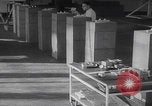
German scientists develop radio directional finding network for various aircraft
German aeronautical scientists testing radio directional finding network, shortly before World War 2. Men opening partition slide of a barn that serves as their laboratory. Small dish-shaped antenna in barn and large search antenna on ground. The two scientists in white lab coats set up radio equipment. Towers and snow-covered field in the background. Wire hanging over a scientist setting up radio. A biplane aircraft marked “DEUTSCHE LUFTREEDEREI (German Air Transport)”, with rear cockpit enclosed. A Junkers W 33 (D-1957) transport aircraft with wheel gear instead of floats carrying electronic gear. The Junkers W 33 has visible external antenna. Aerial view of the Junkers W 33 in flight. Two men with radio antenna of a Dornier Do X flying boat. Dornier Do X flying boat aircraft in water is seen as it taxis away from dock and then in flight low over water.
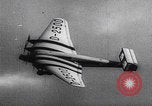
Junkers G.38 transport aircraft in flight; Fieseler Fi 156 in short takeoff; Focke-Wulf Fw 61 helicopter demonstration
A Junkers G.38 transport aircraft (D-2500) in flight over Germany in the late 1930s, before World War 2. A small, single-place, tailless monoplane with turned down wing tips in flight. A Fieseler Fi 156 Storch making short takeoff and steep climb over control tower of an airfield. The first functional helicopter, the Focke-Wulf Fw 61 helicopter (D-EKRA) (later Focke-Achgelis Fa 61), demonstrating its hovering ability.
CRITICALPAST.COM: About Us | Contact Us | FAQs - How to Order | License Agreement | My Account | My Lightboxes | Shopping Cart | Advanced Search | Featured Collections | Website Terms & Conditions | Privacy Policy ©2026 CriticalPast LLC.
License Agreement |
Terms & Conditions |
Privacy Policy
©2026 CriticalPast LLC.