


 Francais
 Deutsch
 Italiano
Refine Your Search
V2 stock footage and images
- Showing 9877 to 9882 of 9941 results more
more Hide
Hide
Newly naturalized Americans recite the Pledge of Allegiance during the 1944 “I Am An American Day” (WWII)
More than a million people attend the “I Am An American Day” citizenship ceremony in Central Park in New York City, during World War 2. Over 150,000 people attended the ceremony as newly naturalized American citizens. Native American Indians in traditional dress and women and men in military uniform attend the ceremony. Flags of various nations are flown. Wounded Army soldiers and wounded Navy sailors arrive as guests of honor. New York City Mayor Fiorello LaGuardia shakes hands with servicemen, giving tribute to their heroism during World War II. Immigrants stand up to recite the Pledge of Allegiance to the United States of America as part of the naturalization ceremony. Speaker recites the Pledge of Allegiance, which predates the inclusion of "under God" which was added later in the 1950s.
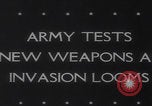
United States troops test new aerial and land military weapons (WWII)
The United States Army tests new weapons during World War II. United States Army Air Force bombers drop 100-pound bombs in a huge concentrated salvo over a field. Shells explode simultaneously. A medium bomber drops an aerial torpedo. Anti-personnel bombs burst in the air shortly after being dropped from a flying bomber. Fighter planes diving and dropping auxiliary gasoline tanks used as incendiaries. This is a WW2 example of napalm use. Gasoline tanks explode and burst into flames upon hitting the ground. Artillery officers fire phosphorus shells from mortars. Explosion from phosphorus shells. Soldiers testing flamethrowers on a tank. A group of soldiers use flamethrowers simultaneously, covering the screen with thick smoke and flames.

Men transport and load incendiary bombs, chemical officer reads a bomb chart in Europe (WWII)
World War II (WW2) Chemical Warfare Service logo and words, "Incendiaries over the Axis." An M76 incendiary bomb explosion. The United States officers in meeting room in front of wall map of Europe. A man puts a pin into “Berlin” on the map. A pillar of smoke rises from a bombed Nazi German war plant. Allied trucks carry chemical bombs on the road to a chemical park. A man carries a bomb, stacking it on a neat pile of incendiary bombs. Men unload wooden crates with incendiary bombs. Bomb warning reads “Do not assemble fuze to cluster until loaded into airplane”. The chemical officer at the headquarters of the United States Strategic Air Forces in Europe signs a document from his desk before handing it over. The chemical officer reads a chart showing the increased use of incendiary bombs by Allied forces from January to March 1944.
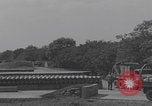
Men unload large incendiary bombs, arming sky markers before storage in bomb dumps (WWII)
Incendiary bomb storage in Allied bomb dumps during World War II. Incendiary bombs are neatly stacked in a bomb dump. A truck backing on the right of the pile. Men unload wooden crates and large incendiary bombs from trucks. Man unloads crates containing 100-pound M47A2 bombs. Men unpack bomb from its wooden protective crate. 500-pound PT-1 Pyrogel-filled AN-M76 bomb is rolled off from the truck. The AN-M76 is also called "Blockburner" or "Goop". Technicians remove the shipping bands off the AN-M76. Truck crane carries an AN-M76 bomb. Stacks of AN-M76 bombs are stacked in the bomb dump. Men carefully place the bomb in the stack. Men flip the crate containing an M17 Aimable Cluster bomb. Men unpacking the M17 500lb Aimable Incendiary Cluster Bomb. Technicians remove the tape and cuts the wires securing the incendiary bomb. A man removes the protective frame of a bomb. The men roll an M17 Aimable Cluster bomb to a stack. Two men stand in front of a shed with a door sign “Bursters”. Man opens a crate, inspects bursters. A Chemical Warfare officer shows a sky marker (made from a converted M47 bomb casing filled with FM smoke producing solution) while other soldiers look on. The Chemical Warfare officer demonstrates the method of arming the sky marker with a modified US 101 fuse. A sky marker is sealed with a rubber washer and a plastic disc. A threaded aluminum fuse adapter and another fuze are inserted. A flange is bolted down. Men marking sky markers prior to storage in bomb dumps. Wooden sign reads “DANGER ACID”.
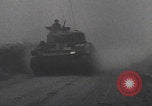
Allied armies advance through Gustav Line in Italy during World War II
Allied armies advance to break the Gustav Line in Italy during World War II. Medium tank (likely Sherman M4A2 Medium Tank) advances through foggy weather. Allied tanks advance through forested terrain. Troops advance in Jeeps, trucks and M3 half-tracks. M3 half-tracks towing artillery.
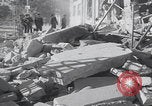
British soldiers rescue survivors from the Irgun bombing of the Goldsmith Officers Club in Jerusalem
Irgun bombing of the Goldsmith Officers Club in Jerusalem. British soldiers pulling out an injured man from the ruins of the Goldsmith Officers Club. Rescue workers carry wounded to an ambulance. An empty street and its buildings after the declaration of Martial Law in Palestine. Laundry hanging in a courtyard outside a building. British soldiers lay down barbed wire on the street. A Bedford MW 4x2 truck with British troops drives away. Some soldiers march on foot. A group of universal carriers (also known as Bren gun carriers) drive through the streets. Some Palestinian civilians watch the universal carriers from the sidewalk. A white truck with the Star of David drives past a universal carrier. A British solider guards two suspects as they walk down a road.
CRITICALPAST.COM: About Us | Contact Us | FAQs - How to Order | License Agreement | My Account | My Lightboxes | Shopping Cart | Advanced Search | Featured Collections | Website Terms & Conditions | Privacy Policy ©2026 CriticalPast LLC.
License Agreement |
Terms & Conditions |
Privacy Policy
©2026 CriticalPast LLC.