


 Francais
 Deutsch
 Italiano
Refine Your Search
V2 stock footage and images
- Showing 1171 to 1176 of 9858 results more
more Hide
Hide
U.S. Navy Lockheed P-2H and C-117 Hummer aircraft at Tan Son Nhut Air Base in Saigon, Vietnam during the Vietnam War.
U.S. Navy aircraft in Vietnam during Operation Market Time of the Vietnam War. A U.S. Navy Lockheed P-2H aircraft taxis at Tan Son Nhut Air Base in Saigon. Aircraft in flight. One of the patrol aircraft returns. A U.S. Navy C-117 Hummer aircraft moves towards a parking area. A patrol aircraft taxis in to the parking area. A P-2H aircraft taxis to the parking area. Ground crew directs the aircraft as it makes a starboard turn. The aircraft in parking area as crew men stand next to the aircraft. Engines stop. The aircraft being towed to a parking area.
2nd Sino-Japanese war, precursor to World War II in the Pacific. Pearl Harbor attack. Early phase of Pacific conflict between Japan and the U.S.
The film 'Sea power in the Pacific' showing Japanese dominance in China and at start of World War 2. Then it chronicles U.S. efforts to build Navy and fight back on sea and in the air. Opening scene shows Japanese Mitsubishi G3M (Type 96) bombers high overhead, and then closeup in formation. View from bomber of bomb bays open with bombs falling and view from ground of explosions and destruction. Overlay on film says: "China---1931." (This is not correct. The G3M bomber was not yet in service.) This film depicts Japanese attacks during second Sino-Japanese War, commencing 1937, Chinese civilians running to escape Japanese bombing of Singapore. Buildings destroyed and on fire. Next, Japanese troops, carrying the Rising Sun flag, are seen establishing a beachhead in an Amphibious assault. More scenes of Japanese infantry advancing through Singapore, ad it is being destroyed and burned. Soldiers charging along an alleyway, with pagoda in background. Next, Japanese soldiers are seen attacking Nanking, and committing atrocities and killing Chinese during the so-called "Rape of Nanking," in December, 1937. Chinese civilians being summarily shot and dumped into a large open grave after execution. Two Chinese prisoners with hands bound, being executed by rifle fire. Jubilant Japanese troops celebrating their victory. Map shows areas of China occupied during second Sino-Japanese war and the East Indies to the South. View of oil tanks; an open pit tin mine; a native cutting rubber tree bark to collect latex. Flags on map show regions of English, French, and Dutch colonial interest. It also shows Islands to the East, fortified by the Japanese. Cartoon shows Japanese soldier opposed by and American sailor (representing U.S. Sea Power). Next, famous images of the Japanese attack on Pearl Harbor, Hawaii, December 7, 1941, are shown, including the USS Arizona burning and sinking. Hawaii, Midway, Wake, and the Philippines Islands, are highlighted on a map and Japanese control of the Pacific is illustrated. Japanese soldiers are seen displaying a captured American flag. U.S. Lieutenant General Jonathan M. Wainwright is seen surrendering the garrison at Corregidor, on May 6, 1942. View of Japanese General Masahara Homma discussing surrender terms with Wainright. Map shows interlocking web of Japanese fortified bases in Pacific and need for seapower to oppose it. View of American shipyard with hundreds of workers, employed to build ships for the war effort, in World War 2. Views welding, metal fabrication, and other shipbuilding activity. A new ship going down the ways and a woman christening a new ship with splash from bottle of champagne. A new "Liberty Ship," the Richard Bassett, going down the ways at Bethlehem-Fairfield Shipyard Inc. Baltimore, Maryland. Closeup view as the stern of another ship enters the water upon launching. View of it from a distance. Shipyard workers knock supports from under what may be a landing craft, as it is launched. Japanese warships underway in the Pacific and firing their naval guns. Explosions on a shoreline from naval bombardment. Japanese infantry wading ashore during an amphibious assault. Map shows where Japanese forces attempt an amphibious assault on Southern New Guinea, thwarted by the U.S. Navy in the battle of the Coral Sea of May, 1942. In June, 1942, a Japanese attempt against Midway Island, was again checked by the U.S. Navy in the Battle of Midway. View of USS Wasp (CV-7) carrier deck filled with airplanes, including Grumman F4F Wildcats. A Douglas SBD Dauntless dive bomber being cleared for takeoff from the Wasp. Gun camera film showing Japanese airplanes being shot down by pursuing U.S. aircraft.
U-2 aircraft takes pictures of Soviet missile sites in Cuba during the Cuban missile crisis
U.S. Air Force U-2 aircraft takes off from runway, and climbs rapidly.Next scene shows interior of a U.S. Air Force photo reconnaissance laboratory where films from U-2 aircraft are developed and are being examined by Air Force photo interpreters. Images of Soviet missile installations in Cuba are seen on the close-up images.
American people honor sailors of the U.S. Navy; views of towns, cities, people in the United States right after World War 2.
A film intended for U.S. Navy personnel about the return to civilian life after World War 2 and the better life of Americans in the United States as a result of their service. Film created immediately after the end of World War 2. A boy practices baseball, hitting the ball and running. View of the baseball diamond with a New York City bridge in the background. Women with children walk around in a park. A man greets a sailor of the U.S. Navy, shakes his hand and thanks him for his service. A mother talks to a child that is sitting on her lap as they read a book. Fishermen raise up fishing nets at a dock and process a catch of crabs. A man works in a laboratory. Dignitaries salute as soldiers march carrying the American flag. Two boys walk directly behind two U.S. Navy sailors and try to copy exactly how the sailors are walking. An elderly woman prays, kneeling in a church. People stand in a baseball stadium as the U.S. National Anthem begins to play. A sailor raises the American flag as other sailors stand at attention. Aerial view of a field in the U.S. Cattle graze on field. A man rides a bicycle in a small town, and tips his hat to a woman leaving a house. A boy with a manual push lawn mower cuts grass in the background. Automobile traffic in a small American town of the 1940s. Aerial view of the skyscrapers of a city. View of the U.S. Declaration of Independence. Houses or businesses and small boats and docks along a waterfront in Essex Connecticut. A board reads 'Here was built the Oliver Cromwell Connecticut warship in the Revolution 1776."
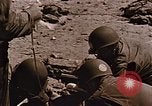
Day two of the amphibious assault on Betio, Tarawa atoll, by U.S. 2nd Marine Division, during World War II in the Pacific.
U.S. Marines of 2nd Marine Division setting up communications on beachhead of Betio, Tarawa Atoll, on day two of their amphibious assault against Japanese forces there, in World War 2. Individual marines moving low and fast across the sand, as gunfire sounds all around. Casualties being moved on litters. Entire area under fire with destruction everywhere. Marines taking cover wherever possible. Some firing machine gun from sandbagged position. Area covered by smoke from gunfire and explosions. Marines shielded by remains of Japanese structures as they move about, engaged in fierce fire fights. More wounded being tended. Marines using hand grenades and flame throwers against Japanese soldiers in fortified positions. Marines moving carefully across series of Japanese positions, checking for remaining Japanese defenders. Several move against a Japanese position in a hill, using small arms hand grenades and flame thrower. Many dead Japanese soldiers are seen on the other side of the hill, after it is taken. Marine carrying a machine gun and setting it up. An ambulatory wounded marine.
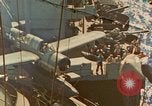
A OS2U Kingfisher is catapulted from the Cruiser, USS Chester in the Pacific Ocean, during World War II.
The U.S. Cruiser, USS Chester prepares to catapult a scout plane. An OS2U Kingfisher float plane OS2O Kingfisher on a catapult. U.S. sailors on the deck. Guns mounted on the deck in the background. A pilot in a the cockpit. The float plane is catapulted and makes a low pass by the ship. An island in the background. Several U.S. warships are seen including an Amphibious Force Command Ship (AGC).
CRITICALPAST.COM: About Us | Contact Us | FAQs - How to Order | License Agreement | My Account | My Lightboxes | Shopping Cart | Advanced Search | Featured Collections | Website Terms & Conditions | Privacy Policy ©2026 CriticalPast LLC.
License Agreement |
Terms & Conditions |
Privacy Policy
©2026 CriticalPast LLC.