


 Francais
 Deutsch
 Italiano
Refine Your Search
V2 stock footage and images
- Showing 1201 to 1206 of 9860 results more
more Hide
Hide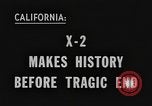
An X-2 Starbuster aircraft is released from a B-50 Superfortress aircraft during its test flight in California, United States.
Test flights of United States Air Force Bell X-2 "Starbuster" in California, United States. Aircraft parked at an air base. Men stand nearby. A pilot wearing a helmet. United States Air Force B-50 Superfortress aircraft in flight overhead. An X-2 aircraft being released from a B-50 aircraft The aircraft in flight overhead.
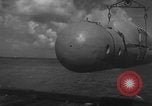
Demonstration shows how Italians intended to employ 2-man SSB torpedo to sink ships
Italian SSB 2-man torpedo hoisted in a crane hook. View of controls in the cockpit of the SSB torpedo. Pilots in the cockpit of the SSB underway in water. Crew put on their scuba type face masks. SSB torpedo dives under the water surface. Torpedo comes on the surface and alongside a merchant ship. The Captain remains in the cockpit and the 2nd man gets off the torpedo. He fastens a clamp to the keel of taget ship and then pulls a warhead from the torpedo and fastens it to the target ship. He climbs back aboard the the SSB and they pull away.
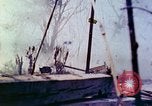
The U.S. 2nd Marine Division fires at an enemy position and advance in Saipan, Mariana Islands during World War II.
The United States 2nd Marine Division in Saipan, Mariana Islands during World War II. Marines of the 2nd Division advance behind a tank. The marines look towards an enemy position and fire rifles. Explosions occur near the enemy position. The marines use flame throwers at the enemy position and a column of smoke rises. Wooden supply crates piled up on a field. The marines advance across a field. Smoke rises from the enemy position. 75 mm gun crew fire at the enemy position.
Engineers and scientists in Station 2- Bermuda of the Mercury-Atlas 6 Network anticipate launch of “Friendship 7” in Cape Canaveral, Florida
View of Bermuda coast at sunrise, location of Station 2 of the Mercury-Atlas 6 network. A scientist checks telemetry data coming from a teleprinter. View of stamping of document using automatic stamper, the scientist hands the printed data to a woman assistant. The woman assistant hands the document over to the tracking and telemetry control. Telemetry communicators speaks through microphone in headphones. Telemetry scientists and engineers work on computers in Station 2 of the Mercury-Atlas 6 network. Telemetry scientist, wearing headphones, jots down notes. Telemetry engineer, wearing headphones with a built-in microphone, speaks, saying, “Displays and recorders have been calibrated.” The telemetry communicator inside the control acknowledges with a “Roger, thank you; flight, this is MNO” A telemetry communicator with a British accent radios his colleague.
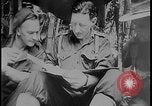
United States and Australian soldiers in jungle combat, fire machine gun at Japanese soldiers, evacuate and bury casualties, bomber performs belly landing during the Salamaua-Lae campaign in WW2
United States and Australian soldiers confer over battle plan in jungle near Salamaua, Papua New Guinea during the Salamaua-Lae campaign in World War 2. United States and Australian soldiers follow Papuan local in jungle. United States and Australian soldiers traverse jungle carefully with Papuan locals. Australian soldier hides in tall grass. Soldier uses telescope to look for Japanese enemy soldiers in jungle. Soldier uses a machine gun to fire at Japanese soldiers in jungle. Soldier in foxhole firing mortar rounds. Soldiers fire with machine gun and cannons at Japanese soldiers. Dead Japanese soldiers in fox holes and around jungle of Salamaua after battle with American and Australian forces. American and Australian soldiers carry an injured comrade in a stretcher. A soldier being treated for injury from attack by a Japanese sniper in the jungle. Medic puts soldier's arm in a sling. Papuan locals carry an injured soldier in stretcher through a jungle. Papuan locals, carrying injured soldier, cross a jungle bridge over Francisco river. An Allied soldier assists his blind comrade out of the muddy jungle. Blinded soldier walking through muddy trail with assistance from another soldier. Soldiers lying in stretchers in the emergency airfield near Salamaua. An injured soldier boards a support aircraft with assistance. Support plane takes off from emergency airfield. Support plane flies over Salamaua. Allied soldiers pay respect to their fallen comrades over makeshift graves. An army chaplain reads a prayer for the dead soldiers. At an airfield near Port Moresby, Allied troops load supplies in bomber. United States Air Force pilot in cockpit. Australian Air Force co-pilot in cockpit. A Douglas C-47 Skytrain takes off from airfield to Salamaua. Douglas C-47 Skytrain in flight. Douglas C-47 Skytrain begins to malfunction mid-flight. Douglas C-47 Skytrain performs an emergency belly landing on runway. American and Australian soldiers disembark from Douglas C-47 Skytrain after belly landing. United States and Australian soldiers point out towards enemy positions. American and Australian soldiers wade through jungle river. American and Australian soldiers crossing bridge in jungle together. American and Australian soldiers engage in battle with Japanese, firing mortar rounds. Several shots of mortars being fired including M2 mortars. M1919 Browning machine gun being fired while ammunition belt fed by soldier. Soldiers admiring the blade of a captured Samurai sword. Soldier smiling after battle and giving the thumbs up sign.
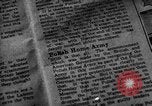
Warsaw bombed by Germans in retaliation to 1944 uprising, various scenes of Warsaw before WW2
Newspapers around the world reporting on the bombing of Warsaw by Nazi Germany as retaliation for the Warsaw Uprising during World War 2. Newspaper headlines read, "Poles Fighting Inside Warsaw," and "Warsaw Being Razed by Hitler's Order," and "Warsaw's Plight" and "Warsaw Poles Fight Tanks in Streets." Scenes of Warsaw in flames as buildings are being bombed by German forces. Montage depicting Warsaw on fire. Scenes of Warsaw before WWII, including scenes such as the Warsaw Old Town Market Square (rynek Starego Miasta, 00-279 Warszawa, Poland), the column of Sigismund III Vasa (plac Zamkowy, 00-001 Warszawa, Poland), the Royal Palace (plac Zamkowy 4, 00-277 Warszawa, Poland) and the Lazienki Park, before World War 2. Statue of King Jan III Sobieski in Lazienki Park. Men strolling near a palace. Baroque gates in park.
CRITICALPAST.COM: About Us | Contact Us | FAQs - How to Order | License Agreement | My Account | My Lightboxes | Shopping Cart | Advanced Search | Featured Collections | Website Terms & Conditions | Privacy Policy ©2026 CriticalPast LLC.
License Agreement |
Terms & Conditions |
Privacy Policy
©2026 CriticalPast LLC.