


 Francais
 Deutsch
 Italiano
Refine Your Search
V2 stock footage and images
- Showing 1327 to 1332 of 9860 results more
more Hide
Hide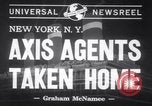
German and Italian agents leave New York early in World War 2.
With World War 2 tensions simmering, German and Italian agents and their families, expelled from the United States, bid farewell to relatives and friends at New York port. Distant view of USS West Point carrying agents and their families back home. Ship underway with New York City skyline in background. Axis country diplomats or agents prepare to board chartered airplane.

Children collect scrap aluminum utensils for World War 2 effort in Wilmington Ohio.
People of Wilmington Ohio including hundreds of children collect scrap aluminum metal for the War cause during ration effort for World War 2. Small boy throws metal cup toward three Boy Scouts in truck loaded with scrap metal. Scrap metal deposited under banner saying "ALUMINUM FOR DEFENSE". Boy Scouts pose for camera with scrap metal in hands. They add scraps to collected pile.
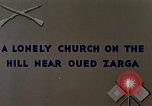
Bombed church in the town of Oued Zarga in Tunisia, North Africa (WW2)
View of a church damaged by bombing and shelling, in the town of Oued Zarga in Tunisia, North Africa, during World War 2. Bombed interiors of the Oued Zarga Church. A broken glass painting and a statue of Jesus Christ inside the church. (November 1942-December 1942).
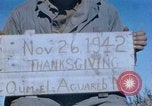
Thanksgiving Day celebrations at Oum El Aguareb in Algeria, North Africa in World War 2.
Thanksgiving Day celebrations at Oum El Aguareb in Algeria, North Africa, during World War 2. American soldiers chase a flock of turkeys. Natives gift turkey to U.S. soldiers. U.S. soldiers roll up copies of detailed war maps meant for tank commanders. Allied tanks deployed near Tebourba in Tunisia. Convoy of Allied tanks, half tracks and jeeps move.
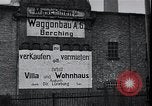
Life in Germany before, during, and after World War 2, including rise of Nazi party and intolerance in Germany
Unrest in Germany in 1930's during crisis of unemployment and inflation that had followed after World War I. A closed and boarded-up German factory. Two barefooted, jobless German men sleep in a park. During Great Depression in the United States, a weary woman is seen walking through an alley and looking in garbage cans. Sign for Los Angeles California Leather Company seen on building behind her. Children play in streets of a slum area. In Germany, scene of boys in training in Hitler Youth and carrying shovels, then carrying rifles and learning low crawling and military attack techniques. German farmers plowing on farms. Several night scenes including Nazis and brownshirts on the march, burning of books. Secret police or Gestapo and soldiers escort a church priest or clergy out of a church. During time of rising anti-Jewish sentiment in Nazi-led Germany, scenes of abuse and Gestapo arrests of some German citizens such as Jewish people, suspected Communists, political foes, and others critical of the Nazi party. A group of people attack and beat Jewish people in streets. A parade by the Wehrmacht German troops. Rearmament of Germany in 1930's. Scenes from busy German munitions factories. A Junkers Stuka aircraft factory filled with planes being built. A German artillery factory. German Luftwaffe and Panzer attack. German tanks roll over landscape. Scenes at end of war of burning German cities. Women run through bomb-wrecked streets of devastated Berlin during an aerial bombing raid by Allied aircraft. One woman falls as she runs. A woman and children race for the doors of a bomb shelter in Germany. The bomb wrecked streets of Berlin heaped with rubble and wreckage. Elderly German man walks through ruins. Small locomotive train running carrying cars of cleared rubble. German civilian dig potatoes in gardens. German women stand atop a collapsed building pile and clear rubble with shovels. German man waters a newly planted garden with empty shells of wrecked buildings in background. Newspapers produced by M.G. seen in newspaper printing press and rolling off presses. Binding of booklets and magazines from a German printing press. Sculptured bust of Goethe superimposed over books written by Goethe and Schiller. A montage shows in contrast the peaceful life in Germany before war, and scenes again of war, with alternating, juxtaposed scenes: German police officer escorts children across a street, book burning by Nazis, Gestapo violent arrest of a German citizen who is being pushed and hauled away. A German football (soccer) match in a stadium. Cook serves food to a man. A man in a concentration camp tips a bowl to his mouth. German children playing in a pool. Then juxtaposed scene with German women and children racing for a shelter during an air raid in World War 2. Scenes of bomb explosions. A peaceful waterfall.
French 2nd Moroccan Division convoy passes through the heavily shelled village of Alvignano, Caserta in Italy.
Convoy of French 2nd Moroccan Division equipped with American clothing and equipment, passes through the heavily shelled village of Alvignano, Caserta, Italy during World War II. Troops of Morocco standing along roadside converse with each other as the French driven convoy of U.S. trucks, jeeps, motorcycles, DUKWs (amphibious trucks) and half-tracks passes the village . A destroyed concrete building in the background.
CRITICALPAST.COM: About Us | Contact Us | FAQs - How to Order | License Agreement | My Account | My Lightboxes | Shopping Cart | Advanced Search | Featured Collections | Website Terms & Conditions | Privacy Policy ©2026 CriticalPast LLC.
License Agreement |
Terms & Conditions |
Privacy Policy
©2026 CriticalPast LLC.