


 Francais
 Deutsch
 Italiano
Refine Your Search
V2 stock footage and images
- Showing 1435 to 1440 of 9860 results more
more Hide
Hide
Confederate Air Force of World War 2 aircraft at Airsho '76 in Harlingen Texas, including Pearl Harbor reenactment scenes
Confederate Air Force showing historical aircraft at air show in Harlingen Texas. Reenactments of Pearl Harbor attack during World War 2. Japanese planes (torpedo bomber) Kate's replica and (fighter plane) Zero's replica remade from U.S. aircraft are used in the show. Zero and Kate Japanese planes in flight. Explosions seen. Smoke rises in the sky.
Airshow '76 presented by the Confederate Air Force shows WW 2 era airplanes in Harlingen Texas.
Confederate Air Force showing historical aircraft at air show in Harlingen Texas. United States fighter planes of World War II in show. P-40E fighter aircraft and P-39 Airacobra fighter plane take off. Reenactment of Pearl Harbor attack with B-17 bomber aircraft simulated emergency landing. B25 bomber take off. SB2C Helldiver bomber aircraft seen. P- 40 fighter aircrafts in flight. B-24 bomber take off. P-39 Airacobra in flight.

Carole Landis and Jack Benny at Eniwetok Island to entertain troops during World War 2
American comedian Jack Benny at Eniwetok Island during World War 2 to entertain U.S. troops. Actress Carole Landis talks to Benny while smoking a cigarette. Carole Landis signs her autograph for several soldiers who approach her. Landis and other members of the show, including singer Martha Tilton, board a PBY Catalina aircraft. PBY Catalina takes off from the island.

Detroit factory workers visit Camp Atterbury in WW2, and Army officials tour arms plants in Detroit.
Group of United Auto Workers visits Camp Atterbury during World War 2 to get a first hand perspective on what life is like for the soldiers who are receiving the military vehicles and weaponry they build as factory workers in Detroit. The auto workers exit a train car at the camp and run through steps similar to new recruits, including a basic medical check and receiving uniforms from a quartermaster. The auto workers try some of the same training drills as regular soldiers, including an obstacle course, bayonet drills, and crossing a ravine over water on a rope bridge while mock bombing takes place near them. The men clean dishes in a mess hall kitchen and make beds in a barracks. Scene changes to a Detroit factory where officers and soldiers from the Camp tour with the auto workers. They view B-24 liberator aircraft being built, tanks being built as treads are assembled onto vehicles, other vehicles being built. War production workers building and assembling war materiel. Welding and assembly line operations seen. Wide view of factory floor with many newly assembled military tanks and vehicles completed. Newly completed tanks are demonstrated on an open field as officials observe. A war production worker speaks and encourages fellow workers to work hard to support the soldiers.
Scenes of destruction in Leningrad as German forces attack the city during World War 2
The Siege of Leningrad, Soviet Union, during World War 2. German Army bombs Russian city of Leningrad. German artillery fired. Fire and explosion. Smoke rises up in the sky. Streets burn in Leningrad. The native people of Leningrad, Russia. Women remove rubble from streets. Animated maps show Leningrad blockade.
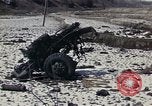
Aftermath of battle of Hoengsong, involving elements of U.S. Army 2nd Infantry Division, during Korean War
On Feb. 12 and 13, 1951, elements of the U.S. Army 2nd Infantry Division, including 38th Infantry Regiment, suffered severe losses in combat with superior Chinese forces, near Hoengsong,during the Korean War. Photos shot three weeks later show the carnage on a frozen battleground. Remnants of a destroyed U.S. field piece are surrounded by dead U.S. Army soldiers frozen on snow-covered ground. A severely damaged U.S. halftrack sits in the dirt. An unidentified jumble of burned out war machinery. Damaged 20mm dual mount anti-aircraft guns. U.S. Marines, of the 7th Regiment, in full field gear, entering the area for the first time since the February battle. They march over a snow-covered road, past remnants of the U.S. Army convoy that was fighting its way out of the area besieged by Chinese forces on all sides. A destroyed U.S. Army truck. Sign next to wreckage reads:"38th I.FL Co CP." A dead American soldier frozen in a rice paddy. Smoke rising from Korean village buildings burning in background, above terraced landscape. More views of wrecked equipment and fallen soldiers. A mountain pass in the background. A destroyed truck. Suddenly black smoke starts rising in the background. A U.S. Marine standing near an M46 Patton tank. More debris and destroyed trucks.
CRITICALPAST.COM: About Us | Contact Us | FAQs - How to Order | License Agreement | My Account | My Lightboxes | Shopping Cart | Advanced Search | Featured Collections | Website Terms & Conditions | Privacy Policy ©2026 CriticalPast LLC.
License Agreement |
Terms & Conditions |
Privacy Policy
©2026 CriticalPast LLC.