


 Francais
 Deutsch
 Italiano
Refine Your Search
V2 stock footage and images
- Showing 151 to 156 of 9858 results more
more Hide
Hide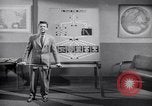
U.S. Army Public affairs film to explain idea of Universal Military Training (UMT) as a Plan for Peace, in 1947
The Universal Military Training Plan for Peace, 1947. A civilian spokesperson stands before a briefing chart entitled "Plan for Peace." He explains the concepts for the program, involving military training for young men immediately after they complete high school.He explains how young men would register and be screened, assigned, and trained under the program. Two college students discuss a requirement to join the Reserve Officer Training Corps (ROTC) under the program. Scene shifts to a U.S. Army officer talking with a civilian about the cost of World War 2. As scens of wartime military production are shown, Narrator interjects that "a full year of Universal Military Training will cost less than three days of war." Scene shifts to Separation Center, Fort Douglas, Utah. U.S. soldiers are seen mustering out. One holds his Honorable discharge certificate. View of marching German soldiers is inserted at this point. Contents of the U.S. Constitution are displayed in plain print, higlighting the part: "...provide for the common defense..." View of college students on a campus. Closeup of Dexter Gate at Harvard College, and three men walking through it into Harvard Yard. ROTC cadet talking with acquaintances about studying rockets. ROTC cadet talking with two middle aged men about unique sounds of airplanes. A B-17 bomber in flight. A C-119 (flying boxcar) aircraft in flight. A formation of B-17s viewed from above with clouds beneath. The XP-84 jet in flight. A V2 rocket being test fired at White Sands, New Mexico.
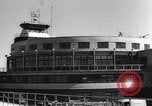
Military and civilian applications of radar and electronics
1946 Film about military and civilian applications of radar and electronics. View of the LaGuardia Airport Administration Building (passenger terminal) in New York, with control tower and various antennas on its roof. A TWA Constellation and DC-3 airplane on the airport ramp, as another aircraft is on the final approach to land. Commercial cargo vessels in New York harbor (Statue of Liberty barely seen in the misty background). A passenger railroad train speeding along the tracks. Radar returns shown on a plan position radar scope, tracking weather returns. Tropical storm hitting a seaside area. Scientists and technicians at work in a laboratory filled with electronic equipment. View of buildings at U.S. Army Signal Corps' Camp Evans, New Jersey. Sign above one entrance reads: "Evans Signal Laboratory." Inside the laboratory, images created by radar signals bounced off the moon are seen on a radar scope, during "Project Diana," on January 10, 1946. View of the Army's GB-4 radio controlled television glide bomb, suspended on a chain inside a building. It rotates around showing various views. Scene shifts to a launching track outdoors at a coastal facility, where a glide bomb takes off raising smoke as it accelerates along the launch path. Next, a GB-4 glide bomb is released from underneath a B-17 bomber in flight. It is seen flying away from the aircraft. Inside the aircraft, a crew member views its progress by means of television images received from a transmitter in the front of the bomb. Glimpse of the television images. View from the ground of the GB-4 bomb gliding to the ground and exploding. Views of a German V-2 rocket at Launch Complex 33, White Sands Proving Ground , New Mexico, where it was being tested by the U.S. Army Ordnance Department in 1946. Inside a control room, an Army technician gives the signal to launch, and the V-2 rocket fires and rises straight into the sky, with its fiery tail visible as it gains altitude. More views of scientists, engineers, and technicians inside a Signal Corps electronics laboratory. Soldiers being trained in radar technology, seated at an electronic array. An army staff sergeant technician working on radar components. A variety of different radar antennas rotating outdoors.

Canadian troops occupy a German flying bomb launching site and describe launching apparatus in Flanders, France.
Canadian troops occupy a German flying bomb launching site in Flanders, France. Map of France. Long rocket launching ramp. View of pistons that propel buzz bomb during take off. Allied pilot takes photographs. Canadian troops inspect the ramp mounted with a 400 pound piston. Canadian troops carry V-2 bombs and load them on to piston. The operation of the V-2 and launching apparatus: Man operates remote control boxes for launching. Soldier handles jet nozzle assembly. Jet propulsion engine is used for fire piston set off explosives. Compressed air bottle supply power for gyro pilots. Servo motors moves radar and elevator. Unexploded head contains explosives for bomb. Diagram shows flying bomb and its parts. View of a bomb site. (World War II period).
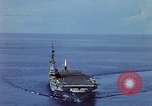
Flight deck of USS Midway (CVB-41) during Operation Sandy at Atlantic Sea.
Flight deck of USS Midway (CVB-41) during Operation Sandy at Atlantic Sea. Captured German V2 rocket in firing position. Rocket is fired and takes off. Rocket in flight. Rocket comes down and drops into water. Officers look over railing of ship. Radar moves on the ship.
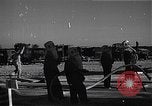
Technicians wear asbestos suits and masks.
Group of technicians wear asbestos suits and masks. Man in mask and asbestos suit. Base of rocket V2 on stand in position for firing. Smoke comes out of exhaust. Technician speaks into the phone.

U.S. Army Tactical nuclear weapons and preparations for Atomic Exercise Desert Rock VI at the Atomic Energy Commission Nevada Proving Grounds in 1955
United States Army cameraman seen recording Nike missile launch. Atomic cannon fires shell creating atomic explosion and classic mushroom cloud in the distance. Army troops carried to a field by Sikorsky YH-19 helicopters. U.S. infantry climb a hill firing their rifles. U.S. Army Master Sergeant Stuart Queen narrates the film. He speaks about the role of the soldier in the United States Army. Scientists inside a control room during a rocket launch. A rocket launch in the United States. Rocket tracker and telescope move to the rocket’s direction. Cameramen taking footage of rocket launch. Jet propulsion with rocket. A V2 rocket launch. A jet explodes after launching. A nuclear bomb explosion. A missile takes off. Devices and people track missile takeoff. A rocket launches from a ship. Midair explosion after a rocket hits a target aircraft.
CRITICALPAST.COM: About Us | Contact Us | FAQs - How to Order | License Agreement | My Account | My Lightboxes | Shopping Cart | Advanced Search | Featured Collections | Website Terms & Conditions | Privacy Policy ©2026 CriticalPast LLC.
License Agreement |
Terms & Conditions |
Privacy Policy
©2026 CriticalPast LLC.