


 Francais
 Deutsch
 Italiano
Refine Your Search
V2 stock footage and images
- Showing 1651 to 1656 of 9860 results more
more Hide
Hide
German submarine U-564 attacks small American sailing yacht during World War 2
German submarine U-564, commanded by Reinhard Suhren, on patrol in the South Atlantic Ocean during World War 2. Periscope view reveals a Swedish freighter flying neutral flags. The freighter is permitted to pass. Periscope view then shows American sailing yacht. The yacht crew abandons ship and then U-564 destroys the yacht.
US Army soldiers and heavy equipment transported by railroad trains in the United States, bound for war front in World War 2
Activities of the United States Army in the United States during World War II. A U.S. Army band from the 407th Engineer Battalion playing musical instruments and marching. U.S. Army soldiers board railroad trains at a railroad station for transportation toward the war front. A railway steam locomotive pulling train cars. M4 Sherman tanks are seen on them as well as M2A4 (Mae West) tanks sitting partially turned with their guns out of sight away from the direction of travel.Browning M1919 .30 caliber machine guns are seen in their extra turrets. Army trucks and other military vehicles are also aboard the supply trains. The supply train moves through American countryside. Two women seated under hair dryers converse about the war in a beauty shop or beauty parlor. U.S. troops on troop transport railroad trains at night. Interior of a train car. American soldiers read books, sleep, and some play dice. An African American porter watches the game. A chaplain speaks to the soldiers. Civilians buy newspapers at a news stand. Headline on newspaper reads "London Expects Invasion of Europe at Any Hour" (before the upcoming Normandy Invasion of France in June 1944.)
United States sailors and officers transferring old submarines to British Navy and Polish Navy early in World War 2.
US Navy ceremony handing over older submarines, early in World War 2 to the British Navy and Polish Navy, in New London, Connecticut. U.S. Navy officer reads a document as sailor stand and watch. U.S. Navy officers and sailors leave submarine and walk onto dock. British sailors take possession of the submarine. British officers conduct review of sailors on the submarine. Polish flag raised on another submarine as personnel salute. A sailor raises a ribbon flag on the conning tower. A Polish Navy sailor holds the flag of Poland on the submarine deck. An officer near a deck gun.
Scenes from foundation stone ceremony during reconstruction of British House of Commons, following World War 2
The House of Commons in London England. Damaged and roofless areas of the building, with standing water on floors. The ruined buildings after the German bombardment in 1941 during World War 2. The debris on the ground. A man standing nearby. View of Big Ben clock tower. Officials gather outside the House of Commons, including Prime Minister Winston Churchill. They step up onto a stage with construction scaffolding nearby. Official on podium with Churchill standing behind.
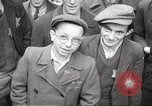
Jewish people gather on the street in Dombrowa, Poland during World War 2.
Jews in Dombrowa, Poland during World War 2, following occupation of Poland by Germany in 1939. Jewish citizens gather on a street in Dombrowa. All of them wear the star of David patch or badge on their clothing to identify them as Jewish in the German-occupied city. Close-up views of Jewish men, women, and children in the town. Men discussing amongst themselves. Buildings along the side of the street.
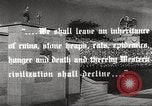
War devastation, rubble, people scavenging for food after World War 2 in Europe.
A film on the reconstruction of Europe after World War II. Image of Adolf Hitler speaking at a rally earlier in the war, with translation of some of his words superimposed on the image. Stone heaps in a European city following bombing in World War 2. A sign for Hazelaarstraat (area of Amsterdam, Netherlands.) Rubble of destroyed buildings. The ruins of a church. Closeup views of address numbers in a city, including 6, 24, and 40, each followed by scenes of rubble and twisted metal. Woman emerges from a cave dwelling with a young child. A sad woman holding a young child. Close-up view of a rat emerging from a hole in a wallboard, walking directly toward camera position. Person placing a blanket on a crying baby. A sign board on a street reads, "Danger: Typhus carried by lice." Children (possibly Italian) gathered with water vessels near a well, collecting what appears to be dirty water. A boy lying in a hospital bed, with images of Christ and Italian writing above bed. Hand taking down a hospital chart record. "Napoli" visible on chart implying Naples, Italy. Hungry men, women, and children in Greece, living in poverty, are seen scavenging for food from trash cans. Sign on wall behind reads, "ΚΟΣΜΙΚΟΝ." Arms of women holding water pitchers, standing in a group waiting for water. A desperate looking woman holding a half-clothed sleeping child in her arms. A young boy holding the leg of an adult and crying. A carriage of a undertaker or funeral service driving away on a street.
CRITICALPAST.COM: About Us | Contact Us | FAQs - How to Order | License Agreement | My Account | My Lightboxes | Shopping Cart | Advanced Search | Featured Collections | Website Terms & Conditions | Privacy Policy ©2026 CriticalPast LLC.
License Agreement |
Terms & Conditions |
Privacy Policy
©2026 CriticalPast LLC.