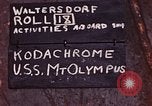
Iwo Jima invasion during World War II. Two small landing craft, LCVP (Landing Craft Vehicle Personnel) heading towards the beach. U.S. Navy Curtiss SB2C Helldiver aircraft dive bombing over Mount Suribachi. Navy hospital ship USS Samaritan (AH-10) anchored in bay. BB (battleship) in the background.
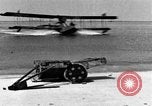
Japanese military operations in the 2nd Sino Japanese war (World War II). A rough wartime Japanese airfield with several Mitsubishi G3M "Nell" bombers. One has engines running. Japanese pilot wearing flying helmet and flotation vest, is standing by a communications tent. Group of Japanese fliers being briefed before a mission. Closeup of pilot in cockpit of bomber as engine starts.Pilots or navigators of two crews comparing notes and charts, as other crew members stand nearby. Another closeup of an engine running. The number 22 seen on tail of one plane. Bombers taxiing and taking off. Closeup of right engine and prop of one bomber viewed from inside the plane during takeoff. Glimpse of another bomber, ahead and below, as the formation flies over populated area. Formation of these Japanese type 96 "Nell" bombers (Mitsubishi G3M) in flight directly overhead. Closeup of one in the formation, with number 15 on its tail. Another closeup of engine and turning prop. A bomb falling. Irregular coastline area of china. Bombs exploding on coastal towns. Imperial Japanese Naval ensign displayed on mast of a ship. Japanese marines descend side of troop transport and enter landing craft. Closeup of marines in landing craft. several landing craft proceeding toward shore. Nakajima E8N naval scout floatplane is seen in flight overhead. Japanese marines climbing a hill under fire. Marine firing a Japanese Type 11 Light Machine Gun atop a hill. The Japanese flag flying near the top of a hill.
Japanese forces occupy part of Vichy French Indochina during 2nd Sino Japanese War and World War II. Animated map shows Leizhou (luichow) Peninsula and Hainan Island of China opposite the North Central coast of North Vietnam, centered at Haiphong harbor. Lines appear showing the path of Japanese troops occupying North Vietnam from Haiphong, in two sweeps to Northeast and Northwest and circling towards Hanoi. Mountainous terrain of the region is shown. Camera pans down a sheer cliffside in the mountains. Narrow roads are shown carved in the mountains and hills. A Japanese sentry stands at a sandbagged outpost, displaying the Japanese flag. A solitary building sits atop a hilltop in the background. A concrete marker indicates distance of 171 km to Hanoi. Several Japanese engineers make their way to the top of a mountain, accompanied by soldiers. An abandoned French heavy gun is seen in a concrete emplacement. View of Japanese soldiers looking out from the hilltop. A sign along a mountain road reading "Keep to the right," in French, English, and Japanese. Soldiers gather around a large tree fallen across the mountain road. They pose for the camera next to the tree. Japanese officers walking through an archway, from a large building in background. Closeup of barrel containing portland cement, followed by view of many such barrels being examined by Japanese engineer.
Slate begins film reading: Sante Fe alongside to take off wounded. (Refers to the U.S. Navy light cruiser USS Sante Fe (CL-60) evacuating survivors from the aircraft carrier USS Franklin (CV-13) after it was bombed by Japanese aircraft during World War 2.) View of the Sante Fe starboard of the Franklin. Survivors are watching from the forward section of the Franklin as wounded are transported to from the Franklin to the Sante Fe by bos'n chair and similar means for transporting wounded on cots. Aboard the Franklin, sailors help an ambulatory wounded to a place where medics are giving first aid. They help him to a bed, of sorts that a medic quickly prepares on deck. Sailors passing a wounded to others who prepare him for evacuation. Back on deck, medics are tending to some wounded, bandaging injuries and preparing bed-ridden for evacuation. Intervening slate reads: Most terrific blast of morning.(Note; all explosions are made from ships distant from CV-13. Impossible to shoot film aboard during detonations.) (Indicates that subsequent scenes are filmed from other ships.) Distant views of huge fire ball and dense smoke coming from the USS Franklin. Slate reads: Sante Fe returns. Had been forced by explosions to shear off The Sante Fe seen starboard of the Franklin and closing with her fire hoses directing streams of water on the Franklin. Water running off the Franklin's deck. Small fire seen below decks. The Sante Fe inundating the Franklin with water from her hoses. View of aft deck of Franklin in pieces. Slate intervenes stating: Until dark Father O'Callahan, paying no heed to explosions and his own great peril attends the dying. Glimpse of sailors hauling lines on the Franklin flight deck. Then, Navy Chaplain, Father Joseph Timothy O'Callahan, is seen administering last rites to a dying sailor on the deck.
U.S. Marine Corps Communication activities at Peleliu, Palau Islands. Forward observation party, for 75mm pack How, U.S. 5th Marines 2nd Battalion, with binoculars, other men sitting in jungle. Marine observer watches fire through binoculars. Large body of water in background. Target area observer in the foreground silhouetted against sky. Operator of BC-1306 radio set sending message using hand crank generator. Shell bursts, smoke rising skyward. Shell burst in water. (World War II period).
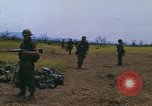
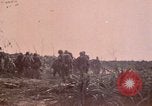
First scenes show United States Marines riding in a landing vehicle tracked (LVT) heading toward a Japanese occupied island in the Pacific. View from one of the landing craft of heavy smoke obscuring the island coast. Next, a dozen landing craft from the USS George Clymer (APA-27) are seen with mountains of the target island looming in the background. View from a different perspective shows several landing craft heading toward an inlet to the island. View from a landing craft of a Japanese Mitsubishi A6M "Zero" airplane flying overhead. Closeup of American soldiers in a landing craft headed toward a different Japanese occupied island. U.S. soldiers leaving a landing craft in the surf. View from inside a landing craft as U.S. Marines head ashore. Soldiers splashing in the surf. Troops wading ashore. Soldier dug in on beach near underbrush, firing many round from his Browning M1919 machine gun. Marine firing his rifle behind a palm tree. Troops seeking cover at very edge of shore. Some lying in the water, before moving on. A soldier firing an automatic weapon through foliage. A bomb explodes near an invasion ship. Troops descending on rope nets from the troopship, USS Crescent City (APA-21) and entering her Higgins boats. Heavy equipment and ammunition being offloaded from the troop transport ship. Marines coming ashore. An LVT in the background. Marines behind a barricade built by the Japanese. Marines throwing hand grenades and firing Browning M1919 machine guns. Flame throwers being used to force Japanese from strongholds. Marines gathered all along a shore line. A bulldozer driving along the waters edge. Soldiers rolling steel mesh across the sand. An antiaircraft machine gun with a side magazine mounted on a jeep, moves on the sand. Several ensuing scenes show flame throwers being used. Marines near a wrecked Japanese structure and then escorting a Japanese prisoner. A group of Japanese prisoners being spoken to by a Marine with a microphone. Marines hunkered down on a beach. One is cranking a hand powered radio transmitter. Front ramp of a landing craft is dropped down with a splash at waters edge. An M3A1 light tank drives off the landing craft. A truck being offloaded onto the shore. A heavy field artillery piece being moved into position. Troops work to move another field artillery piece into position. Trucks and other vehicles wading through shallow water as they leave an LST. Troops wading ashore from the LST. Trucks arriving on the shore. A tractor pulls a canvas covered vehicle. Soldiers ride aboard a light tank. Unusual view of troops assembled on shore of a mountain with ice seen in places on it (likely in the Aleutians). Crowded beachhead with LST 477 seen beached. Marines looking at destroyed Shore defense installation containing heavy gun. Remains of a 4-engine Japanese Kawanishi H8K2 (Emily) flying boat in the water. Seabees building an airfield with heavy construction equipment. Troops gathered around a Navy F4F aircraft that landed on the new (unfinished) airfield. Closeup of the smiling pilot climbing down from his plane. Troops saluting as the American flag is raised on remains of a Palm tree trunk, on Eniwetok, February 1944. Remains of a Japanese shrine and views of dead Japanese soldiers.
CRITICALPAST.COM: About Us | Contact Us | FAQs - How to Order | License Agreement | My Account | My Lightboxes | Shopping Cart | Advanced Search | Featured Collections | Website Terms & Conditions | Privacy Policy ©2026 CriticalPast LLC.
License Agreement |
Terms & Conditions |
Privacy Policy
©2026 CriticalPast LLC.