


 Francais
 Deutsch
 Italiano
Refine Your Search
V2 stock footage and images
- Showing 2605 to 2610 of 9862 results more
more Hide
Hide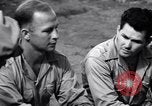
Rescued American war prisoner Edwin Petry describes his escape from a Japanese prison camp in World War 2
A MIS-X officer representing the Prisoners of War Branch interviews American soldiers who escaped from and were then rescued from Japan's 10-A camp in Palawan, Philippines. Private first class Edwin A Petry describes the murder of American soldiers by forcing them to enter a bomb shelter, pouring gasoline, setting the gasoline alight and shooting the men who tried to escape. With the help of a map he also describes how he along with a companion managed to escape from the prison camp by crashing through the barbed wire and swimming across the bay. They were later evacuated to Morotai by 13th Army Air Force Catalina.
United State H-6 helicopter flies over and lands at Luzon,Philippines during World War 2
United States H-6 helicopter flies over wooden terrain in Luzon,Philippines during World War II. It approaches a clear area along a mountain road with a building as a number of locals stand there. H-6 lands and local children gather around the helicopter. Later it lifts off.
U.S. Stinson L-5B aircraft and Sikorsky H-6 helicopter carry wounded soldiers in Luzon, Philippines, after World War 2
United States Sikorsky H-6 helicopter carrying wounded soldiers lands in Luzon,Philippines, after World War II. Five men look at the wounded soldier as he is released from a litter pod. A man lying on stretcher in Stinson L-5B smokes a cigarette. A wounded soldier inside an L-5B air craft as Philippine children stand near the plane. L-5B takes off and is refueled later. Natives and military men stand near an H-6. An H-6 lands carrying a wounded soldier. Soldier is taken out of H-6.
United State L-5 guides rescue party in Shingbwiyang,Burma during World War 2
Volunteers of rescue party rest in Shingbwiyang, Burma during World War II. United states L-5 aircraft guides the volunteers through the jungle. A man examines a wrecked PT-19 and a hospital tent. C-47 air craft drops supply parachutes. Men look through the parachute for radios, engineering and medical supplies. Men run after setting off charges to blast trees for helicopter string. Trees fall after the blast.
United State Lieutenant William Diebold talks to Naga chieftain in Shingbwiyang,Burma during World War 2
United States Army Lieutenant William Diebold talks over radio as Sergent Harry Bremer pumps power to the radio set in Shingbwiyang,Burma during World War II. The two of them talk on hand radio to a Naga chieftain. A black engineer cooks food in a large pot. Lieutenant Diebold talks to Naga chieftain in sign language. Sergent Bremer,Captain Brane and Lieutenant Scott bathe in water flowing from rocks. Men send smoke flare signals for planes.
United States Captain R.D.Underwood treats wounded soldiers in Shingbwiyang, Burma during World War 2
United States planes drop medical supplies and engineers gather supply parachutes in Shingbwiyang, Burma during World War II. Captain R.D.Underwood, and an assistant prepare and inject penicillin to Captain James I. Green's leg. Captain Green's jaw being examined and given liquid diet.
CRITICALPAST.COM: About Us | Contact Us | FAQs - How to Order | License Agreement | My Account | My Lightboxes | Shopping Cart | Advanced Search | Featured Collections | Website Terms & Conditions | Privacy Policy ©2026 CriticalPast LLC.
License Agreement |
Terms & Conditions |
Privacy Policy
©2026 CriticalPast LLC.