


 Francais
 Deutsch
 Italiano
Refine Your Search
V2 stock footage and images
- Showing 265 to 270 of 9857 results more
more Hide
Hide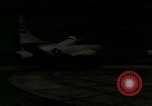
Normal operating procedures including start, take off, stall and landing of the U.S. Navy T2V-1 SeaStar.
Normal operating procedures including start, take off, stall and landing of the U.S. Navy T2V-1 SeaStar. Start: The plane on the runway. A crewman arrives with the air impingement car. He inserts the pipe into the air impingement inlet. The crewman gives a signal when the air impingement hole is secure. The pilot adjusts the battery operator switch and turns on the ignition. He moves the throttle to ignite and then to idle position. The exhaust gas temperature gauge. The pilot signals the crewman to disconnect the air impingement starter and adjusts the instrument power switch. Post-start Cockpit Check: The pilot checks the RMI for alignment, adjusts S2 compass controller, annunciator panel touch button, fire detector test switch, fuel quantity indicator button. He checks the communication, navigational, annunciator and left panel. He goes through the take off check list, moves the plane into position, advances throttle, inspects the tachometer, exhaust temperature, releases brake and taxis to the end of the runway. The plane taxis, pilot applies brake and rudder control and takes off. He raises the nose wheel, retracts the landing gear and flaps after take off. The plane in flight over clouds. Stall occurs. The attack angle gauge. Landing procedure: View of the runway. The pilot begins the let down, reduces power, extends the brake, lowers landing gear and flaps, and continues to reduce speed. Diagram of the runway depicting approach. The plane approaches the runway, touches down and lands.
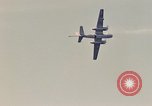
USS Norfolk and USS Decatur underway and HSS-1 helicopter, AD-5W and P2V-7 aircraft in flight, United States.
Anti-submarine warfare exercises in United States. U.S. Navy S2F Anti-submarine warfare aircraft in flight. USS Norfolk (DL-1) underway. HSS-1 helicopter hovers over the water. MAD (magnetic anomaly detector) gear is extended. Sonar system used. USS Rooks (DD-804) drops depth charges. Explosions in water on the back of the ship. Destroyer ships underway. Weapon Alpha fired. Splashes in the water near USS Norfolk (DL-1). Drone Anti-submarine (DASH) helicopter in flight. Aircraft AD-5W and P2V-7 in flight. USS Decatur underway.
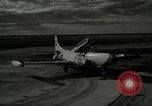
Pre-flight procedures including exterior and cockpit inspection of the U.S. Navy T2V-1 SeaStar.
Pre-flight procedures of the U.S. Navy T2V-1 SeaStar. Exterior inspection: Two airmen approach the plane to conduct a normal walk around inspection which includes highly important and unique inspection points. The airmen manually retract and extend the leading edge wing flap to check for freedom of movement. They inspect the ram air orifices in the nose of each tip tank, speed brake, fuel dump outlet, boundary layer control orifice, position of snubber piston, main hydraulic reservoir, and upper left fuselage. Interior inspection: The pilot in the cockpit. He inspects the engine, aircraft performance, navigation and fuel controls. He checks the electrical, navigational, air conditioning and lighting controls on the right panel and console. Pre-start Cockpit Check: The pilot adjusts the tip tank switches, oxygen supply valve, main fuel shut off switch, battery generator switch, flight instrument power switch, cabin pressure and temperature switches.
Emergency operating procedures including ejection and landing of the U.S. Navy T2V-1 SeaStar.
Emergency operating procedures of the U.S. Navy T2V-1 SeaStar. The aircraft in flight. Simulation of ejection procedure. Pilot in the cockpit and view of gauges and flight controls. Pilot places his feet in the stirrups, sits erect in the seat with head braced against head rest. He pulls the emergency bail out cord, disconnects oxygen hose at the mask connection, and pulls down face curtain handle firing the canopy and ejecting the seat. He pulls the auxiliary canopy jettison handle and turns on the canopy open switch. In case this procedure fails, the pilot demonstrates a back up including adjustment of canopy interlock release handle, pulling of the face curtain to eject the seat through the canopy. Air start: The pilot moves the throttle to off position. View of altimeter as pilot lowers the plane to maximum altitude for an aircraft and assumes a glide. He drains the tail pipe of residual fuel and places the plane in a shallow dive. He adjusts the battery generator switch and holds position. Landing: A stylized illustration of the landing pattern depicts adjustment of glide path and approach. The plane approaches the runway, maintains speed, decreases altitude, retracts landing gear and flaps, and touches down.
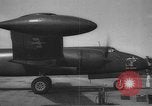
JATO assisted takeoff of the P2V-1, BuNo 89082, The Turtle, starting its historic flight from Perth Australia to Washington DC
View of the U.S. Navy P2V-1 (BuNo 89082) on the RAAF Base Pearce, Perth, Australia. The Turtle logo painted on its fuselage. The aircraft at the end of the runway commencing its takeoff roll, and then being boosted into the air as 4 JATO (Jet assisted takeoff) bottles ignite. Dark smoke from the JATO bottles is clearly visible.
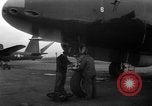
Aviation crew members check nose wheel of U.S. Navy P2V Neptune in North Korea during the Korean War.
U.S. Navy Air VP-6 Patrol Squadron in North Korea during the Korean War. Aviation crew members check nose wheel of U.S. Navy Lockheed P2V Neptune. A U.S. aircraft parked in the background. The crew members work on the wheel. A crew member cleans the bomb bay doors of the aircraft.
CRITICALPAST.COM: About Us | Contact Us | FAQs - How to Order | License Agreement | My Account | My Lightboxes | Shopping Cart | Advanced Search | Featured Collections | Website Terms & Conditions | Privacy Policy ©2026 CriticalPast LLC.
License Agreement |
Terms & Conditions |
Privacy Policy
©2026 CriticalPast LLC.