


 Francais
 Deutsch
 Italiano
Refine Your Search
V2 stock footage and images
- Showing 3529 to 3534 of 9863 results more
more Hide
Hide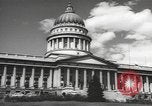
World War II veterans adjusting to civilian life after discharge after WW2
First scene shows the State Capitol building (350 State St, Salt Lake City, UT 84103) in Salt Lake City, Utah. Next a sign identifies a military separation center in Fort Douglas during post-war demobilization. Soldiers in uniform are being processed for separation from the U.S. Army. A sergeant salutes an officer and receives his discharge papers. Narrator identifies Corporal Kirk being processed by a sergeant. He later salutes and receives his discharge papers. Corporal Kirk steps down the stairs from a house, arm and arm with his girlfriend. They are seen enjoying a soda together. Next, they shop together for a civilian hat for him. Then they share shopping for a complete civilian wardrobe. They share time skiing together. Glimpse of some national parks in Utah and of the great Salt Lake. View of people floating easily in the dense waters of the salt lake. Views of the Mormon Salt Lake Tabernacle (50 N W Temple St, Salt Lake City, UT 84150). The couple stroll streets of Salt Lake City. They visit the Veterans' Information Service. He sits with an advisor. View of Provo, Utah and the Geneva Steel Company there. Exterior views of the industrial steel plant. Hot coke being discharged into special rail cars. Steel plant operations with fiery molten steel being poured from Ladles. Billets of steel being formed. Open rail cars full of ore at the Columbia Iron Mine, Cedar City, Utah. A steam shovel loading ore into a truck. Coal mined and moving on conveyers. Miners leaving a mine in open box cars. Miners in rail cars entering a mine. A sign reading: "Welcome, Binghan Canyon, Home of the World's largest Open Cut Copper Mine, Drive Carefully!" Views of the open mine with numerous terraces cut into the walls. A steam shovel digging and loading copper ore into rail cars that carry it away across rail bridges. A sign for the Eitel-McCullough, Company, Inc. where radar tubes are currently being made. Several women employees in the plant.
War veteran takes up courses at University of Utah in Utah, United States (WW2)
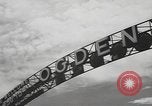
World War II veterans in Utah, United States. A sign for the city of 'Ogden'. Traffic on the streets. A sign reads 'Entering the Cedar City'. Farmers till and plow farm land. Cattle graze on farm lands. Expansive wide views of farm valley landscape with snow covered mountains in the distance. A war veteran talks to Veteran's Department official. The veteran meets the Dean at the University of Utah campus. He strolls on the tree lined sidewalks of the University campus. He enrolls for a course at the university and attends lectures.
German aircraft are shot down after attacking British Merchant Shipping vessels in the English Channel during World War 2
German air attack on British ships in the English Channel during Battle of Britain in World War II. British ships underway in the English Channel. German Stukas in flight. Explosions occur at sea as German aircraft bombard a British merchant convoy. British Royal Air Force Hurricane aircraft fly across camera. Vapor trails in the sky. RAF Hurricane aircraft being shot down. British soldiers look at a wrecked German Junkers 88 dive bomber aircraft.
The FBI arrests eight Nazi German spies after they landed off the coast of the United States (WW2)
Nazi German spies attempting sabotage are caught in the United States during World War II. A sign on a building reads 'Federal Bureau of Investigation'. An official at a desk inside an office. A submarine underway at sea as a crew member looks through a periscope. Pictures of Nazi German would-be saboteurs caught by Coast Guard personnel and apprehended by the FBI after they landed near the coasts of Amagansett, Long Island and Ponte Vedra Beach, Florida. (This was Operation Pastorius which disrupted a Nazi German sabotage plot on U.S. soil in 1942.)
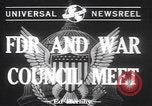
Roosevelt and Churchill attend a meeting of the Pacific War Council in Washington DC, United States (WW2)
The Pacific War Council meets in Washington DC, United States in World War II. U.S. President Franklin D. Roosevelt and British Prime Minister Winston Churchill seated in chairs as members of the Pacific War Council stand in the background.
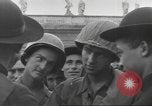
Italian civilians celebrate the Liberation of Rome, Italy (WW2)
Liberation of Rome by the Allied forces during World War II. Allied soldiers are greeted by civilians. Roman Catholic priests speak to Allied soldiers in Saint Peter’s Square, Vatican City. Italian people and children clap and cheer as they celebrate the liberation of Rome from Nazi German rule. People gathered outside the RAI building. Tanks move past Victor Emmanuel II National Monument (Altare della Patria, Piazza Venezia, 00186 Roma RM, Italy). Soldiers walk as civilians look on. Children seated along a sidewalk. Civilians milling about in front of the Colosseum. Civilians gathered around a bulletin board. Allied soldiers on a truck near the Victor Emmanuel II National Monument.
CRITICALPAST.COM: About Us | Contact Us | FAQs - How to Order | License Agreement | My Account | My Lightboxes | Shopping Cart | Advanced Search | Featured Collections | Website Terms & Conditions | Privacy Policy ©2026 CriticalPast LLC.
License Agreement |
Terms & Conditions |
Privacy Policy
©2026 CriticalPast LLC.