


 Francais
 Deutsch
 Italiano
Refine Your Search
V2 stock footage and images
- Showing 355 to 360 of 9857 results more
more Hide
Hide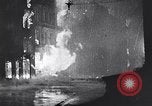
Churches on fire and water is pumped from the river Thames to fight fires in London, England during Nazi blitz in World War II.
The work of London's fire guards during a German blitzkrieg incendiary bomb raid in Britain during World War II. Bombs fall and fire breaks out at night. Nighttime views following the Luftwaffe attack. London buildings and churches are on fire. St. Lawrence Jewry Church (Guildhall Yard, London EC2V 5AA, United Kingdom) on Gresham Street, designed by Christopher Wren, in ruins. Views of damage to St. Brides Church (Fleet St, London EC4Y 8AU, United Kingdom) on Fleet Street. Firemen spray water on the buildings and churches. Firefighters team up to connect 6,000 feet of 3 1/2-inch firehose from fire boats in the Thames River, to reach burning buildings of London. Firemen seen in relay lines connecting fire hoses and working to extinguish blazing fires.
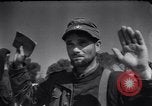
15 Divisions of German troops (266 thousand) surrender to the Allies, ending the Tunisia campaign during World War II
At beginning, the film shows German soldiers surrendering in World War 2. First they surrender in small groups and then in increasingly larger numbers. Eventually whole divisions are seen surrendering, some even marching behind their Division brass band. They are being interned in outdoor areas under guard. A U.S. Military policemen monitors some and collects identifications papers from them as they enter a barbed wire enclosure. Numerous views of the German soldiers, some arriving in full open railroad cars. German commander of the Army Group Africa, Generaloberst (Colonel-General) Hans-Jürgen von Arnim, followed by British officers, steps from a U.S. C-47 transport airplane and salutes. (He was captured by the British Indian Army’s 4th Infantry Division). Aerial view of the wheat field where the German prisoners were interned for processing. Views of numerous destroyed German aircraft, artillery, fuel trucks, tanks, and other war materiel. A pile of German steel helmets. Closeups of German prisoners in the outdoor compound. An unidentified German General stepping from the cab of a truck, to join the other prisoners. German Colonel-General von Arnim leaving a building and standing as if waiting for a car. Series of closeup views showing soldiers from the various countries comprising the Allied forces. Allied soldiers wading through deep waters; and elsewhere in amphibious assaults, as World War 2 continues. Cheering crowds in Tunis welcoming French, Free French, and British forces occupying the city. General Eisenhower standing before Allied flags, with British Field Marshal Harold Alexander, and French General Henri Honoré Giraud, as Allied warplanes fly in formation overhead. Film ends with "V" for Victory.
Americans in New York City celebrate the surrender of Japan in World War II, at Times Square.
Film opens showing aerial view of a United States B-29 Superfortress bomber aircraft in flight, then scenes of numerous U.S. Army Air Forces warplanes and bombing (partially obscured by on screen newsreel text). Next, crowds are seen jamming Times Square in Manhattan, New York City, celebrating victory over Japan in World War 2. (Known as V-J Day or Victory over Japan day, marking the end of World War 2, on 14 August, 1945.) A facsimile of the Statue of Liberty has been set up in the square. Moving lights on Times Building motograph news zipper or ticker announce Japanese surrender. Jubilant celebrations and smiling Americans wave American flags. Closeup of the Statue of Liberty facsimile. A woman dances the Lindy Hop with a U.S. Navy sailor, as others (including many servicemen in uniform) watch.
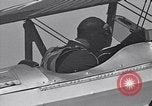
Aviator Charles Lindbergh talks to U.S. Navy officers aboard USS Saratoga, and takes off in a biplane fighter bomber.
Aviator Charles Lindbergh aboard USS Saratoga (CV-3) in the Pacific near the Panama Canal. Charles Lindbergh seen in a Boeing F3B-1 carrier based fighter bomber (BuNo A-7739) from Bombing Squadron VB-2B aboard the aircraft carrier USS Saratoga. Lindbergh visited the USS Saratoga on 8 February 1929. He was aboard for two days and while he was there he was invited to fly the new Boeing F3B-1. The VB-2B made him an honorary member of the squadron. U.S. Navy officers talk to Lindbergh on the deck of Saratoga, including Admiral Joseph Mason Reeves (aka "Bull" Reeves), A.P. Storrs, and W.V. Davis. Pilots pose for a photo with Lindbergh. Lindbergh seated in the aircraft. Squadron emblem of Felix the cat holding a spherical bomb is painted on side of plane. Plane takes off from the carrier deck. Lindbergh, U.S. Military and Navy officials aboard Saratoga talk to each other. Another naval ship can be seen in the sea. Bow of the aircraft carrier.
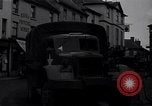
American military trucks and tanks pass through English village of Shaftesbury, Dorset, in World War II
American military trucks and tanks traverse New Road through village of Shaftesbury, Dorset, England. An African American soldier drives one of the trucks. An overhead crane pulls a 2-1/2 ton cargo truck,two wheeled trailer aboard a ship. Trucks and two M1 tanks drive through, turning in front of the Abbey Printing Works. Several townsfolk stand in front of V.F. Pike & Co.Ltd. shop and watch tanks driving past. U.S. soldiers ride in an open stake trucks pulling field artillery. View from vehicle moving along village street past army trucks and entering a courtyard, between stone pillars. A U.S. Military policeman directing truck traffic in center of town. View from truck driving over rails and into port where large ship is being loaded by cranes.
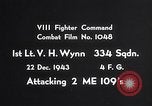
Gun camera footage: German ME-109 aircraft explodes after attack by U.S. Lt Wynn, 334 Squadron, 4th Fighter Group
A film about U.S. 8th Fighter Command in World War 2. Gun camera film from P-47 aircraft flown by First Lt. V.H. Wynn 334th Fighter Squadron, 4th Fighter Group. It records his attacking 2 German ME-109 aircraft on 22 December 1943. The German pilot of the last Me-109 jettisons his canopy and bails out of his plane in the last frames.
CRITICALPAST.COM: About Us | Contact Us | FAQs - How to Order | License Agreement | My Account | My Lightboxes | Shopping Cart | Advanced Search | Featured Collections | Website Terms & Conditions | Privacy Policy ©2026 CriticalPast LLC.
License Agreement |
Terms & Conditions |
Privacy Policy
©2026 CriticalPast LLC.