


 Francais
 Deutsch
 Italiano
Refine Your Search
V2 stock footage and images
- Showing 3943 to 3948 of 9863 results more
more Hide
Hide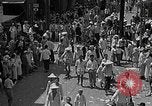
Chinese New Year parade in Taipei under Japanese occupation (WW2)
Taiwanese people attend a Chinese New Year festival parade in Taipei, Formosa (present day Taipei, Taiwan) during Japanese colonial rule in World War II. A busy street. Crowds convene on the sidewalk to watch a festival. A Japanese ice cream shop behind crowds. A group of men perform a serpentine-like dragon dance. A man performs acrobatics in front of a group performing a lion dance. Man performs lion dance. A boy pushes an artillery gun. A man with a papier-mâché donkey costume. Signs and banners depicting Chinese products such as Tiger Balm ointment. Chinese women dressed in elaborate traditional costumes on top of floats. Men carry an intricate model of a pagoda. A float of a symbolic god. People performing dance in the parade. The Taiwanese people watch the parade. A policeman stands in the foreground. People on the streets and decorative floats in the parade.
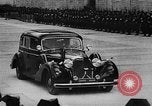
General Francisco Franco attends Catholic services in a church in Spain (WW2)
General Francisco Franco the Caudillo of Spain attends a Roman Catholic mass during World War II. A motor carriage arrives on a path lined with troops. Flags displayed in front of a building. Franco shakes hands with officials. General Franco waves to the crowd while proceeding with the officials to a Spanish Catholic Cathedral. Francisco Franco is greeted by a bishop. General Franco and his entourage enter the cathedral. Franco attending Catholic services inside a church.

The U.S. Army Quartermaster Corps store procured supplies and enlisted men are trained in quartermaster operations (WW2)
The United States Army Quartermaster Corps in the United States during World War II. A diagrammatic comparison of army manpower of 8,000,000 in December 1943 as against 1,750,000 in December 1941. A diagrammatic representation of huge increase in volume of obligated procurement in 1942 as against 1941. Men wheeling carts of supplies at a store. Men carrying supplies coming down a gangway from a ship onto a dock. Soldiers with guns standing on the dock. Soldiers moving through a wooded area. Men carrying the procured materials for storing. Officers watching the men. Two soldiers wearing their uniforms. People and vehicles moving on a city street. A signboard on a building reads 'Office of the Quartermaster General War Department'. The headquarters building in view. A map of the U.S. showing locations of different procuring offices across the nation. Men and women working in an office at the headquarters. Petroleum, Subsistence and Textile sections at the headquarters. Officers working in the headquarters. Men getting into a truck. Enlisted men being trained in various quartermaster operations at a training center.
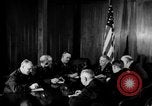
U.S. Army Quartermaster Corps' plan for procurement of materials for military services in the United States (WW2)
The United States Army Quartermaster Corps in the United States. Members of the Headquarters Army Service squad and Quartermaster Corps officers seated around a table during a meeting discuss the procurement plan of items for the military services in World War II. A signboard over the Quartermaster Headquarters building reads 'Office of the Quartermaster General War Department'. A map of the United States shows locations of procurement offices across the nation where authority is given to field officers for procurement. A field officer with a military personnel signing a contract for a fixed amount for the procurement of materials. A map shows the authority given in the procurement of materials which helps in speedy and efficient procurement. A simplified contract form which is used when the prices are known and when the total purchase does not exceed 500 thousand dollars. A purchasing officer hands over the contract to a staff to be sent to a manufacturer or a dealer. The manufacturer in his office signing the contract. Workers at the Quartermaster Headquarters at work.
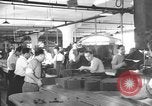
Small war plants' participation in U.S. Army Quartermaster Corps supply program in the United States (WW2)
United States Army Quartermaster Corps supply program in the United States. Workers at small war plants during production of different materials and military uniform parts in World War II. Two officers looking at a sample fur cap. U.S. military personnel with Quartermaster Corps officers seated around a table discuss procurement of materials in association with small war plants. A diagrammatic representation of the increase in the number of purchase transactions and the volume of dollar purchases as a result of the small war plant participation in the Quartermaster Corps supply program for the period of November 1942-43. War produciton workers at the war plants.
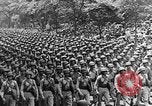
U.S. Army Quartermaster Corps supply program through depots in distribution areas in the United States (WW2)
United States Army Quartermaster Corps supply program in the United States. Soldiers holding guns march in formation. The soldiers on a vessel. Tanks firing during World War II. The soldiers using supplies procured by the Quartermaster Corps. Supplies in a room. Houses on a hillside. A man and a boy moving with a cattle herd on a road. Damaged buildings in a liberated area. Aerial view of debris and damaged buildings and people in the area, where left over supplies procured by the Quartermaster Corps could come into use for rehabilitation of people. The Quartermaster Corps store the procured supplies in boxes. The corps carry the boxes of supplies for distribution to soldiers. Quartermaster depots located in easily accessible areas near railways and highways. The supplies being wheeled in carts at a depot. Trucks with supplies moving on a road. Aerial view of a depot located in the commercial center of distribution. Workers inside a Quartermaster depot which is classified according to the functions they perform including distribution, reserve and manufacture. A map of the United States shows 15 distribution areas, with a depot each, which have the same boundaries as the procurement districts and which supply ports, camps or stations in that particular area.
CRITICALPAST.COM: About Us | Contact Us | FAQs - How to Order | License Agreement | My Account | My Lightboxes | Shopping Cart | Advanced Search | Featured Collections | Website Terms & Conditions | Privacy Policy ©2026 CriticalPast LLC.
License Agreement |
Terms & Conditions |
Privacy Policy
©2026 CriticalPast LLC.