


 Francais
 Deutsch
 Italiano
Refine Your Search
V2 stock footage and images
- Showing 433 to 438 of 9857 results more
more Hide
Hide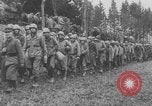
American prisoners of war captured by Germans during the Battle of the Bulge in World War II
Opening scene shows large numbers of U.S. Army soldiers taken prisoners in the final German counter offensive of World War 2, known as the Battle of the Ardennes or Battle of the Bulge. German photographer concentrates on African American soldiers in the group, with closeups of many, juxtaposing them with closeups of German soldiers. A German Panzer IV tank passes a hillside where many American prisoners are seated on the ground. A horse-drawn wagon and a Panzer III tank pass the hillside, and then the American prisoners are herded, under guard toward the road below. Scene shifts to German soldiers sharing captured American foods and cigarettes. Several German soldiers in camouflage uniforms. One carries an M34 machine gun with a circular magazine. A dozen German soldiers are seen crowded atop a Sturmgeschütz III (StuG III) assault gun. Closeup of crewmen on a tank. Another mans a machine gun. Closeup of another machine gunner atop a tank. Several German Panzer V ("Panther") tanks drive through a village.
The Philippines under Japanese occupation, liberation by allied forces, Philippine Independence ceremony.
The Philippines under Japanese occupation, liberation, and subsequent granting of independence by the United States in World War 2. Bodies of Filipino and United States soldiers killed during the Japanese invasion of the Philippines. Captured American, Filipino, and Australian soldiers raise their hands after the Fall of Corregidor. United States General Jonathan M. Wainwright negotiating the surrender of The Phillipines with Japanese General Masaharu Homma in 1942. Brigadier General Lewis C. Beebe and Major Thomas Dooley are seen to Wainwright's left. An American warship firing during the United States Pacific campaign to defeat Japanese occupying forces in the Pacific. United States soldiers get off an amphibious landing craft during the U.S. retaking of the Philippines. United States General Douglas MacArthur arrival in Leyte Gulf with a retinue consisting of Philippine President-in-exile Sergio Osmeña, Lieutenant General Richard Sutherland, Philippine Brigadier General Carlos P. Romulo, Major General Courtney Whitney, Philippine Sergeant Francisco Salveron and CBS Radio correspondent William J. Dunn in Palo, Leyte, the Philippines- a fulfillment of his promise to return to the Philippines. General Douglas MacArthur speaking at the Independence Day ceremony in Manila on July 4, 1946. “America never wavered in that purpose. America today redeems that pledge.” Says General MacArthur. United States Senator Millard Tydings, the co-sponsor of the Tydings–McDuffie Act (a law that provides independence to the Philippines after a 10-year transition as a Commonwealth) attends the ceremony. Paul V. McNutt, the United States High Commissioner of the Philippine Commonwealth (later the first United States Ambassador to the Philippines), reads the United States President Harry Truman's official proclamation of Philippine Independence. Filipino elites and United States dignitaries watch the ceremony in the Independence Grandstand (a temporary structure built in front of the Rizal Monument). Manuel Roxas being sworn in as the first President of the Philippines after gaining independence from the United States. The Philippine national anthem, Lupang Hinirang, plays in the background. High Commissioner McNutt lowers the United States flag from the flagpole as President Manuel Roxas raises the flag of the new Republic of the Philippines. A celebratory parade following the Independence ceremony takes place, which includes floats from various provinces in the country. A float with signs reading: "Let's Produce and Rebuild,". "Mountain Province" float with women wearing formal Filipino Baro’t Saya gowns. "The City of Manila" float with soldiers. "The University of the Philippines" (UP) float featuring two women dressed as allegorical figures and sign saying, “The University of the Philippines At the Service of the State”. "The Division of City Schools" float features two Filipinos in traditional attire in front of a Statue of Liberty model. A float, likely belonging to the National Library of the Philippines, with children and a huge book model. The Chamber of Commerce Philippines float contains a machine gear model and small models of an aircraft and a ship. American soldiers marching, carrying the United States flag. A military marching band play. Filipino soldiers marching with the Philippine flag. Military aircraft in flight above the Independence Grandstand in Manila.
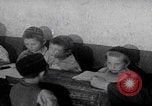
Jewish boys study the Torah; Crowded streets in Jerusalem during Passover
Children attend a Jewish school in Bethlehem, Palestine. A male teacher supervises Jewish boys studying the Torah. Jewish boys wearing Kippah (skull cap) and Payot (side locks) reading the Torah. Slide reads “Now His parents went to Jerusalem every year at the Feast of the Passover. St. Luke.Ch.2.v.41”. Crowded streets in Jerusalem during the week of the Jewish Passover. A crowded street leading to the Temple Mount. People gathered outside the Dome of the Rock in Jerusalem.
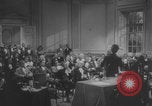
Filipino citizens after United States occupation of Philippines
Dramatization of the Second Continental Congress during the American Revolutionary War. The United States Declaration of Independence. The Thomas Jefferson Memorial (16 E Basin Dr SW, Washington, DC 20242, United States) in Washington DC. Bronze statue of Thomas Jefferson. The statue of United States President Abraham Lincoln at the Lincoln Memorial (2 Lincoln Memorial Cir NW, Washington, DC 20002). President Woodrow Wilson meets European leaders in France after World War I. Artistic depiction of United States soldiers fighting in the Spanish-American War. Map showing the Philippines, one of the two territories acquired by the United States after the Spanish-American War. Filipino students attend a class. They listen to the teacher standing in front of them. Behind the teacher are two blackboards. Two American consultants working with a Filipino man at the Manila City Planning. A scale model of Manila. Men constructing a house in the Philippines. Filipino men carry an entire native Kubo nipa house as a form of “Bayanihan”. A parade in Manila in 1946. The United States grants independence to the Philippines on July 4, 1946. Paul V. McNutt, High Commissioner to the Philippines, reads a proclamation at the ceremony held at the Independence Grandstand in front of the Rizal Monument. Filipino women wearing traditional Filipiniana dresses attend the ceremony. The United States flag is lowered as the Philippine flag is raised.
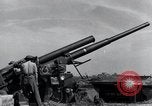
British forces attack V-1 flying bombs in skies over England; scenes of bomb damage from V-1 attacks.
British anti aircraft guns fire at German V-1 flying bombs and shoot them out of the skies in London, England. Air raid warden spotter looks at the sky. Barrage balloons suspend in air above the city. A V-1 falls to earth and explodes after being caught in the line of a barrage balloon. Aerial point of view shot from an Allied aircraft (narrator says a Tempest or Mustang or Spitfire aircraft) as it tracks and fires on a V-1 Flying Bomb in flight, and the V-1 explodes in mid air. British soldiers look through their binoculars. British civilians watch V-1 bombs flying overhead, including farmers working in fields, and a group of British women in bathing suits beside a river, who then jump in the water after seeing the V-1 in the sky overhead. A young woman in a British city races with a baby carriage or pram toward an apartment building and quickly grabs her baby to head inside as a V-1 is spotted in the British sky. Two road workers look up at the sky; a teenage girl looks up at the sky. Elevated view in London with visible smoke plume rising from a V-1 strike location. View of various bombed sections of the city from V-1 attacks, including rubble of schools, hospitals, churches, and homes. Civilians help in clearing the rubble. A nurse treats a wounded old woman. Two children walk through the rubble of a bombed building. Heavy equipment in use clearing rubble of a destroyed building. The equipment has a sign that reads, "L.C.C. War Debris Survey. P-40." (World War II period). A man shovels debris in a destroyed home beside a telephone still sitting on a telephone stand in the home, with its receiver off the hook. Man guides heavy debris bucket from crane and dumps it into a waiting truck. Many scenes of open skeletons of buildings with twisted rubble, missing walls and roofs. A nurse treats the bandaged face of a woman patient in a bed. A British teenage girl and a young boy walk, holding hands, through rubble of a destroyed neighborhood of homes.
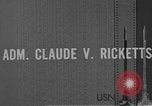
U.S. Navy officers pay tribute to Claude V. Ricketts and USS Biddle renamed to USS Claude V. Ricketts, United States.
Vice Chief of Naval Operations, Admiral Claude Vernon Ricketts' funeral in the United States. The Navy officer march holding SU flags. The officers and sailors salute. The casket of Claude Vernon Ricketts on a horse drawn carriage. The sailors walk on either side of the carriage. The U.S. Navy officer, commanders and sailors pay tribute. The ceremony of USS Biddle renamed to USS Claude V. Ricketts. Sailors stand aboard USS Claude V. Ricketts. Chief of Naval Operations David Lamar McDonald and other guests aboard the ship. A Navy officer speaks into a microphone. Biddle banner on the ship. The banner is replaced with Claude V. Ricketts. The sailors aboard take pictures. USS Claude V. Ricketts underway.
CRITICALPAST.COM: About Us | Contact Us | FAQs - How to Order | License Agreement | My Account | My Lightboxes | Shopping Cart | Advanced Search | Featured Collections | Website Terms & Conditions | Privacy Policy ©2026 CriticalPast LLC.
License Agreement |
Terms & Conditions |
Privacy Policy
©2026 CriticalPast LLC.