


 Francais
 Deutsch
 Italiano
Refine Your Search
V2 stock footage and images
- Showing 4789 to 4794 of 9941 results more
more Hide
Hide
Montage of scenes showing American civilian mobilization on the home front, life in the Navy, war scenes and demobilization after war.
View of a U.S. battleship heading toward the camera at high speed. Images of hip's wake becoming gradually more turbulent as camera focuses closer upon it in successive views. U.S. sailors in uniform. The first wears a the Silver Star medal. The next wears a Navy Cross medal. The third sailor wears a Cross medal with red and gold ribbon. A petty officer and two sailors posing together, each one displaying Cross and star medals, respectively. The scene fades to this last three, wearing civilian clothes in a flashback to the beginning of World War 2. The three watch as a draftsman lays out a Roll of Honor for a place called Middletown. Townspeople cheering at an outdoor sporting event. Next they sit and watch a tennis match. Next, many are seen as sailors scrubbing the deck of a battleship. Scene shifts to a Navy Wave guiding a C-45 aircraft into parking position. Another one is parked behind her. Next a "white shirt" on deck of an aircraft carrier is seen directing an aircraft with signals. A Douglas Dauntless aircraft is parked on the deck behind him. Abrupt change of scene shows a wounded sailor being attended by a physician. Members of a Navy ship's crew enjoying a swim, hanging out on a boom extended from their ship, and using rubber rafts and a dinghy as they enjoy recreational time allowed by the Captain. A sailor in a dining hall relishing a large piece of chicken. In contrast, a sailor at an antiaircraft station eats hastily. Twin guns are silhouetted behind him. Sailors getting dressed to go on shore leave. Photos of pinup girls displayed on locker behind them. They leave, but one sailor remains behind, on some kind of restrictions. Sailors on deck in formation as they are inspected by officers. One asks a sailor to adjust his hat and also examines his tie. A sailor sitting alone by a lake in Central Park, New York City. A sailor standing watch in setting sun. A chief Petty officer instructing a sailor on wearing his hat. Successive closeups of the imposing face of the Chief. that transitions into the face of a Lieutenant Junior Grade who is yelling at a sailor. Scene shifts to actual World War 2 battle footage scenes as Navy crew battles fire in an aircraft carrier's Island during naval combat in the Pacific. Hose lines are stretched across the flight deck and smoke envelopes the ship. Injured are carried to place of safety. Another scene aboard a U.S. Navy ship in World War 2, shows a Navy Chaplain praying over sailor who was killed, followed by a ceremonial burial at sea for the dead. U.S. Marines fire rifle salutes as coffins slide out from under American flags to carry the fallen sailor into the sea. As the nation demobilizes after the war, various "rabble-rousers" begin to cause trouble. One is seen speaking before a group of women, who seem influenced by his remarks. Scene shifts to aerial views from a low-flying airplane revealing the total destruction and rubble over miles of a German city, probably Berlin, from Allied bombing and shelling during World War 2. Views of suffering survivors of World War II (especially children) in various parts of the world. Emaciated and starving children in a war-torn area.
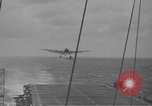
U.S. Navy TBF Avenger gunner from USS Essex is buried at sea with his aircraft during World War II
A Grumman TBF avenger torpedo bomber of VT-15 Torpedo Air Group, approaches and lands on the deck of the USS Essex (CV-9) during the Battle of Manila Bay, in World War 2. Upon landing, Lt. Robert Cosgrove (Pilot) and Sailor Digby Denzek (Radioman) can be seen in their respective forward and middle crew positions. But the rear gunner position, occupied by Aviation Machinist Mate 2nd Class, Loyce Edward Deen (Gunner), has been completely destroyed by Japanese enemy 40mm shell fire, and AMM2C Loyce Deen is dead. As the aircraft is parked among others, with wings folded up, U.S. Navy sailors of the USS Essex take fingerprints and cut dog tags from the body of AMM2C Deen in the gunner position. Captain Carlos W. Wieber, Commanding Officer of the Essex, and her crew, participate in funeral services on the deck. A chaplain conducts the services from beside the aircraft, where Loyce Deen's remains in the gunner's position have been shrouded. Closeup of Rear Admiral Frederick C. Sherman during the service of burial at sea. A bugler plays taps. Beside the bugler is David L. McDonald, who was XO of the USS Essex (and later Chief of Naval Operations in the 1960s). Deen's remains are then buried at sea in the TBF avenger in which he died. The aircraft floats off the fantail for a short time before sinking from view. Two TBF Avengers are seen flying overhead, in tribute. Crew members then disband and return to their duties.
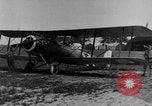
Observers test guns in cockpits of French airplanes in France during World War I.
Aviation activities in France during World War I. A French Salmson 2 A.2 aircraft parked at an airfield. A ground crewman turns the propeller of the aircraft. Tent hangars in the background. An observer in the rear cockpit of the Salmson 2 A.2 tests movement of twin machine gun mounts. Observer Lieutenant T. E. Hibbon fires a machine gun in the observer's cockpit of a stationary Spad 11 aircraft. A pilot is seated in the front cockpit of the aircraft.
SECNAV inspects the Marine Honor Guard, receives a 19 gun salute and souvenir book aboard USS Shangri La in Mediterranean Sea.
Paul Robert Ignatius, the United States Secretary of the Navy (SECNAV) visits USS Shangri La (CV-38) in the Mediterranean Sea. View of the Marine Honor Guard standing at attention on the flight deck. Front view of Vice Admiral Edward H. Martin, COMSIXTHFLT (United States Sixth Fleet), approaching up the flight deck with a small party of officers unit. Vice Admiral Edward H. Martin, and party walk past over the flight deck. Vice Admiral Martin, Rear Admiral Lawrence Geis, Rear Admiral Isaman talk, next to the C-2A. View of one rank of the sideboys at Parade Rest on the flight deck. View of the honorable Paul Robert Ignatius, the United States Secretary of the Navy (SECNAV), walk over the flight deck alone. View of View of an unidentified Commander come down, the SECNAV Ignatius having received his Honors. The SECNAV inspects the Marine Honor Guard on the flight deck. Rear Admiral Lawrence Geis, Commander Carrier Division Four (ComCarDiv 4), and Captain Coogan, aboard USS Shangri-LA, (CVA-38). View of SECNAV standing on the flight deck, receives a 19 gun salute. SECNAV standing beside the C-2A chat with Rear Admiral Geis, and Capt. Coogan. SECNAV getting aboard the C-2A over the ramp, after having received a souvenir book from Capt. Coogan. SECNAV being assisted into a life jacket by one of the crewmen of the C-2A.
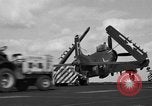
Flight deck crew respot planes aft in readiness for next launch and jets being catapulted aboard USS FDR in the Atlantic Ocean.
Midway-class aircraft carrier USS Franklin D. Roosevelt in the Atlantic Ocean during Operation Long Step. Flight deck crew re-spots the aircraft aft in readiness for next launch. A lineup of U.S. Navy F2H Banshees wait to be spotted aft. Three-inch gun crew stand during condition watch. Essex-class aircraft carrier USS Leyte in the background. A U.S. Navy HUP helicopter lands aboard USS FDR. A pilot sits in a Banshee aircraft awaiting his turn to be moved in position over a catapult. F2H-2s warm up. F2H Banshees in position on catapults ready for launching. Handling and catapult crew stand in assigned positions between airplanes during jet launchings. The jets being catapulted. A helicopter aboard USS FDR during the launching of the aircraft.
Soviet forces attack German heartland during World War II.
Soviet forces laying siege to Germany in Battle of Berlin and environs, during World War 2, are seen in positions at the front under many sets of camouflage netting. Closeup of Soviet Marshal Georgy Zhukov and then of Zhukov and other officers in a dugout, under camouflage netting. Camera pans downhill toward other dugouts. One contains an artillery officer looking through periscopic binoculars. Breech view of Soviet gun crew loading a shell into a heavy artillery piece. The gun fires. Numerous artillery batteries firing and explosions on the ground. Soldiers use a wheeled cart to carry a heavy shell to a gun crew. Other soldiers carry propellant charges over their shoulders and gun crew member rams them into gun breech. Gun crew officer gives signal and gun fires. Another gun crew receives shells and fires its gun. Numerous gun batteries firing and shells exploding. Marshal Zhukov and staff observing the artillery attacks. Formations of Petlyakov Pe-2 attack bombers seen inflight. Marshal Zukov and staff looking skyward at Soviet bombers overhead. Views of the Petlyakov Pe-2 attack bombers overhead. Views from a bomber dropping bombs. Extreme aerial closeup bombs-away shot of underside of Pe-2 bomber as it releases bombs. View from bomber of its bombs dropping and exploding in concentrate area below. More bombs dropping and explosions on ground. More views of artillery batteries firing. Empty artillery shells piling up near a gun crew. A flight of Ilyushin Il aircraft buzz the field where many are parked. Ilyushin II aircraft in formation and then strafing ground targets. Batteries of Katyusha multiple rocket launchers firing. More Ilyushin II planes strafing targets. One of them is struck by gunfire and explodes.
CRITICALPAST.COM: About Us | Contact Us | FAQs - How to Order | License Agreement | My Account | My Lightboxes | Shopping Cart | Advanced Search | Featured Collections | Website Terms & Conditions | Privacy Policy ©2026 CriticalPast LLC.
License Agreement |
Terms & Conditions |
Privacy Policy
©2026 CriticalPast LLC.