


 Francais
 Deutsch
 Italiano
Refine Your Search
V2 stock footage and images
- Showing 4921 to 4926 of 9941 results more
more Hide
Hide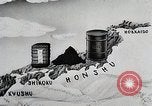
Japanese natural resources related to Second Sino-Japanese war and World War II
Animated map illustrating shortage of indigenous raw materials in Japan. As stockpiles vanish during Second Sino-Japanese war, Japan's domestic sources supply only 10% of the nation's needs for war. Animated sequence shows lack of steel, aluminum, copper, and power generation for the conduct of war. But one of the nation's greatest resources is the population of skilled Japanese workers, who are shown at various high tech jobs, as well as on the farms and in the fishing industry. Japanese workers are seen who work for the Zaibatsu (four ruling families of Japan). Banks of Japanese women typists and women in a factory. Young women painting faces on a "Kewpie doll." A Japanese family at dinner time. Women engaged in fabric spinning. Animated graphic illustrates Japan's war-related resources for World War 2, by showing a Japanese soldier standing astride map of Japan with lines extending to sources of needed raw materials from Japanese possessions in Korea, Manchuria,Formosa, China,Indochina,Malaya, and its network of Pacific Islands. Final scene displays copy of Los Angeles Times newspaper with headline reading: "Jap Supply Lines Blasted." It also features a story that appears to refer to the U.S. 6th Army invasion of Leyte in the Philippines, in October, 1944 (when General MacArthur waded ashore and stated,"I have returned"). (Note: Although produced during World War 2, this film shows prewar scenes of Japan. The animated illustrations and maps and, of course, the newspaper shown at the end, date from World War II.)

IAC Prize winning documentaries
Shows opening credits for the IAC,Institute of Amateur Cinematographer's two prize winning documentaries namely Human Documentary class 2nd ,prize 2nd and Daily Mail class 5th,prize 3rd .1934.
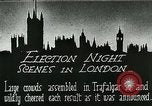
People gather at Trafalgar Square in London, England, to hear results of 1924 UK General Election.
Crowds gathered in Trafalgar Square (Trafalgar Sq, London WC2N 5DS, United Kingdom) in London, at night, to hear results of the 1924 United Kingdom general election. Groups cheer favorite candidates' elections are announced. Mounted policemen keep order. A double-decker bus and an automobile move slowly along the street near the crowd. First, light rain is falling. So many people carry umbrellas. Later, the rain stopped. Men setting up powerful "sunlight arc lamps" to illuminate other crowded streets for cameramen. View of the crowds illuminated by the arc lamps. A bus passes displaying a large advertisement for the show "Leap Year" playing at the London Hippodrome (Cranbourn Street, Leicester Square, WC2H 7JH London, United Kingdom).
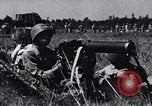
Japanese-American recruits get training with machine guns, field training and 37 mm gun at Camp Shelby, Mississippi.
Japanese-American recruits at Camp Shelby, Hattiesburg, Mississippi, United States. Company 2nd Infantry Combat Team. Combat team boys get trained with machine gun. The gunner fires, 2nd man swaps position and the observer watches. Combat team gets training in field about advancing in field. Artillery is driven by road followed by ammunition in truck by combat team. Soldiers put 37 mm gun in position. (World War II period).
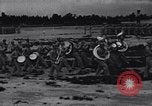
Japanese-American Combat team during retreat march and assembles at Camp Shelby, Mississippi in United States.
Japanese-American recruits at Camp Shelby, Hattiesburg, Mississippi, United States. Company 2nd Infantry Combat Team. Combat team band plays during retreat march. Commanding officer assembles soldiers in front of the United States flag. Soldiers in trench with machine gun. Soldiers in prone position in field. Guard in position past board of Headquarters Company 2nd Infantry Combat Team. Combat team marches with rifles at Camp Shelby. (World War II period).
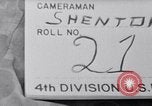
U.S. 4th Division Marines in final phases of battle for Iwo Jima in World War II
Views of the rocky barren terrain of Iwo Jima, in final phases of battle by U.S. 4th Division marines against Japanese defenders, during World War 2. Mount Suribachi in the background. A U.S. Navy F4F Wildcat airplane flies overhead. Closeup glimpse of a marine eating. A marine Sherman tank moving along a path through the rocks. A tank parked near marines preparing defensive positions in a valley. Two U.S. Navy Curtiss SB2C Helldivers attack Japanese positions in successive passes. Huge clouds of smoke arise from each bombing pass.
CRITICALPAST.COM: About Us | Contact Us | FAQs - How to Order | License Agreement | My Account | My Lightboxes | Shopping Cart | Advanced Search | Featured Collections | Website Terms & Conditions | Privacy Policy ©2026 CriticalPast LLC.
License Agreement |
Terms & Conditions |
Privacy Policy
©2026 CriticalPast LLC.