


 Francais
 Deutsch
 Italiano
Refine Your Search
V2 stock footage and images
- Showing 5353 to 5358 of 9941 results more
more Hide
Hide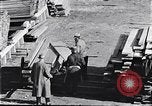
Construction site and two African American children walk on a sidewalk in Richmond, Virginia, mid 1930s.
Three African American men look at logs piled in Richmond, Virginia. Heap of waste. View of construction site. A board reads "2nd Baptist Church". Two African American children walk on sidewalk. An young African American boy holds the hand of a very young child at a street crossing. Close-ups of several African American boys wearing caps and smiling for the camera.
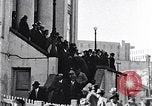
President William J Clark of Virginia Union University talks with Pastor Hill in Richmond, Virginia.
African American men wearing hats come down steps of the 2nd Baptist Church in Richmond, Virginia. A woman with two children. Pastor J T Hill greets congregation emerging from Second Baptist Church. An African American man stands at a building. President William J Clark of Virginia Union University talks with Pastor Hill.
African American tenant farmer women farm land, and statue of Abraham Lincoln at Lincoln Memorial, Washington DC.
From film "Toward the Horizon" depicting life of African American population in the United States post World War II. The statue of Abraham Lincoln at Lincoln Memorial (2 Lincoln Memorial Cir NW, Washington, DC 20002), Washington DC. African American farmers work in a field, plowing it with mule and plow. African American women till the soil by hand.

Scenes in and around U.S. Naval facilities at Tsingtao, shantung Province, China during U.S. postwar presence.
U.S. Naval facilities in Tsingtao (Qingdao) Shantung Province, China, after World War 2. Camera pans across top of building labeled: United States Naval Air Base. It pans over semi-tropical flora. View from hill looking down on rice paddies, and coastal waters. A U.S. Navy R5D transport plane seen overhead, through mist, with landing gear down, approaching to land. Series of jerky images from vehicle moving along a road on Naval base and vicinity. Steel framework at industrial site. Partially destroyed building. Various industrial areas. Sign at driveway entrance reads: "ASAN." Heavy construction equipment. Chinese people wading in flooded area, seemingly fishing for something. U.S. military truck, quonset huts, and American servicemen at a base. View down on a cemetery containing various monuments, including some Christian crosses.
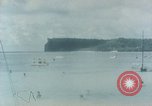
Views of Guam at end of World War II
Beach scene at Tumon Bay, Guam in 1945, at end of World War 2 . Bathers and some small boats in water of a bay. Sand beach covered with palm trees and other semitropical flora. People seated on the sands. Water of the bay and promenatory of land in background. Different sequence, showing three U.S. Landing Craft Support, Large, LCS (L) clustered together at anchor in a bay, with buildings on shore in background. The mast of a U.S.warship. A U.S. Army Air Forces B-29 bomber in flight overhead. It displays tail code of solid black square with "M" inside, identifying it as belonging to the 20th Air Force, 314th Bomb Wing, 19th Bomb Group, based at Anderson Air Force Base, Guam. Camera focuses on the bomber as it passes overhead. Sailors speed into the bay, aboard a motor boat. The B-29 circles directly overhead, passing the American flag displayed on the main mast of a warship. The B-29 appears to be descending to land at the airbase.

Large crowd gathers to watch 74th Preakness Stakes horse race at Pimlico Race Track in Baltimore, Maryland.
Large crowd gathers for the running of the 74th Preakness Stakes horse race at Pimlico Race Track, Baltimore Maryland, where they watch as the tree year old Citation, of Calumet Farms, ridden by Jockey Eddie Arcaro, wins the race by 51/2 lengths.
CRITICALPAST.COM: About Us | Contact Us | FAQs - How to Order | License Agreement | My Account | My Lightboxes | Shopping Cart | Advanced Search | Featured Collections | Website Terms & Conditions | Privacy Policy ©2026 CriticalPast LLC.
License Agreement |
Terms & Conditions |
Privacy Policy
©2026 CriticalPast LLC.