


 Francais
 Deutsch
 Italiano
Refine Your Search
V2 stock footage and images
- Showing 5887 to 5892 of 9941 results more
more Hide
Hide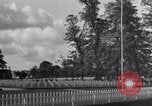
United States soldiers and officers at a military cemetery in France for Memorial Day services in 1945.
American soldiers and officers at a military cemetery in Ste Mere Eglise, France. Flags on grave markers. Soldiers stand with flags in hand. Officers stand. They pay respect to the graves of the American soldiers killed in World War 2 in the invasion of France. They place wreath on a grave. Children watch the officers paying respect to the graves. Soldiers stand with flags. Soldiers band. They fire in the air. They march with the band.

Two captains of the 507th paratroop infantry talk at a field in France.
Activities of 82nd Airborne Division in days after invasion of France in World War 2 Two captains of the 507th paratroop infantry talk at a field in France. They smoke. Paratroopers pass on the street. A sign on a board on which is written: 'Amafreville-Gourbesville'.

Devastation from atomic bomb dropped on Hiroshima Japan in World War II
U.S. War Department film showing devastation from atomic bomb dropped on Hiroshima, Japan, during World War 2. Opening scene is darkness of predawn in Alamogordo, New Mexico, on 16, July, 1945, at 5:29:45 AM. Suddenly, a huge explosion lights up the sky. A fireball and mushroom shaped cloud form. Closer view of the explosion from another camera. Following the initial explosion, the ensuing sound is a continuous roar. Another view is shown, from a third camera location. It highlights the boiling fire and smoke of the explosion. These scenes document the first successful test of a nuclear weapon, code named "Trinity". Change of scene shows glimpse of the Manhattan Project B Reactor site at Hanford, Washington, as viewed from a car driving past. Closeup of the facility, from right up against a boundary fence. Glimpses of other Manhattan Project facilities in New Mexico, Oak Ridge, Tennessee, and another view of the Hanford, Washington facility. Next, a rough topographical map of Japan is shown. Closeup of elevated railroad train traveling in Hiroshima, Japan. Imperial Japanese Army motorized vehicles are shown on parade, including fully tracked open personnel carriers with soldiers aboard and Type 94 Tankettes being driven by individual soldiers. Japanese infantry marching in full field gear including shouldered rifles with fixed bayonets. Closeup of a Japanese Army officer. Glimpse of Japanese support troops, such as quartermaster elements, in black uniforms. Japanese technicians in white lab coats at a wartime facility. Japanese Navy Warships being launched from Hiroshima ship yards. A lone B-29 bomber seen in flight over clouds. Its tail number, 42-63735 is clearly seen. It displays a large "05" on it upper tail. (This is not the "Enola Gay" whose tail number was 44-86292.) Closeup of one of the aircraft's engines with propeller turning. Glimpse upward from interior of the aircraft. Scene shifts to aerial photograph of Hiroshima with overlay depicting the bomb strike zone. Animated map showing explosion and precise point ot detonation above the junction of the Motoyasu and Ota Rivers. A view at the ground of destruction from the atomic explosion. An American soldier stands in the midst of the destruction. Slabs of heavy concrete are destroyed. View looking East from ground zero, past a burned tree trunk in the foreground, where the shells of several stronger buildings still stand amidst a sea of rubble. To the South, hardly anything is left standing. Looking West, everything is essentially leveled.
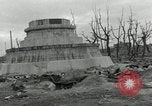
Ruins and devastation caused by the atom bomb explosion in Hiroshima, Japan.
Ruins and devastation caused by the atomic bomb explosion in Hiroshima, Japan during World War 2. Members of a United States mission inspect the ruins. Effect of the ruins on the Russo-Japanese War Memorial. Trees in the field destroyed due to the explosion. Rubble and ruins in the city. Wrecked houses and buildings. A destroyed statue amidst the city. Damaged Hiroshima Prefectural Industrial Promotion Hall with Motoyasu Bridge in the background. People walk on a street.
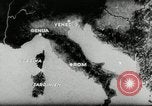
German forces engage Americans in battle of Monte Cassino, Italy, in World War II, and take American prisoners.
Map of Italy showing major cities. During a battlefield lull,in World War 2, in Italy, a German soldier reads a newpaper called the "Southern Front." View of Monte Cassino,Italy, with German troops taking cover amongst war debris. Fencing and signs identify minefields. German soldiers with their weapons, hidden in foliage. German soldier looks through binoculars as American forces bombard the town of Monte Cassino. German soldier, seeking cover, jumps over a stone wall. Smoke rises from the U.S. bombardment. German officers consult in a dugout. German soldiers move stealthily across a stream and through battle scarred landscape. Some take up positions and fire machine guns, rifles, and rifle grenades toward American lines. They advance from their trenches and come across fallen American soldiers on the field. They encounter one crawling, and several others from the U.S. 34th Division, whom they take prisoner. They remove their equipment and weapons, and smoke the American cigarettes. Behind the lines, a man in civilian clothes questions the captured American soldiers. A German soldier uses periscopic binoculars to spot targets for German artillerymen firing heavy weapons. Explosions seen in valley below as shells burst.

Adolf Hitler greets Marshal Antonescu of Romania, in Rastenburg, East Prussia, during World War II
German leader Adolf Hitler stands with members of his staff on a snow covered train station platform in Rastenburg, East Prussia (now Poland) during World War 2. A train arrives, with icicles clinging to its roof. Romanian military officers render traditional hand salutes (not Nazi salutes) from the train as it pulls into the station. Ion Antonescu, salutes with his Marshal's baton and exchanges greeting with Hitler. He is accompanied by Romanian Foreign Minister, Mihai Antonescu. The two exchange salutes and handshakes with members of Hitler's party. (Mihal gives Nazi salute, but Ion does not.) Hitler walks past and exchanges salutes group of Romanians accompanying Antonescu. (Hitler gives his Nazi salute, but the Romanian officers render traditional hand salute to forehead.) Change of scene, shows Nazi Foreign Minister, Joachim von Ribbentrop, escorting Marshal Ion Antonescu and Foreign Minister, Mihai Antonescu, up some stairs to a meeting room.
CRITICALPAST.COM: About Us | Contact Us | FAQs - How to Order | License Agreement | My Account | My Lightboxes | Shopping Cart | Advanced Search | Featured Collections | Website Terms & Conditions | Privacy Policy ©2026 CriticalPast LLC.
License Agreement |
Terms & Conditions |
Privacy Policy
©2026 CriticalPast LLC.