


 Francais
 Deutsch
 Italiano
Refine Your Search
V2 stock footage and images
- Showing 5923 to 5928 of 9941 results more
more Hide
Hide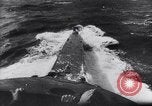
Sights and sounds aboard a German U-boat operating in the North Atlantic during World War II
German U-boat underway on the surface in stormy weather on the North Atlantic ocean during World War 2. The crew all wear foul weather gear. They search for British ships. Upon seeing one, they quickly descend and the boat rapidly submerges. View inside the submarine as sailors close all hatches and manipulate valves. Underwater view of periscope rising from a submerged U-boat. The boat's Captain looking through his periscope. He and the second officer look through the periscope and check book of known British ships to identify it. They fire a torpedo from tube number 4, start a stop watch, lower the periscope, and wait. Next, they hear an explosion and then the sounds from screws of a destroyer passing nearby. A depth charge from the destroyer explodes, knocking items in the boat to the floor. Lights go out in the U-boat and water leaks in places. Crew members inspect by flashlight and confirm minimal damage. With lights on again, the U-boat Captain looks through the periscope and then surfaces,to see a sinking ship

German ambassador, Hans Thomsen, visits famous Swedish explorer, Sven Hedin in Stockholm, Sweden.
Sven Hedin, famous Swedish explorer, geographer, and author, is seen in his book-lined study, in Stockholm, Sweden, around the time of his 80th Birthday, in 1945, during World War 2. He opens a large map and points to a part of Sweden, that narrator implies is important to German interests. Next the German ambassador to Sweden, Dr. Hans Thomsen, enters, bringing greetings in the name of the Fuhrer, through Joachim von Ribbentrop, the German Foreign Minister. He expresses appreciation of the German nation. The two men sit and converse.
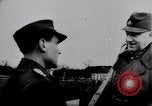
Konstantin Hierl, Head of German Reichs Arbeit Dienst (RAD) with women antiaircraft operators and RAD member in World War II
Konstantin Hierl, leader of the Reichs Arbeit Dienst (RAD), which is the German National Labor Service, is seen in RAD uniform, during World War 2. He watches as several young German women demonstrate how they operate an antiaircaft battery. Scene shifts to Konstantin Hierl decorating a member of the RAD. Snow is on the ground. Members of the Wehrmacht (Army) form an honor guard.
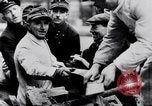
Ordinary German citizens build barricades and dig trenches for defense of Berlin in final months of World War II
People build barricades and dig trenches for defense of Berlin in Germany, during World War 2. Men build barricades for defense of Berlin against advancing Soviet forces. Women carries goods on wheel carts to help in building barricades. Man smokes cigar. They build tank traps. They dig a trench in the field.
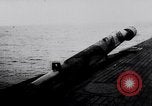
Demonstration of a German torpedo fire control system on a U-boat to control torpedo accuracy, in World War II
View of a German U-boat with a snorkel to its periscope, laying on its deck, during World War 2. The crew actuates control that raises the snorkel to periscope height above the conning tower. Views of U-boat submerging and of the snorkel plowing through the water ahead of the boat's periscope. Below, in the control room, the Captain looks through his periscope and sees several ships ahead. Closeup of one ship dead ahead. U-boat crewman adjusts fire control equipment. View of the snorkel moving through the water. A torpedo strikes the target ship and sinks it. The U-boat submerges.
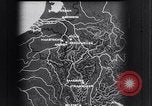
German soldiers fight in and around the ruins of Aachen, Germany.
German soldiers fight in and around the ruins of Aachen in Germany during World War 2. A map shows places. Soldiers on an Sdkfz.250 Neue halftrack arrive on the war front armed with Panzerfaust recoilless antitank weapon and Assault Rifle. Wrecked buildings and houses near battle area. Soldiers walk on the field. They walk in the trench and fire a mortar (several running out of the trench before it goes off). Numerous close-up views of faces of German soldiers as they talk, move, or fire weapons at Allied forces.
CRITICALPAST.COM: About Us | Contact Us | FAQs - How to Order | License Agreement | My Account | My Lightboxes | Shopping Cart | Advanced Search | Featured Collections | Website Terms & Conditions | Privacy Policy ©2026 CriticalPast LLC.
License Agreement |
Terms & Conditions |
Privacy Policy
©2026 CriticalPast LLC.