


 Francais
 Deutsch
 Italiano
Refine Your Search
Vienna Austria 1923 stock footage and images
- Showing 139 to 144 of 702 results more
more Hide
Hide
A stagecoach being driven around to mark the 100th anniversary of Ypsilanti, Michigan.
A stagecoach to mark the 100th anniversary of settlement in Ypsilanti, Michigan. A stagecoach with a sign on the top that reads ' on our way to Ypsilanti-100th anniversary-1823 to 1923' as it moves past people on street. Stagecoach in front of a pavilion in a park. Horses tied to a fence with ' Welcome' sign on it. Building with a sign on it that reads ' Welcome- Ypsilanti stage' Costumed ladies leave the building. Horses being fed and harnessed to coach. Stagecoach drives away.
Town residents celebrate 100th Anniversary of Ypsilanti Michigan. A carriage travels roads and encounters a dramatized robbery.
A horse drawn carriage in Ypsilanti, Michigan. A horse drawn carriage makes a stop. Sign on the carriage reads "On our way to Ypsilanti's 100th Anniversary. 1823 to 1923". The carriage drives past a truck and pedestrian traffic in the business district. The carriage stops outside a building and a costumed woman and a child (in early 1800's clothing) get out and enter the building. The woman and the child come out of the building and get into the carriage. The carriage being driven away. The carriage drives down a country road. Dramatized scene in which Men in a car rob the carriage and its passengers. Men and women stand with their hands up as a man points a rifle at them.
Scenes related to the Ford Motor company and the Ford Model T automobile in the United States.
Ford Model T cars being driven out the exit door of the Highland Park factory, Michigan,circa 1916. Numerous Model T cars driving on both sides of a divided highway. The Ford Highland Park Plant, circa 1920. Panoramic exterior views of the Ford River Rouge plant and factory buildings, circa 1930. A Ford Freighter ship, docked at the River Rouge plant. A view of the home of Henry and Clara Ford, at 66 Edison Road (now 140) Dearborn, Michigan, in 1914. Sketch of children coming home from school, singing song from McGuffey reader school book. View of schoolroom with McGuffey readers on desk. Narrator relates story of Henry Ford trying to buy a McGuffey reader and being unable to obtain one. Narrator states that Ford realizes from this incident "the changes that are reordering his culture. The modes of life which Henry so loved are passing, disappearing into history." Street scene outside Ford Plant, during shift change, and street filled with workers. A car driving on empty road in Sudbury, Massachusetts. The historic Wayside Inn (immortalized in Henry Wadsworth Longfellow's "Tales of the Wayside Inn") which Henry Ford purchased in 1923, to preserve for posterity. View of the original Pennsylvania Railroad Station in New York City, circa 1912. View of crowded sidewalks and street on 5th Avenue, and other street scenes in New York City, circa 1920. Model T Ford cars driving in U.S. National Parks. A visitor feeding a bear from his Ford car, as a U.S. National Park Ranger stands nearby. People in Ford Model T, stopped by side of road to pick wild flowers. Two men remove a seat back from their Model T car to make a camper. Both men lying down in the car. Man carrying picnic basket from Ford Model T, parked beside a beach, where he joins the rest of his party on the sand. Children run along the beach, and stop to play with seaweed.
Drawings and hardware of Professor Eugen Sänger's S.R.6 and 7 rocket motors designed in 1934.
Drawing of "L-Rocket," dated January 5, 1933. Professor Eugen Sänger's S.R.6 Rocket motor from May 23, 1934, in which the combustion chamber is the same design as the slim nozzle of the L-Rocket. Actual parts of the S.R.6 motor. Plan of Rocket motor S.R.7 from May 21, 1934, with fuel inlet cooling by coiled pipe to the nozzle jacket. Second version of S.R.7 from June 5th, with cooling in the outer shell. Drawings of Versions three and four of the S.R.7. and scenes of the actual hardware held in Sänger's hand. He unscrews part and points out the features. He points out the cooling coils around the combustion chamber. Another version is similarily displayed after he removes its outer shell.
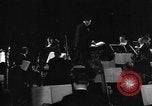
One-armed pianist, Paul Wiggenstein, performs in a concert with full orchestra
Conductor converses with concert master violinist onstage, before a performance. Musicians begin to play under the baton of the conductor. Musicians dressed formally. Instruments, music stands and music manuscripts clearly seen. Soloist Paul Wiggenstein plays the piano, with left hand only, on stage. Right sleeve of his jacket hangs limp at his side. Soloists play violins. Audience seated in concert hall. Wiggenstein and the conductor taking bows after the performance.
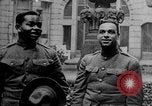
African American soldiers and army officers posing in front of building with fountain having small elephant carvings
Following World War 1, U.S. Army African American soldiers posing in front of a fountain at an official building. At about 10 feet above the ground, there are many small carved elephants encircling the fountain. Group of American Army officers poses in the same place, including Colonel William Hayward, commander of the African American 369th Infantry, 93rd Division (also known as the 15th New York National Guard or Old Fifteenth or "Harlem Hellfighters." A bigger group of American officers poses in front of what looks like a memorial with bas relief carvings. They hold a long banner reading "The Stars and Stripes forever."