


 Francais
 Deutsch
 Italiano
Refine Your Search
Vienna Austria 1923 stock footage and images
- Showing 373 to 378 of 702 results more
more Hide
Hide
European Persons and Events leading to World War I.
The funeral of Archduke Franz Ferdinand of Austria. Emperor Franz Joseph I of Austria arrives in a horse drawn carriage. Kaiser Wilhelm II of Germany with entourage. The German Emperor reviews German troops on parade. A newspaper headline "Kaiser defies Czar. Hands off or War!'. Nicholas II of Russia walks down steps followed by his wife and two daughters. People stand on steps and salute. The Czar and family are seated in an open carriage. Russian Soldiers parade. Another headline, 'France enters War'. French Cavalry and troops parade in open fields. A newspaper headline 'England prepares for War, German armies sweep France'. British King George V , in military uniform, and Queen Mary, standing at a window. British troops march and a soldier drives a motorbike.
Funeral of United States General George Patton and key moments and accomplishments during his life.
On the life of U.S. General George S Patton Junior (with narration by Ronald Reagan). Fight at the Siegfried Line during World War 2. U.S. 3rd Army cross the Siegfried Line. General Patton with his officers. Patton's troops cross the Rhine. American soldiers in the streets of Germany. Patton presents the Medal of Honor to a soldier. Patton sees dead people at a concentration camp in Germany. Patton's army moves towards Denube Valley. Civilians in the streets. Patton with officers. Written on a wall 'Hitler is kaput'. Trucks loaded with soldiers. A gun thrown on a pile of guns on the ground. Patton in a barge. A welcome ceremony for General Patton on his return to US: A parade along Broadway in Los Angeles on June 9, 1945, as over 1 million citizens welcome General Patton home and cheer. Shops and offices on Broadway in Los Angeles. Patton waves at the people from an open jeep. Patton and General Doolittle in Los Angeles. General Doolittle makes a speech at a ceremony and introduces General Patton. Patton addresses the gathering and talks about the war and the accomplishments of the Third Army. He notes that from aerial view, Germany and Austria "look like hell from the top." And "that's what any place that the 8th Air Force and the Third Army worked on looks like." Also Patton says, "You must remember this. That from Brest, to various towns in southern Germany and Austria whose names I can't pronounce, but whose places I have removed," (laughter in crowd), "the trail of the Third Army and the 19th Tactical Air Command and the 8th Air Force is marked by more than forty thousand white crosses; forty thousand dead Americans." View of a military cemetery graveyard. General Patton lays flowers at the grave of one of his soldiers. Patton watches a race at Soldiers Field Academy. He shakes hands with the winners. Soldiers carry Patton's coffin wrapped in American flag. Patton's grave with flowers on it. Two soldiers stand beside it. Patton's statue at the West Point Military Academy.

British RAF bombers operating from France early in World War II.
British Royal Air Force operations early in World War 2, during deployments of British Expeditionary Force to France. Whitley bomber takes off from France for a raid on Austria. Harrow bomber parked in a field and British airmen around it. Close up of two British airmen The airmen board the bomber. The bomber taxis and takes off for a raid on Austria. The bomber in flight and two bombers parked in the foreground.
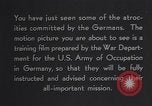
Training film for U.S. troops with the Army of occupation in Germany after world War II
Opens with bell tolling Victory against Germany in World War II. Next, a slate reads: "Victory Leads to Peace," and a farmer is seen with cattle pulling a plow. But narrator says "the problem now is future peace," and a map of Germany is shown overlaid with "Your Job in Germany." A cartoon of a soldier is superimposed on the map, along with one of a World War 1 American soldier and a figure of possible future soldier with similar mission. Camera focuses on parts of German aircraft in a jumbled heap. Closeups of weary defeated German soldiers at end ot World War II. Glimpse of Adolf Hitler speaking and haranguing an audience from a podium in an animated and forceful way. Swastika flags displayed from houses in a quaint German town. Joseph Goebbels, Nazi Reich Minister of Propaganda, at a microphone. Glimpse of a German concentration camp. But as they appear, each of the Nazi elements promptly disappears, showing the scenes without such Nazi symbols and persons. Skeleton remains of bombed buildings. Flower displays. Bucolic German rural countryside and quaint old villages in peaceful settings. Camera focuses on a book titled "German History." Chapter I, titled "Blood and Iron," shows Image of Otto von Bismarck. German troops march in a parade. Narrator states that "under Bismarck, the German empire was built." (He formed the German Empire in 1871, unifying Germany with himself as Imperial Chancellor, while retaining control of Prussia at the same time.) The film shows mounted German lancers as it alludes to Bismarck's campaigns against Denmark in 1867; Austria in 1866; and France, in 1870. Germany's leaders celebrating its status, in 1871, as the mightiest power in Europe. Troops marching and girls dancing nearby. Farmers plowing field with a horse and cow. Classic peaceful rural alpine scenes with local people in agricultural pursuits. A group of local German musicians playing folk music as village people dance outdoors. Back to the book, Kaiser Wilhelm II is shown on Chapter 2, entitled: "Deutschland über Alles." Gathering of German soldiers in Pickelhaube (spiked helmets). A German Big Bertha howitzer firing. German troops marching against Serbia; Russia; and France (with view of war damaged French cathedral). German invasion of Belgium in 1940 (with view of clock tower resting in rubble). German troops seen in Italy, walking past battle-damaged buildings. German Zeppelin dropping bombs on British targets and view of bombed out London neighborhood. Next scene shows a capsized ship with survivors running across its hull. Film slate labels the scene as United States, as if it is a U.S. ship attacked by Germany. (Actually, it is the Austro-Hungarian Battleship, SMS Szent Istvan, torpedoed, by Italian torpedo boats, during World War I.) Next, American soldiers in trench are seen going "over the top" and into "no man's land" on the western front of World War 1. Glimpse through a window of Kaiser Wilhelm II, after defeat of Germany, in 1918. View of Germans in a Beer Garden. Picturesque view of German town. A German orchestra performing. American soldiers marching out of Germany, with flags waving. Back to the history book,as chapter III is revealed, entitled "Today Germany, tomorrow, the world," and featuring Adolf Hitler. German troops invading Austria (where a civilian lies dead on the ground). German troops entering Czechoslovakia (where local people in tears render the Nazi salute). They march into Poland (where a girl weeps over someone, not seen, on the ground). They march into France (where a wounded, bandaged child cries in a bed). Next, is a scene from England, where a British child victim of bombing lies dead in the remains of a shelter. German troops invading Norway, Holland, Denmark, Belgium, Luxembourg and Russia (where a woman tries to rouse a dead woman). They invade Yugoslavia (where women sit near coffins of children) and Greece (where a woman rescues a naked child). A U.S. merchant ship explodes after being torpedoed by a German submarine (unseen). Scenes of destruction with people plucking dead victims from rubble of buildings. American troops invading Normandy, France on D-day, June 6, 1944. Several American soldiers fall to German gunfire on the beach. Wounded American soldiers being transported in jeeps on the battlefield and being placed on landing craft for evacuation. Americans walking past huge piles of destroyed aircraft parts. A landing craft filled with wounded American soldiers. American wounded and dead on a battlefield. Sailors abandoning a burning American ship by jumping into the sea. A sailor picked up in a life boat. A wounded American soldier being dragged from the beachhead at Normandy. Various wounds being treated by U.S. Medical Corps personnel. More scenes of American wounded being moved on stretchers. Scene shifts abruptly to German people folk dancing. Film concludes with question marks about the future.
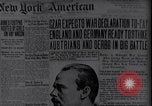
Headlines of prominent newspapers show rising tensions in Europe, assassination of Archduke and Russia's entry in World War I
Headlines of prominent newspapers show rising tensions prior to World War 1. Headline of New York American 'Czar expects war declaration today, England and Germany ready to strike, Austrians and Serbs in big battle'. Montage of headlines from various newspapers regarding looming war. Berliner Tageblatt New York Times headlines say 'Austria and Serbia ready for war, Russia gives warning to Germany, London still sees hope for peace'. New York Times and Freier Press headlines about the assassination of Archduke Ferdinand of Austria. Serbian police dragging the assassin. Blood stained tunic of Archduke. Burial ceremony of Archduke Ferdinand with coffin covered with Austrian flag. Czar Nicholas II of Russia reviews troops. Various Cossack regiments being reviewed. Russian Revolution scenes and mass demonstrations and riot in streets of Moscow as Bolsheviks seize power in 1917. Russian civilians and Bolshevik loyal soldiers armed with rifles marching in mass funeral processions and demonstrations in Russia against the Czar led government. Leon Trotsky speaking to a crowd and saluting Red forces as Bolshevik troops parade. Food distribution to Russian children and people eating on snow covered streets of Moscow around time of revolution. Headlines showing Russian entry in World War I. Snow covered Kremlin. Vladimir Lenin at a desk talking. More views of newspaper headlines regarding outbreak of World War 1.
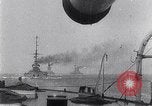
Italian and French navy forces combat Austrian forces, U boats, and fight in Dardanelles Gallipoli Campaign during World War 1
A fleet of warships seen off the coast of Austria-Hungary during World War I. Italian Navy flag waves on an Italian naval ship. Destroyer warships conceal troop ships behind smoke screens to prevent attack by German submarines. Italian sailors release depth charges targeting German submarines along the Austria-Hungary coast (or Austro-Hungarian coast). Underwater explosion boils to surface. Italian navy sailors aboard warships fire on coastal cities and villages of Austrian empire. View of many large naval guns in action, and bombing and destruction of Austro-Hungarian coastal buildings. Close up view of a French naval warship during rendezvous with British warships heading for the Dardanelles (also called Hellespont) for the Gallipoli Campaign or Dardanelles Campaign. Torpedo boat destroyers with the fleet sight a German submarine and begin firing deck guns and dropping depth charges. View of K Gun depth charge projectors shooting depth charge from French destroyer into ocean at a target U boat. British and French forces shelling Turkish defenses in the Dardanelles along the Gallipoli peninsula . Close-up views of French crews preparing guns, loading shells into naval guns, firing, and quickly reloading to repeat while the British forces are attempting to land troops for battle.