


 Francais
 Deutsch
 Italiano
Refine Your Search
Vienna Austria 1923 stock footage and images
- Showing 415 to 420 of 702 results more
more Hide
Hide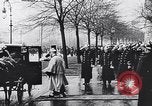
Emperor Franz Joseph among troops; mobilization of French and German forces; World War 1 refugees
Events early in World War I. Emperor Franz Joseph I of Austria gets out of the car and walks with military escorts in front of troop formation. French troops happily enter protected fortified area. Woven wooden supports for trench. French Colonial soldier smiles as he poses in trench with rifle. German Kaiser Wilhelm II leads procession in front of honor guard. Ladies are in attendance. German parade led by goose stepping military band. Russian cavalry and the mass of autos. German lancers. Sign posted in France, announcing general mobilization of Army and Navy. French street scene with notices being passed out among the population. French Legionnaires march in crowded street. British palace guards parade in London followed by British Horse Guards. Belgian refugees walking along a roadside and cattle pulling wagons loaded with refugee belongings.
Ski flying championship at Vikersund Norway
Ski flying championship at Vikersund Norway. Austria's Rheinhold Bachler sets a new world ski flying record on his first try. The ski jumper soars 505 feet. Other ski jumpers also seen.
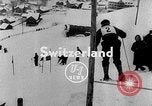
Top skiers compete for the Lauberhorn trophy in Switzerland
Top skiers compete for the Lauberhorn trophy, a top European meet. Participants from France, Germany, Austria and Switzerland compete in the skiing competition. A slalom race and a downhill event ends with the Austrians taking the trophy.
Bombed Berghof residence; German leaders surrender to Allies; stolen art collection retrieved after German defeat.
Ruins of Hitler's Berghof residence in Berchtesgaden after bombing by Allied forces near the end of World War 2 in Europe. Goering's stolen collection of paintings and art pieces taken from all over Europe. The stolen collection was hidden in air raid shelters and loaded on battle trains. View of U.S. soldiers retrieving the stolen works of art. Book 'Mein Kampf' written by Adolf Hitler in Landsberg prison. Portrait of Adolf Hitler with a Nazi symbol. German military officials including General Herman Gred Von Runstedt, Field Marshal Albert Kesselring, and Hermann Goering surrender to the American Army. Views of Hermann Göring after having been flown from Austria to U.S. Army headquarters in Augsburg, Germany on May 9, 1945, where he is seen handing over his handgun. Göring talking to U.S. 7th Army officials.
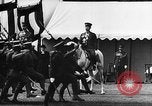
Actions of Axis and Allied powers on brink of World War II in period 1937-1939.
Japanese troops parade for Emperor Hirohito, mounted upon a white horse. Italian troops goosestep and German troops goosestep on parade. View of an Austrian town with snow-covered Alps mountains in background as German troops enter Austria on March 13, 1938 during the Anschluss. Local citizens welcome them, displaying swastika flags and giving Nazi straight arm salutes. Troops, military vehicles, tanks, motorcycles, and horse-drawn artillery comprise the German invading force. Shifts to Spain, where war torn buildings reflect effects of German and Italian intervention during the Spanish Civil War. A donkey standing near field artillery piece. Artillery being fired from an urban park in Spain. Artilleryman using a range finder. German gun crew with heavy artillery piece. Soldiers wearing Adrian steel helmets, firing a two-wheeled water-cooled machine gun. Spanish carrying wounded on stretcher. Spanish civilians inadvertently slain during civil war conflict. Starving dog walking in street. Huge poster of Francisco Franco and view of him on reviewing stand saluting marching Nationalist troops. Repeat of Hirohito reviewing troops and Italian and German troops goosestep. Adolf Hitler and Benito Mussolini stand together in open car heading to Fuhrerbau in Munich, Germany, for signing of Agreement between Germany, Italy, Britain, and France in 1938. Neville Chamberlain, and Edouard Daladier riding in car to Fuhrerbau. Views of the principals signing the accords. First is Adolf Hitler, followed by Prime Minister Neville Chamberlain, Benito Mussolini, and Edouard Daladier. After the signing, the principals, plus Hermann Goering, mingle and converse. Change of scene to nighttime in Rome, Italy, where Benito Mussolini addresses a huge throng gathered near the Victor Emmanuel Memorial to cheer him after his return from Munich. Next, German troops are seen entering Sudetenland (Czechoslovakia) greeted by joyous ethnic German inhabitants. Banners are stretched across a street. One gives thanks to the Fuhrer. Several scenes of cheering population. A woman strews flowers in a roadway. Hitler arrives, standing in an open car, and is met with cheers of adulation. A military brass band plays from the open beds of two moving army trucks. Signpost points to Prag (Prague), Eger (Cheb), Joachimstal (Jáchymov), and Komotau (Chomutov) after German annexation. Scene shifts to Prague, where German troops are seen occupying the city. High ranking German officers in a car are seen coming through the gateway from the Court d´honneur of the Prague Castle into the Hradčany Square. The next sequence shows an Italian Freccia-Class destroyer in the Albanian Port of Durrës. An Italian L3/35 Tankette is driven off a large cargo ship. Italian troops on bicycles ride in a city street. A German 88mm antiaircraft (flak) gun is shown, mounted at a fort overlooking a river and city. Final scene shows Adolf Hitler addressing a meeting of the Bundestag in the Kroll Opera House (alternate meeting place after burning of the Reichstag). He reads, contemptuously from an April 14, 1939 letter sent to him by U.S. President Roosevelt, asking him to give "assurance that your armed forces will not attack or invade the territory or possessions of the following independent nations: Finland, Estonia, Latvia, Lithuania, Sweden, Norway, Denmark, The Netherlands, Belgium, Great Britain and Ireland, France, Portugal, Spain, Switzerland, Liechtenstein, Luxembourg, Poland, Hungary, Rumania, Yugoslavia, Russia, Bulgaria, Greece, Turkey, Iraq, the Arabias, Syria, Palestine, Egypt and Iran." As Hitler reads through the litany of nations, the Bundestag erupts in laughter.
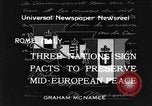
Benito Mussolini, Engelbert Dollfuss and Gyula Gömbös sign pact to preserve Mid-European peace, in Rome Italy.
Three nations sign pacts to preserve Mid-European peace, in Rome Italy. Italian Prime Minister Benito Mussolini, Chancellor Engelbert Dollfuss of Austria, and Premier Gyula Gömbös of Hungary sign Agreement to help maintain peace in Europe. The pact is also signed to stimulate trade and improve commercial relations between the signatories.