


 Francais
 Deutsch
 Italiano
Refine Your Search
Vienna Austria 1923 stock footage and images
- Showing 439 to 444 of 702 results more
more Hide
Hide
Players engage in traditional Bavarian Fingerhakeln finger wrestling championship in Germany.
Finger wrestling championship in Bavaria, Germany. Players pull the opponent over the table using finger. Competitors (wearing Lederhosen) from Bavaria and Austria engage in Fingerhakeln. Spectators cheer the players. Referee gives the judgment.
Ending phase of Soviet attack against Berlin, Germany during Battle of Berlin in World War II.
At beginning, the film shows views of the smoking ruins of Berlin from an overflying aircraft. Scene shifts to illustrations of confilict in 18th Century Berlin. A sculptured bust of young Frederick the Great of Austria. Flags of various States and historic horns displayed in a museum where all the exhibits are labeled in Russian. Flash forward to the final phases of the Soviet offensive against Berlin, Germany during World War 2. Soviet soldier picks up an artillery shell and hands it to member of a gun crew who loads it into the breech of a harge gun. Another Soviet gun being loaded. Soviet artillery pieces of all sizes and kinds are seen firing into Berlin, creating explosions and smoke and demolishing buildings. A civilian man and woman run along a street carrying their belongings in a baby carriage. Other German civilian refugees fleeing the battle zones. Three Soviet officers confer looking at a map. Soviet infantry running from house to house. A woman running along a rubble strewn street. Civilians taking shelter at corner of a building. A boy holding his ears against the sounds of the artillery fire, as he joins several civilians sheltering in a doorway. Three civilian women with their belongings walk along a street but stop and turn back when a building ahead of them is struck by shellfire and partly collapses into the street. A woman running away from the battle zone trips and falls down. Soviet troops using a flame thrower that sets a building on fire. Soviet infantry scampering through damaged buildings and rubble.
Lord of Admiralty Churchill speaks to Britain's stronger position during World War II, during a speech in London.
A speech by British Lord of the Admiralty Winston Churchill in London, England during World War 2. He states that Britain is in stronger position than it was at the start of the war. He says that fate of Holland, Belgium, Czechoslovakia, Poland and Austria will be decided by the victory of Britain and French Republic.
Two hundred thousand Hungarians flee Hungary during the Hungarian Revolution in 1956
Hungarian rebels in crowd during the Hungarian Revolution in 1956. Hungarian rebels with Hungarian soldiers in Budapest. Damaged buildings in Budapest. A devastated street car in Budapest after the Hungarian Revolution. Abandoned Soviet military vehicle, equipment and tank in Budapest. Hungarians curiously observe the tank. Hungarian freedom fighters, with rifles, patrol Budapest. Piles of blocks in road near apartment buildings in Budapest. Russian tanks roll in Budapest, returning to the Hungarian Revolution with more reinforcements. Soviet military vehicles pouring into Andrassy Avenue, Budapest. Hungarians cross a river and walk to the Austrian border. Hungarian refugee smokes a cigarette. A Hungarian couple kiss and laugh together. Two hundred thousand Hungarian refugees trekking towards the temporary refugee shelters in Austria. Austrian border control. Hungarian refugees flee with their luggage and bicycles, hoping to make it to countries that could accept them such as England, France, Scandinavia, Switzerland and the United States.
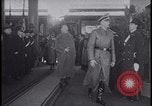
Adolf Hitler arrives in Brenner railway station to meet Benito Mussolini for a brief Germany-Italy dialogue (WW2)
Italian Prime Minister and Il Duce Benito Mussolini welcomes German Chancellor and Führer Adolf Hitler upon his arrival in the Brenner railway station (39041 Brenner, South Tyrol, Italy), the border station of Italy and Austria. Adolf Hitler gives the Nazi salute while Benito Mussolini extends the Roman Salute to honor guards while it snows outside the Brenner station. Italian Foreign Minister Count Galeazzo Ciano and Nazi German Foreign Minister Joachim von Ribbentrop follow behind their leaders. Hitler shakes hands with Mussolini and Count Ciano, greet each other with the Nazi and Roman salutes, before boarding train back to Germany. Joachim von Ribbentrop greets the Nazi salute to Mussolini before the latter shake hands with him. Hitler speaks to Mussolini while leaning on train window before departure. Hitler’s train departs from Brenner station. Mussolini gives a final Roman salute to Hitler as his train departs for Germany. Mussolini, Count Ciano and other Italian fascist officials leave the platform. “Brennero” (Italian for Brenner) station sign in heavy snow. Italian fascist officials salute to Mussolini’s snowy train departing Brenner station after Hitler's visit to Italy during World War II.
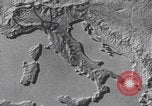
The growth of fascism in Germany and Italy up to World War II
The growth of Nationalism in Prussia and the Kingdom of Italy as shown in Italian WWII propaganda film. An animated map depicting the division of Italian city states on the Italian peninsula during the early Modern Era. The animated map also shows the unification of Italy (also known as Risorgimento) by 1870. Another animated map depicts Prussia. Portraits of Royal House of Savoy, Prussian kings and prominent figures of Italian and German national movements such as Frederick II the Great (Friedrich II.), the Count of Cavour (Camillo Benso). Prussian-Italian alliance written in Italian. Portrait of Giuseppe Mazzini, Italian politician and activist. Scroll written with “1861”. Portrait of Otto von Bismarck. Animated map of Italy after the Risorgimento, the foundation of the Prussian Empire, and the annexation of Austria and Czechia. A drawing depicts the Treaty of Versailles. Chains surround Italy and Central Europe in a map. Benito Mussolini performs the Roman Salute from his balcony at the Palazzo Venezia (Piazza di S. Marco, 49, 00186 Roma RM, Italy) in Rome, Italy. Fascist supporters hold signs reading “DUCE”. Adolf Hitler gives a Nazi Salute to crowds during an outdoor rally in Germany. Nazi flags decorate the stage and venue. A weighing scale with coins and two swords. The scale tipping down. Close-up view of Mussolini, with googles on his head, working in what appears to be a farm field around straw bales. Adolf Hitler raising his hand in a Nazi Salute. Crowds perform a Nazi Salute. Large columns of Italian soldiers marching in formation, followed by a scene of German soldiers marching in formation with rifles over their shoulders.