


 Francais
 Deutsch
 Italiano
Refine Your Search
Vietnam Bien Hoa Air Base 1965 stock footage and images
- Showing 6493 to 6498 of 13233 results more
more Hide
Hide
Participants taking off in hot air balloon race from Catalina Island to California mainland
Five Hot air balloons preparing for a race from Catalina Island, to the mainland, California. Views of gas tanks and flames that create the hot air for the balloons. Participant, Barbara R. Keith,a 42 year old grandmother, from Hartford, Connecticut, seen wearing an inflatable life jacket and donning her helmet. She boards her balloon and tucks her goodluck mascot (a stuffed toy dog) into the gondola. she is seen rising in her balloon. Brief view of the ground and sightseers from a balloon about 50 feet in the air. Famed balloonist, Donald Louis Piccard, is seen igniting his heater and leaving the ground aboard his balloon. (Note: This was an ill fated venture. Only one balloonist successfully reached the mainland, California. The rest had to be rescued from the water. Mrs. Keith lost her life and her body was recovered days later.)
The U.S. Air Force tests rocket-assisted takeoff on a C-47 transport aircraft
A United States Air Force C-47 aircraft (tail number 43-48765) is seen parked on a grass airfield, with its rear door open and entry ladder down. Camera zooms in on so-called jet-assisted takeoff (JATO) cylinders fastened underneath the aircraft. Closeup of the aircraft landing gear and tires. Closer view of the JATO cylinders, that appear to be twin 12AS-250 Junior JATO cylinders made by Aerojet Corporation.. Two Air Force officers approach and board the aircraft, which is being guarded by an armed Staff Sergeant. Camera pans across to the aircraft as the crew starts number 2 engine, as a fire guard with extinguisher stands by. A collection of military and other persons stands by vehicles in the background. The fire guard walks to number 1 engine which the crew starts. With both engines running smoothly, the pilot waves to the fire guard from his open cockpit window. Next, the aircraft is seen taxiing on the otherwise empty airfield. It turns near a large tree and commences a takeoff roll. The Jato bottles fire and the aircraft is launched into the air after a very short ground run, with smoke spurting from the JATO rocket cylinders. Another view of the Jato takeoff is seen as well.
French President Charles De Gaulle inaugurates the twenty fifth air show and observes several unique aircrafts, in France.
French President Charles De Gaulle inaugurates the twenty fifth air show in France. A number of helicopters and planes in the ground. President De Gaulle and other dignitaries arrive at the air show. A helicopter demonstrates lifting of a truck. A super sonic fighter plane stands still in mid air. A one-man rocket made by United States, lifts a man high in sky and returns back.
Peruvian men assist in loading a D6B Cat machine in a C-130A cargo plane of U.S. Air Force during Andes Airlift at Chiloya, Peru.
C-130A cargo airplanes of the United States Air Force transport road construction equipment during Andes Airlift, from Chiloya to Bella Vista village, in Peru. A Peruvian man instructs a U.S. Air Force captain how to operate a D6B Cat machine. Peruvian labor shore lumber in C-130A and place them crosswise in aircraft. The air force captain backs the D6B Cat machine to rear of aircraft and then Peruvian man backs it inside the cargo aircraft.
C-130A cargo airplanes of U.S. Air Force fueled and transport equipment during Andes Airlift, from Chiloya, in Peru.
C-130A cargo airplanes of the United States Air Force transport road construction equipment during Andes Airlift, from Chiloya to Bella Vista village, in Peru. A C-130A cargo airplane lands on airstrip. A Peruvian Air Force Hawker Mk-4 takes off. Plane taxis behind the construction equipment. Another C-130A fueled near the runway. The Chiloya air traffic control tower. A dump truck backs inside aircraft cargo compartment.
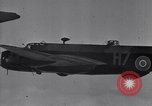
British Royal Air Force aircraft conduct 700-airplane bombing raid over Cologne during World War II
Narrator states that on March 2, 1945, during World War 2, 700 Lancaster and Halifax bombers of the British Royal Air Force fly over Cologne, Germany, to bomb roads and bridges leading across the Rhine River. Closeup aerial view of a British Halifax bomber with H7 painted on its fuselage, identifying it as belonging to No.346 Squadron RAF. (This is a Free French bomber squadron incorporated into the Royal Air Force and operating out of RAF Station Elvington.) View from one of the aircraft looking down on the city below as bombs fall from the plane. Narrator refers to U.S. 1st Army attacking Cologne and this bombing to strike German forces fleeing the city. Heavy smoke seen rising from bomb explosions below. A huge black cloud is seen in the air as a German scarecrow bomb hits a Lancaster bomber and destroys it (Narrator calls it a scarecrow bomb. Later analysis concluded that "scarecrow" bombs may have been attacks by Luftwaffe aircraft equipped with upward facing cannons, or so called "Schräge Musik" attacks.) Smoke rising from the city. Narrator emphasizes that the Cologne Cathedral is not touched.
CRITICALPAST.COM: About Us | Contact Us | FAQs - How to Order | License Agreement | My Account | My Lightboxes | Shopping Cart | Advanced Search | Featured Collections | Website Terms & Conditions | Privacy Policy ©2026 CriticalPast LLC.
License Agreement |
Terms & Conditions |
Privacy Policy
©2026 CriticalPast LLC.