


 Francais
 Deutsch
 Italiano
Refine Your Search
Vietnam Bien Hoa Air Base 1965 stock footage and images
- Showing 6565 to 6570 of 13233 results more
more Hide
Hide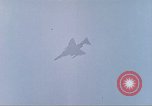
The demonstration of coordination between army and air forces in attacking ground targets at Fort Bragg in North Carolina.
The activities and joint demonstrations by the United States Readiness Command (USREDCOM), Brass Key II at Fort Bragg in North Carolina. McDonnell Douglas F-4 Phantom II aircraft in flight over the target area. McDonnell Douglas F-4 Phantom II drops cluster bombs. Cluster bomb pods split in the air. Aerial view of attack on the ground targets. Heavy smoke arises from explosions. Tactical fighters hovering protective lay overhead. Air mobile assault begins. Armed helicopters escort the troop carrier formation into the landing zone. Airplanes in flight. Helicopters land. Troops come out of the helicopters. An airplane in flight. The airplane tows an artillery. A CH-54 Sky Crane in flight from a distance. CH-47 Chinooks bring artillery and other equipment. Handle boxes and howitzers suspend from a flying CH-47 Chinook helicopter. The CH-47 Chinook places the handle box and howitzer on the ground. Airplanes drop bombs on the target area. Heavy smoke arises from explosion. Helicopters fly in formation. General Dynamics F-111 Aardvark combat aircraft dropping bombs in flight. Soldiers move forward on the land. People watch the demonstration of army-air force coordination. Airplanes in flight. Paratroopers descend towards the land with the help of parachutes.
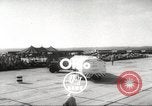
People watch a competition for testing the skills of air force vehicle drivers in Ohio.
A competition for testing the driving skills of air force vehicle drivers in Ohio. Air force vehicles being driven on a racetrack. People watch the competition. 'Air Power is Peace Power' written on the vehicles. Men write information on a paper about the driving skills. Trophies which are to be awarded to the winners are placed on a table.
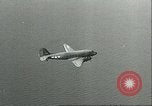
Airplanes, a helicopter and an airship of USCG air-sea rescue agency working for rescue operations in Washington.
A United States Coast Guard ( USCG ) air-sea rescue agency in Washington, United States during World War II. An airplane in flight over a sea. A sign board reads: 'United States Coast Guard Air-Sea rescue operations'. Officials discuss amongst themselves in an office. A sign reads: 'United States Coast Guard'. An airplane parked on the ground. 'Air Sea Rescue' written on the airplane. An airplane in flight over the sea. A boat hitched with a parachute is dropped from the airplane. Men aboard a boat underway at the sea. Men work on a ship docked in a harbor. An airplane in flight overhead. A pilot in the cockpit of the airplane. A helicopter in flight. A man ascends towards a helicopter with the help of a sling. He boards the helicopter which is in flight. An airship in flight. 'US Navy' written on the airship. A man in the gondola of the airship. A ship underway at sea.
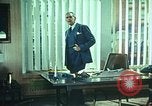
Description of North American Air Defense system components and operation
Actor Raymond Massey talks about the nation's need for defense against possible air attack. He walks to a large wall map depicting North America and discusses joint efforts of Canada and the United States to establish an effective air defense system for North America. On the map, lines of radar stations are shown: The DEW line;Mid Canada line; and the Pine Tree line. Other radar installations are highlighted along East and West coasts on land, on towers in the ocean, on picket ships and on picket aircraft. Sites of the SAGE (Semi-Automatic Ground Environment) network of radars, computer systems, and aircraft command and control equipment are depicted on the U.S. part of the map. The headquarters of NORAD (North American Air Defense Command) at Colorado Springs, Colorado is highlighted. Massey points to models of intercepter missiles and long range bombers, on his desk, and discusses their employment. He then speaks of an intricate communications system to tie everything together. This is depicted on the animated map. Views of men laying telephone cable. Underground view of telephone cables. View of telephone microwave tower. Telephone poles and lines along a rural road. A mother and child telephoning the father long distance. Office workers using telephones. Teletype machines and television communications. A ship laying telephone cable at sea.Map depicts lines of communication provided by undersea cables. views of emergency supplies and equipment available in times of disaster. Downed power lines being repaired. Men at a large emergency diesel generator. Underground communication cables being installed by team of tracked vehicles. Remote lines of communication away from possible targets are depicted.
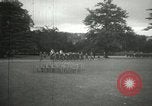
8th Air Force airmen assemble at Wycombe Abbey for a War Bond rally and Glenn Miller concert , during World War II.
Victory Squadron War Bond Rally at 8th Air Force Headquarters (Codenamed PINETREE) at Wycombe Abbey, High Wycombe, England, on July 29th 1944, during World War 2. U.S. Army military band plays the National Emblem March, as they march across a parade field lawn. They stop behind a parked flat bed tractor trailer on which Major Glenn Miller and his Army Air Forces band is seated. While the military band plays, U.S. 8th Air Force airmen march onto the field and take up positions in a large formation at its center. Spectators are gathered around the lawn, outside the airmens' formation, and military policemen are posted inside the circle of spectators.
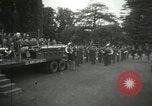
Lieutenant General Doolittle kicks off 8th Air Force War Bond Drive in England during World War II
Kickoff of U.S. 8th Air Force War Bond Drive at Wycombe Abbey, High Wycombe in England on July 29th 1944. Lieutenant General James Doolittle and several staff officers walk to a bandstand set up on a flatbed tractor trailer, where Major Glenn Miller and his Army Air Forces Band is seated. All come to attention as the General and staff ascend the platform. General Doolittle speaks about the good progress of the war and the need for supporting it with war bonds. He steps to a sales booth where he purchases a war bond from a Women's Army Corps (WAC) Corporal, in uniform .She asks him to sign their book of subscribers, which he does.General Doolittle then "sells" a bond to a Sergeant. Doolittle and his staff depart as the military band plays the Army Air Corps anthem.
CRITICALPAST.COM: About Us | Contact Us | FAQs - How to Order | License Agreement | My Account | My Lightboxes | Shopping Cart | Advanced Search | Featured Collections | Website Terms & Conditions | Privacy Policy ©2026 CriticalPast LLC.
License Agreement |
Terms & Conditions |
Privacy Policy
©2026 CriticalPast LLC.