


 Francais
 Deutsch
 Italiano
Refine Your Search
Vietnam Bien Hoa Air Base 1965 stock footage and images
- Showing 6949 to 6954 of 13233 results more
more Hide
Hide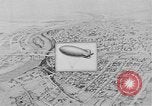
Description of Soviet Air defenses and Civil Defense actions in World War II
Soviet Air defenses in World War 2. Thumbnail of a barrage balloon superimposed on an animated illustration of a Soviet city. Various aircraft sensing devices plotted on the illustration. Animated view of German Heinkel He 111 bomber in flight. Illustrated Soviet industrial or military buildings with defense positions highlighted. View of Soviet citizens inside an air raid shelter. Women looking for food supplies. Men dressing in fire fighting uniforms. Animation of antiaircraft guns firing at a German airplane illuminated by searchlights.Citizens in shelters reacting to exploding bombs. They rush outside to render aid to injured and search for survivors. Ambulances respond. Workers begin cleanup.
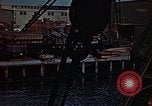
SS Hannibal Victory carrying locomotives underway in the Pacific and men aboard the ship fire guns in the air.
A film depicts how victory ship, SS Hannibal Victory, hull number 579, delivered a cargo of 8 railroad locomotives, tenders, flatcars, rails etc. from San Francisco to the U.S. Army in the Philippines. SS Hannibal Victory leaves the dock. The ship underway in the San Francisco Bay. An U.S. officer and men aboard the ship. A ship underway in the background. A view of the city from the bay. The locomotives aboard the ship. The Golden Gate bridge ahead. Navy hospital ship USS Relief (AH-1) underway. A P-2 undereway, a large new type passenger ship, converted to carry troops when war broke out. The Golden Gate Bridge in the background. A man in the foreground. Two army corporals aboard the ship. A radio operator, with the army security office aboard the ship. A view of the Golden Gate Bridge from mast of the ship. The signal flags flutter in air. The pilots on the flying bridge with the skipper. A talker checks his telephones. Two men seated by the engine. A pilot boat approaches the ship to pick up the pilot. The pilot from SS Hannibal Victory boards the boat. An engineer opens the main throttle. The turbines turning smoothly. The ship underway in the Pacific. View of the Pacific Ocean. The steel cargo on the deck. The men aboard the ship fire guns in air. The men stand around the gun. The shells of the gun. A man loads the shells. They fire the gun.
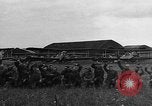
Fliers and support personnel at the First Air Depot, in France, pose and cheer in front of DH-4 airplanes at airfield in World War I
U.S. Fliers of the 96th Aero Squadron, pose with support personnel and some French counterparts, at the First Air Depot in Colombey-les-Belles, France during World War 1. Camera pans across the group posing in front of a line of parked De Havilland DH-4 bombers. They wave and throw their hats into the air.
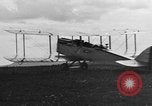
American Air Service men run to an inverted Salmson 2A2 aircraft on a field in Colombey-les-Belles, France in World War I
U.S. 96th Aero Squadron at First Air Depot in Colombey-les-Belles, France during World War I. A De Havilland DH-4 bomber taxis on the airfield. A DH-4 seen in flight overhead, maneuvering to land. Next, it is seen parked on the grassy field. The pilot and gunner are both standing in their respective cockpits, facing each other and conversing, while the engine still runs intermittently as it shuts down. Scene shifts to Air Service personnel heading across the grass toward a completely inverted Salmson 2A2 reconnaissance airplane in the distance. Closeup of an American Sergeant, under the inverted airplane, examining the gunner's cockpit and area around it. The airframe seems to be relatively undamaged. It appears as it the aircraft nosed-over on landing. Another view shows a large group of curious American airmen standing around the aircraft. French roundels can be seen painted on the bottom of its lower wing. A motorcycle stands in the foreground.
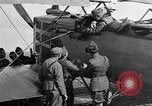
American Air Service officers examine a Vickers machine gun mounted on a Brequet 14 airplane in France, during World War I
U.S. Air Service officers observe test firing of Vickers machine gun on a Brequet 14 airplane, at the First Air Depot in France, during World War 1. Colonel T. D. Milling, Commanding Officer, First Brigade, First Army Corps; Captain G. C. Thomas Jr.,96th Aero Squadron; First Lieutenant V. F. Ludden, 96th Aero Squadron, and Pilot, 1st Lieutenant C. G. Sellers (in the cockpit) examining a Vickers machine gun mounted on the side of a Breguet 14 airplane, named "Photo." Lieutenant Sellers fires the machine gun from the cockpit. View of the machine gun firing with expended cartridges being ejected. (The gun is designed to synchronize and fire through the turning propeller when the engine is running. But that is not demonstrated here.)
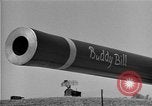
United States advanced air defense systems in the Cold War
The barrel of a 120mm M1 anti-aircraft gun is seen with a white ring and the name "Buddy Bill" painted on it. Another shown is named "Bashful-Baby." A soldier is in the process of painting a name on his gun barrel. View of the M51 Skysweeper anti-aircraft gun. Closeup of the radar dish atop the gun. View of the numerous controls of the gun. A Skysweeper gun set up in a desert setting, test site. An officer approaches the gun crew and gives an order. A gun crew member lowers the gun barrel, while two others retrieve shells for it. Hand of operator seen adjusting settings on gun controls. An aircraft (drone) is seen in flight overhead. The gun begins to automatically track it. A gunner presses a firing switch and the gun begins to fire shells. Black flak clouds form as shells explode in the air. several rounds are fired, the drone is struck and fall, burning, from the sky. Change of scene shows a Nike surface to air missile in a launch position. A soldier stands near a sign at a test site, reading "Launch Area." Soldiers slide a Nike missile across a set of rails, hook it up to a launch stand, turn on various control switches, and quickly leave the area. Aerial view of several Nike missiles laid horizontal on similar rails. Closeup on the ground of a Nike missile being raised to an uptight firing position. A rotating radar antenna. An Army technician at a battery of controls in a Nike operation center. Soldiers at a plotting table in th operation center. One wears a headset and announces countdown to firing. A visiting Allied military officer observes the activities. A clock on the wall records the countdown. A field grade Army officer with a headset stands near the soldier during the countdown. A hand actuates the firing switch and the Nike missile is seen launching. Men track it with elaborate camera equipment. The Army controller then announces time to intercept, as a dial in the control room shows the countdown progressing. . View of a B-17 target drone aircraft in flight at high altitude. As intercept is announced, the Nike strikes the B-17 which explodes and falls. Views of Nike test launch. View of the B-17 drone leaving contrails as it flies at high altitude, and then exploding and burning after being struck by the Nike missile. Pieces of the aircraft fall off as it burns, including two of its engines. Army Master Sergeant Stuart Queen, host of the "Big Picture" television program, wraps up the presentation.
CRITICALPAST.COM: About Us | Contact Us | FAQs - How to Order | License Agreement | My Account | My Lightboxes | Shopping Cart | Advanced Search | Featured Collections | Website Terms & Conditions | Privacy Policy ©2026 CriticalPast LLC.
License Agreement |
Terms & Conditions |
Privacy Policy
©2026 CriticalPast LLC.