


 Francais
 Deutsch
 Italiano
Refine Your Search
Vietnam Bien Hoa Air Base 1965 stock footage and images
- Showing 6991 to 6996 of 13233 results more
more Hide
Hide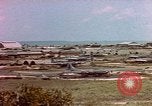
U.S. Army Air Force B-29 Superfortress bomber airplanes parked at airfield Isley Field, Saipan, during World War II
U.S. Army Air Force (USAAF) aircraft at Isley Field, Saipan, Mariana Islands, during World War 2. U.S. Army Air Force B-29 Superfortress bomber aircraft parked on aprons at airfield in Guam. Tail Code "A" of the 497th Bomb Group (73rd Bomb Wing) can be seen on one of the B-29s. A formation of USAAF P-51 Mustang fighter aircraft, in flight. U.S. airmen pull through propeller on number 4 engine of a B-29 to assure against hydraulic lock before starting the engine. B-29 parked next to this one displays "Square M" tail code of the 19th Bomb Group (314th Bomb Wing) stationed on Guam.
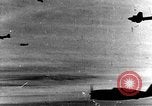
USAAF B-17 Flying Fortress aircraft of the 8th Air Force, in flight over Europe during World War II.
Aerial view from one of the aircraft in a Large formation of U.S. Army Air Forces 8th Air Force B-17 bombers in flight over Europe, during World War 2. Brief view of P-47 thunderbolt fighter escort plane, as it flies past the camera. The B-17s display "Square A" tail codes of 4th Bomb Wing, 94th Bomb Group(H) and "Triangle C" tail codes of 1st Bomb Wing, 303rd Bomb Group(H). The sequence tracks the formation over farmland and cumulous clouds.
Air Force officer looks at wreckage of an aircraft which crashed while landing near Alvarado California, United States.
Transocean Airlines Flight 942, a Douglas C-54G-10-DO Skymaster (registration N88942) carrying United States Air Force personnel, crashes in Alvarado California, United States. The crash killed 30 Air Force personnel and 5 civilians. Parts of the wrecked aircraft on a field. Badly damaged aircraft. The aircraft crashed just before landing. A man looks at the wreckage.
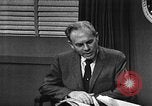
During an interview in the US, Lt. Gen. Ira Eaker talks about problems of expansion of the air corps prior to World War II.
A interview of United States Air Force Lieutenant General Ira Eaker conducted by Dr. Maurer in the United States. General Eaker talks about the development of the air corps. He says that if they had not undertaken bombing in World War II, millions of people would have died. They were also able to raze ammunition factories in Germany. The strategic bombing which they undertaken helped to win the war. He talks about the development of fighter aircraft, the difficulties faced in making funds available for aviation research and development.
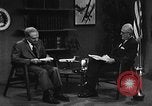
During an interview in the US, Lt. Gen. Eaker talks about becoming the Commander of the the Eighth Air Force in England.
An interview of United States Air Force Lieutenant General Ira Eaker conducted by Dr. Maurer in the United States. General Eaker talks about the time when he became the Commander of the the Eighth Air Force in England. He stressed on daylight precision bombing. Their targets were enemy ammunition factories. He was ordered home to make a presentation in front of the Combined Chiefs of Staff in the Pentagon. They were successful in many strategies. They damaged German airplanes. German supplies and lines of communication were also ruined.
Various USAAF personnel present as General Anderson opens the Cleveland Air Show in Cleveland, Ohio.
A United States Army Air Force air show in Cleveland, Ohio. USAAF Generals standing outside a building. 'Administration' written on the top of the building entrance. USAAF General Carl Andrew Spaatz and a civilian standing on the steps of the building. A group of officers and civilians headed by General Spaatz come out of the building. General Hoyt Sanford Vandenberg accompanies General Spaatz down a walk towards a staff car. General staff getting into the staff car. Other officers walking down the steps from the building. General Curtis Emerson LeMay walks down the steps towards the staff car. A convoy of staff cars drives away. The cars go down a road headed by a motorcycle escort. General Spaatz walks up onto a ramp erected near the nose of a USAAF F-80 Shooting Star. An F-80 Shooting Star on display in the building. A speaker's stand erected near the airplane. The speaker introduces General Nathan Farragut Twining who rises and bows followed by General LeMay. Other notables including General Ira Eaker, Major General Elwood Quesada, Major General Benjamin Wiley Chidlaw, General Thomas S. Power, Major General Carbee Craigie, Spaatz and General Anderson. General Anderson standing on the speaker's stand opens the ceremony. A singer performs.
CRITICALPAST.COM: About Us | Contact Us | FAQs - How to Order | License Agreement | My Account | My Lightboxes | Shopping Cart | Advanced Search | Featured Collections | Website Terms & Conditions | Privacy Policy ©2026 CriticalPast LLC.
License Agreement |
Terms & Conditions |
Privacy Policy
©2026 CriticalPast LLC.