


 Francais
 Deutsch
 Italiano
Refine Your Search
Vietnam Bien Hoa Air Base 1965 stock footage and images
- Showing 8833 to 8838 of 13233 results more
more Hide
Hide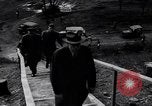
U.S. Army leaders and officials observe demonstration of weaponry at "Little Tokyo" range of Huntsville Arsenal
U.S. Army and elected officials at the Huntsville Arsenal climb up a long flights of steps from a road. Sign at base of stairs says "Little Tokyo". Officials include three star lieutenant generals and two star generals. They stand on a higher observation platform and observe weaponry demonstrations and explosions on the "Little Tokyo" range. Sudden explosion seen on the ground followed by fire and smoke. Smoke clouds rising high in the sky. Flame throwers inundate a building on the proving grounds. Several other officers and officials sitting among a crowd of men viewing the scenes from bleachers. Several army tanks seen moving through smoke on the range. (World War II period).
Views of Soviet missiles and a missile launch
Two Soviet missiles readying for launch as their platforms raise from a horizontal to an angled position. View of a different missile from the base of its silo. A Soviet Army technician at a control panel preparing for a missile launch. Views of a missile emerging from its silo, with smoke and fire emitting from the sides of the silo as the missile rockets upward.
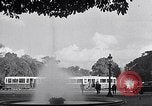
The Eiffel Tower and families visiting parks in Paris, France.
A park in Paris, France. Motorcars, people and a tram near the fountain. People seated near a monument in Paris. The Eiffel Tower. The base structure of the Eiffel tower. Little children sail toy boats in a pond near the Tower. A family watches a swan near a lake. Children in a pony carriage. The Bois de Boulogne. Two women ride side-saddle on horses. People walk their dogs, a lady pushes a pram, or traditional baby carriage.
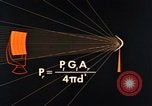
Formula expressing relation between transmitted and received power and factors affecting Space Communications.
Space Communications and the related problems and developments. Animation: Final formula expressing the relation between power transmitted and power received. Comparison of the distance between Earth and the moon, and Earth and Pluto. Factors effecting Space Communication. Payload factor: Effect of payload weight of a communication equipment, transport of equipment, need for small and light equipment. Limitations in miniaturization of components: Inaccessibility in term of maintenance and service. Depicts longevity of power based on available power sources. Advantages and drawbacks of chemical batteries, solar batteries, nuclear batteries. States methods for reducing power consumption: equipping vehicles with command transponders. Factors effecting Sapce Communication: Spatial environment and equipment used. Example of information required to study the planet Venus: atmospheric composition, surface temperature changes and exact period of rotation. Explains spatial movement and solution for this factor: Placing four equally spaced terrestrial stations around the globe, joint by reliable communication links for continuity and data reception.

Japanese sailors and pilots prepare for, and execute the attack on Pearl Harbor in World War 2.
After a speech by an admiral, Japanese newspapermen are given the news of the declaration of war against the United States on 8 December 1941. A Japanese fleet underway in the Pacific. Sailors on the deck of a carrier. A captain looks through binoculars. Sailors prepare the dive bombers on the ship deck. Japanese pilots during a final briefing. A Japanese sailor erases a board, while another stands before a writing on the ship. Bombers on the carrier deck. Japanese Sailors watch as pilots board their planes and take off. The bombers in flight with bombs attached onto the belly. Japanese bombers drop bombs on U.S. ships in Pearl Harbor. U.S. Pearl Harbor Base under attack.
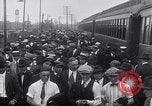
New U.S. Navy recruits arrive at the Great Lakes Naval Training Center in Chicago, Illinois
New recruits for the U.S. Navy line up on a train platform after arriving in Chicago. Sailors in uniform organize the recruits into groups. The next scene shows the recruits, carrying personal belongings, being escorted through the gates of the Great lakes Naval Training Center. Several U.S. Navy officers step from an official staff car and are seen posing in front of a flag pole at the Navy Station. The senior officer is Captain William A. Moffett, USN, Commandant of the center, flanked by a Lieutenant Commander and a Lieutenant, and two other officers in the background. Captain Moffett is later seen observing the new recruits as they are escorted on the base. Next, the recruits are seen carrying white towels as they march to a building where they will be issued personal clothing and uniforms. Later they are seen marching in their new summer uniforms, carrying their original civilian luggage. Under the watchful eyes of the officers, the new sailors use their new mess kits to get food from a chow line. Captain Moffett watches and converses with other officers (not seen). The recruits are next seen, in winter blues, exiting a building carrying their bedding, and presumably headed toward their billets. (World War I; World War 1; WWI; WW1)
CRITICALPAST.COM: About Us | Contact Us | FAQs - How to Order | License Agreement | My Account | My Lightboxes | Shopping Cart | Advanced Search | Featured Collections | Website Terms & Conditions | Privacy Policy ©2026 CriticalPast LLC.
License Agreement |
Terms & Conditions |
Privacy Policy
©2026 CriticalPast LLC.