


 Francais
 Deutsch
 Italiano
Refine Your Search
Vietnam Bien Hoa Air Base 1965 stock footage and images
- Showing 9727 to 9732 of 13233 results more
more Hide
Hide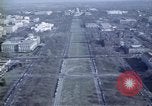
King Saud arrives in the President's personal plane (The "Columbine") and President Eisenhower greets him in Washington DC.
A view of the mall and capitol building in Washington, DC as viewed from the top of the Washington Monument. The personal plane of U.S. President (a Lockheed Constellation, Air Force designation: C-121, named "The Columbine") lands at an Washington National Airport. King Saud of Saudi Arabia and members of the Royal party disembark the plane. Insignia of the United States. Air Force honor guard. President Dwight D. Eisenhower greets him. King Saud's son Prince Mansur is carried down the ramp and is greeted by President Eisenhower. U.S. Secretary of State, John Foster Dulles, salutes His Majesty. President Eisenhower speaks into a microphone and welcomes King Saud. The King addresses the gathering.
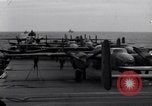
B-25 Mitchell on a deck, Lt Col. Doolittle and Captain Marc A. Mitscher talk during the Tokyo raid in Japan.
B-25 Mitchell bombers raid on Tokyo, Japan. U.S. Army Air Forces B-25 Mitchell on the deck of USS Hornet (CV-8). A bomb comes up on a small elevator. USAAF Lieutenant Colonel James Harold Doolittle and U.S. Navy Captain Marc A. Mitscher stand near the bomb and talk. U.S. Army Air Forces men seated around the bomb. A view of Captain Marc A. Mitscher. Lt. Col. Doolittle wires a Japanese medal on the bomb for its return to the originators. (World War II period).
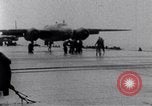
B-25 Mitchell bombers taxi and take off from the deck of USS Hornet for the Tokyo raid on Japan known as the Doolittle Raid.
U.S. Army Air Forces Mitchell B-25 crews prepare for the raid on Tokyo, Japan, under the command of Lt. Colonel James "Jimmy" Doolittle. B-25 Mitchell on the deck of USS Hornet in the Pacific Ocean. USAAF men stand around a plane. B-25 Mitchell taxi and take off from the deck. Insignia of the United States Army Air Forces. A crewman gives a signal. A view of an empty deck. A B-25 taxis on the deck of the USS Hornet (CV-8).

Montage of Wright brothers and their airplanes in France and at Ft. Myer, Arlington, Virginia.
As a contrast to the early pioneering airplanes, passengers are seen seated inside cabin of a "modern" airplane (Douglas DC-4E). View of the DC-4E in flight. A view of Orville Wright. Wilbur Wright gesturing as he talks with officials in France about an aerial course to be flown. Wilbur Wright placing wheels under a Wright Flyer before it is moved across a muddy field in France. A team of men pull a rope raising a catapult weight in a tower. The weight falls, catapulting the Wright Flyer airplane into the air. Soldiers remove a Wright Flyer airplane from a storage building onto the parade grounds at Ft. Myer, Virginia. The airplane is seen in flight with Orville Wright alone, at the controls, On July 30, 1909, soldiers are seen moving a Wright Flyer from its shed for its final acceptance test. President William Howard Taft, U.S. Army Major George Owen Squier, U.S. Army Major Charles E. Saltzman and Wilbur Wright are among those standing with the President, as the Wright Flyer is moved toward the parade ground. Views of the monorail and weight and catapult used for launching an airplane. Men turn the two propellers on a Wright Flyer, as Wilbur Wright stands at the rear of the aircraft engine and makes an adjustment. . On September 9, 1908. U.S. Army Lt. Frank P. Lanham, seen in uniform, seated on a Wright Flyer, is joined by Orville Wright. Wilbur. They take off and set a new airborne endurance record, and Lt. Lanham becomes the first Military officer to fly in an airplane. On July 30th, as part of the final acceptance test, Orville Wright takes Army Lt. Benjamin D. Foulois on a cross country flight to Alexandria, Virginia, and back again. They are seen aboard the Wright Flyer, and then high in the air on their way to Alexandria.
The first successful flight in 1927 by Lt. Albert F. Hegenberger and Lt. Lester J. Maitland from Oakland to Honolulu.
The longest over water flight to date, accomplished by the U.S. Army Air Service in 1927. Chief of Army Air Service, Major General Patrick, standing between Pilot, Lt. Lester J. Maitland, and Navigator, Lt. Albert F. Hegenberger in front of their Fokker C-2-3 trimotor airplane, named the Bird of Paradise. General Patrick is wishing them farewell as they are about to depart on their transoceanic flight from Oakland California to Honolulu, Hawaii. Animation of aircraft leaving Oakland Airport. Fokker C-2-3 in flight. Animation of the longest over water flight ever attempted, 2400 miles, Oakland to Honolulu.
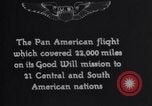
President Coolidge present pilots with citations after the successful goodwill mission.
Brief scenes from the U.S. Army Air Service Pan American good will flight that covered 22,000 miles on a goodwill mission to 21 Central and South American nations, during 1926-1927. A view of the hangar area and flight line of Kelly Air Field in Texas, as one of the five Loening OA-1 Amphibious aircraft, on the mission, takes off from the runway on Dec. 21, 1926. Five of the aircraft in formation over a large city. U.S.President Calvin Coolidge presents the aircrews with citations for the Distinguished Flying Cross, at Bolling Field, Washington, D.C., on May 2, 1927.
CRITICALPAST.COM: About Us | Contact Us | FAQs - How to Order | License Agreement | My Account | My Lightboxes | Shopping Cart | Advanced Search | Featured Collections | Website Terms & Conditions | Privacy Policy ©2026 CriticalPast LLC.
License Agreement |
Terms & Conditions |
Privacy Policy
©2026 CriticalPast LLC.