


 Francais
 Deutsch
 Italiano
Refine Your Search
Vietnam Bien Hoa Air Base 1965 stock footage and images
- Showing 9757 to 9762 of 13233 results more
more Hide
Hide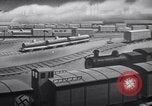
Allied bombing missions to destroy railroads and marshaling yards in occupied France and Germany during World War II
Cartoon representation of German rail yards and war factories, opens the film. Cities of : Anklam; Bremen; and Frankfurt are highlighted as critical factory and railroad junctions. Animated map shows Allied air strikes against French marshaling yards in Spring of 1944 in preparation for the invasion at Normandy. In February, 1945 Allied officers use large wall map to discuss and plan the destruction of all railroad operations in the Ruhr and surrounding areas. View of U.S. bombers in formation (with fighter cover overhead) on bombing missions in Operation Clarion, against all small and medium rail junctions in Germany. View from Allied bomber of Bombs falling and exploding at a rail junction. More aerial views of bombs exploding in numerous places during this operation. An American B-17 Flying Fortress bomber dropping bombs on a railroad marshaling yard. Aerial view of bombs exploding on targets in Essen. Views of wide destruction wrought at German railroad facilities. A US Army Air Forces P-51 fighter plane descending to strafe a target. Gun camera views of aircraft strafing lines of communication in Germany, including road and barge traffic. Closeup of runs firing from P-51 aircraft. Railroad trains being strafed and dramatic explosions at target rail sites.
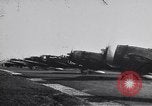
United States B-17,P-47 and German ME-110 in aerial action in Berlin, Germany during Second World War
United States P-47 aircrafts lined up just before take off in Berlin, Germany during Second World War. P-47s take off and escorts B-17 bombers. Aerial dogfight warfare takes place between German and American fighters. German ME-110getting hit, goes into a dive and explodes in mid air. Another ME-110 attacks B-17 but explodes in mid-air. P-47 taxis, pilots count German markers on side of the plane. Flight crew members pose for a photograph in front of B-17.

United States B-17 bombers attack strategic marshalling yards and supporting railway installations in Dresden, Germany
United states 8th Airforce B-17 aircrafts drop bombs to destroy marshaling yards and supporting railway installations in Dresden, Germany. Bombs from American bombers impact causing smoke to rise up from the target area. U.S. Army Air Force B-17 bomber is hit by German anti aircraft flak. The American B-17 bomber begins a nose dive, and explodes in the air. (World War II period).

United States bomber planes bombard marshalling yards and railway installations in Luneburg, Germany
United States Air Force bombers of the 8th Air Force drop bombs to destroy marshalling yards and supporting railway installations in Luneburg,Germany. Bombs away view and bombs impact and smoke rises from targets in Luneburg, as seen from gun camera. (World War II period).

YR-4 Whirlaway helicopter pilot checks a crashed B-25 in Burma during World War II
U.S.Air Force pilot examines a crashed B-25 bomber in Burma, during World War 2. American pilot steps from Whirlaway helicopter, carrying a paint can and brush. He walks through deep grass, to a crashed B-25J Mitchell bomber, serial 43-3951 "Cornhusker" of the 83rd Bomb Squadron, 12th Bombardment Group. He climbs onto the B-25 and paints a large cross on one wing (visible from the air) to indicate that the crash has been reported and checked. He climbs into the cockpit, from the top, and removes instruments.

Allied aircraft bomb the City of Dresden in Germany on February 13, 1945 (British) and again on February 15 (American)
Aerial views of British Royal Air Force Lancaster bomber aircraft heading toward Dresden. View of the Lancaster bombers as they drop bombs over German targets in Dresden during night of February 13-14, 1945, during World War 2. Bombs impact and view of explosions and smoke. Two views of German scarecrow bombs exploding, designed to look like the explosion of an Allied bomber aircraft in order to intimidate the enemy. Next scene is two days later, with aerial views of United States Army Air Force B-17 bombers in flight toward Dresden. They attack the city again on February 15-16, 1945, focusing on railroad marshaling yards. Narrator notes that the population of Dresden before the war was 625,000 people, and that the combined bombing by the American and British forces is estimated to have destroyed virtually the entire city.
CRITICALPAST.COM: About Us | Contact Us | FAQs - How to Order | License Agreement | My Account | My Lightboxes | Shopping Cart | Advanced Search | Featured Collections | Website Terms & Conditions | Privacy Policy ©2026 CriticalPast LLC.
License Agreement |
Terms & Conditions |
Privacy Policy
©2026 CriticalPast LLC.