


 Francais
 Deutsch
 Italiano
Refine Your Search
Vietnam Bien Hoa Air Base 1965 stock footage and images
- Showing 9865 to 9870 of 13233 results more
more Hide
Hide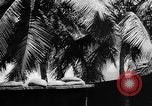
Protective measures taken by Americans in Hawaii, after the Japanese attack on Pearl Harbor.
Aftermath of Pearl Harbor attack. People in Oahu, Hawaii, prepare to deal with more air attacks by Japanese. Armed U.S. soldier in sandbagged position, in Hawaii. The territorial governor of Hawaii, Joseph Poindexter, signing a declaration of Martial Law. Four thousand members of Oahu's Civil Defense Committee, dressed in dark bottoms and white tops, wearing steel helmets with "W" on them, standing at attention in formation on grounds of a stadium. Windows in all downtown shops taped to prevent flying glass. Sand bags surrounding a power substation. Huge quantities of barbed wire in a storage yard and strung along the beaches, along highways, around schools, and public buildings of Oahu. A man pushing a lawn mower between sandbagged defense positions in a residential neighborhood. Construction machinery digging defensive trenches. Bomb shelters being constructed of precast concrete. Air raid sirens installed and school children leaving their building and sheltering in deep trenches during a test. Very small children taking shelter in zig-zag trenches and donning gas masks. Huge assemblies of children, and of grownups, all donning gas masks. Little children being dressed in capsule-like "bunny mask" protective gear.One of them crying inside the covering. Crowds of women and children lined up on a veranda waiting to receive these "bunny masks." Military personnel, civilians, and school children, all carrying personal gas masks with them at all times. Innumerable old rubber tires saved in an open yard. Japanese-Americans donating blood to the American Red Cross and lined up to buy war bonds. Soldiers arresting a Japanese resident known to be an enemy agent. Boarded up shops of Japanese-Americans, who had been interned. Japanese-Americans removing all Japanese language signs from their areas. Language school buildings with closed signs. An empty and boarded-up Shinto temple. One Japanese-American replacing his cafe sign with one reading: "Keep 'Em Flying Cafe." U.S. Army troops posted on roadways. The Aloha Tower in camouflage paint. A Lurline steamship leaving port, and being replaced by warships. Prewar view of people enjoying Waikakee beach, and current view of two boys playing in sand near barbed wire barriers. City streets deserted at twilight, as blackout procedures take effect at dusk. Views of darkened homes and palm trees silhouetted against sky at dusk. The "ghost" of a sailor killed in World War II, stands in front of Arlington cemetery, Washington, DC, and converses with the ghost of a soldier killed in World War I. They discuss idealistic notions about ending wars for good. Displays of flags is seen, including: Australia; Belgium; Brazil; Canada; China; Costa Rica; Cuba; Czechoslovakia; Dominican Republic; England; Ethopia; Greece; Guatemala; Haiti; Honduras; India; Yugoslavia; Luxembourg; Mexico; The Netherlands; New Zealand; Nicaragua; Norway; Panama; The Philippines; Poland; Russia; El Salvador; South Africa; and the U.S.A. "V" created in the sky by a skywriting airplane.
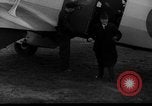
Dignitaries visit a British aircraft shadow factory in Britain.
Royal Air force aircraft shadow factory at work during World War 2. A dignitary gets off a plane. He along with other important persons inspects finished Royal Air Force aircraft lined up. Dignitaries visit the aircraft factory. They get some information about the manufacturing process as they speak to the workers. Men work at machines in the factory. A fighter aircraft pulled out of a hangar. Dignitaries watch the aircraft in flight.
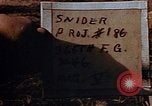
U.S. Army personnel work on airfield in Germany using corrugated hardstand, as P-47 aircraft taxi by and use the airfield
Allied air fields in Germany during World War II. Men construct an Allied air field in Germany during World War II. United States P-47 aircraft taxi along the runway for take off in the background. Men hammer down corrugated hardstand. Army trucks with crane attachments on front in the background to carry supplies as men work on hardstands. P-47 aircraft lined up at the end of runway. Planes taxi along before take off.
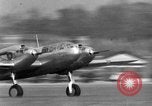
World War II aircraft: Bell YFM-1 Airacuda, Boeing B-17 Flying Fortress, and Consolidated B-24 Liberator
United States Army Air Corps aircraft. A Bell YFM-1 Airacuda taking off and seen in-flight. Close views of this unusual design with twin pusher-propellers behind greenhouse-nosed nacelles with cannons. American aircraft takes off from an airfield. Aerial views of a Boeing B-17 Flying Fortress in flight. Close view of the cockpit area, and then side view of the entire aircraft in flight. A British Royal Air Force Consolidated B-24 Liberator takes off from an airfield and its landing gear is seen retracting horizontally beneath the wings.
German Capitol ship, Ostfriesland bombed by American Bombers, off the coast of Virginia, USA.
U.S. bomber aircraft sinks German Capitol ship, Ostfriesland under the command of General Billy Mitchell. 1000 pound bombs strike near the battleship, Ostfriesland. Direct hits on the ship. American Destroyer USS Shawmut gives signal to cease bombing. USS Shawmut underway in sea. Heavy smoke rises from funnel. U.S. Navy C-2 blimp or airship dirigible flies over the Ostfriesland and the Shawmut. U.S. Navy C-2 blimp in the air. Boarding party climbs aboard the "Ostfriesland". Scenes taken from navy blimp as it flies slowly over the bombed battleship. General Mitchell, pilot, and Captain Saint C1air Street come down to note the effect of the bombs. General Mitchell's plane and the SE-5 fly low across the Ostfriesland. Bomb strikes on and near the battleship.
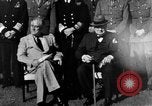
Winston Churchill and Franklin D Roosevelt at the Casablanca Conference in Casablanca, French Morocco.
Events related to the Casablanca Conference. U.S. President Franklin D Roosevelt and British Prime Minister Winston Churchill seated on lawn wearing civilian clothes. Several officers including U.S. Army Air Force Chief, General Henry H (Hap) Arnold, U. S. Admiral Ernest J King, U.S. Army General George C Marshall, British Admiral Sir Andrew B Cunningham, British Field Marshal Sir Alan Francis Brooke, British Lord Louis Mountbatten, British Air Chief Marshal Sir Charles Portal and Harry Hopkins, advisor to President Roosevelt, in the background.
CRITICALPAST.COM: About Us | Contact Us | FAQs - How to Order | License Agreement | My Account | My Lightboxes | Shopping Cart | Advanced Search | Featured Collections | Website Terms & Conditions | Privacy Policy ©2026 CriticalPast LLC.
License Agreement |
Terms & Conditions |
Privacy Policy
©2026 CriticalPast LLC.