


 Francais
 Deutsch
 Italiano

Refine Your Search
Vietnam Bien Hoa Air Base 1965 stock footage and images
- Showing 13063 to 13068 of 13268 results more
 Hide
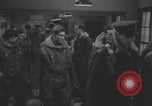
RAF crew of Vickers Wellington OJ-F start engines during WWII.
Period dramatization: British Royal Air Force (RAF) bomber pilots, part of No. 149 Squadron RAF suit up after a briefing on a mission during World War 2 at RAF Mildenhall. A pilot finds his helmet under a seat after a meeting. View of a Vickers Wellington OJ-F 'F for Freddie'. Crew disembark from a military truck after their arrival at bomber. Crew climbs ladder into bomber. View inside Wellington bomber as crew prepares for mission. Radio operator seated and adjusts radio. Pilot puts on his helmet inside the cockpit. A nose gunner climbs through fuselage of Wellington bomber to the nose gun. View outside bomber as gunner prepares inside nose gun. Pilot yells, "start her up" as ground crew members hold bag against engine manifold during startup. Propeller of Vickers Wellington OJ-F begins to move. Other engine is similarly started. Vickers Wellington bomber running its engine before takeoff. Ground control equipment that appears to be ground controlled approach radar equipment (GCA) is towed into place on the airfield.
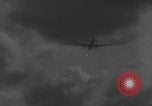
British Vickers Wellington bomber commander radios his crew members while in flight during WWII.
Period dramatization: Vickers Wellington bomber in flight over RAF Mildenhall air field during World War 2. Vickers Wellington OJ-F navigator removing maps from his pack. Pilot and copilot seen through bomber cockpit window at night. The commanding officer radios his crew. View of nose gunner at night as he replies, "I'm OK skipper." Another crew member puts on an oxygen mask and replies. Crew members each reply, including radio operator at his controls, who says, "well, it seems to all be here, sir." Commanding pilot communicates with the copilot inside cockpit, saying, "hello second pilot, ready to do some oil pumping?" The copilot replies, "that's all a second pilot's for!" “Freihausen, here we come” says the commander (Note: Freihausen is a fictitious location). Vickers Wellington OJ-F , part of No. 149 Squadron RAF, in flight at night.
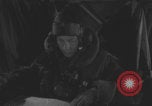
RAF Vickers Wellington bomber drop bombs over Germany at night (WW2) (dramatization)
Period dramatization: A Royal Air Force (RAF) navigator of Vickers Wellington bomber looks at his maps during World War II. Commanding pilot of Vickers Wellington bomber radios navigator, asking, "where are we now" as they approach Germany at night during WW2. Navigator replies, "I can't tell where we are." Crew member gives thumbs up signal after command. Plane descending in altitude. Low angle shot of bomber commander pilot at yoke steering as he radios to crew, "hello everybody, let me know if you see anything." Bomber spinning propeller while in flight at night. Crew member radios, "hello skip, search lights and flak at starboard quarter." Bomber commander replies, "the natives appear hostile." Bomber navigator using calipers on maps at night speaks into mask, "hello skipper, the target's about 50 miles up river." Bomber pilot replying, "OK." Vickers Wellington bomber banking turn at night. Bomber navigator climbing to viewing window with map and radios, "I can see the canal as plain as my face." Pilot radios back, "OK, I'll turn around and check up." Bomber pilot radios, "any signs of life?" German soldiers at night running to anti-aircraft artillery and yelling, "fire" as guns fire. Flares at night as bomber crew radio to each other. Vickers Wellington bomber nose gunner moves gun at night and strafes targets. German artillery fires more as the Vickers Wellington bomber dives towards target. Bomber pilot face lit by night flares. Crew hand actuating switches on control panel to open bomb bay doors. Crew member heard saying, "bomb bay doors open." Crew member looking through Vickers Wellington bomb sight at night. Close up, hand pressing button to release bombs on Vickers Wellington bomber. Dramatization special effects using miniature buildings of bombs dropping on railway and oil storage facility. Side view outside Vickers Wellington bomber at night as nose gun fires. Bomber crewman radios, saying "I got a bulls eye with the last one." Pilot radios back, "good man."
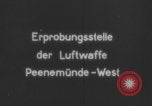
German V-1 rocket fails to launch during WW2
Title card says “Erprobungsstelle der Luftwaffe Peenemünde- West” (“Test site of the Peenemünde-West air force” in English). “Flakzielgerät 76 V99 Schnittaufnahmen 4.8. 1943 HK” (“Anti-aircraft target device 76 V99 cut recordings 4.8. 1943 HK” in English). A V-1 rocket, also known as a buzz bomb or doodlebug, on a launch ramp in Germany during World War 2. The Argus engine on the V-1 fires up, but the rocket fails to launch from the ramp.
Animation depicting parts of a WW2 V-1 rocket missile in German
Title card saying “Erprobungsstelle der Luftwaffe Karlshagen” (“Test site of the Air Force Karlshagen” in English). “Flakzielgerät 76 Trick 3.1. 1944” (“Anti-aircraft target device 76 trick 3.1.1944” in English). Animation demonstrating the parts- such as the engine (Triebwerk), tail unit (Leitwerk), wings (Tragflächen) and odometer (Wegmesser)- of a V-1 rocket, an early cruise missile developed in Germany during World War 2. Animation demonstrating cut away parts and the inside parts of a V-1 rocket in German.
Animation depicts steam generation used to launch V-1 via Walter catapult during WW2
Title card says “Erprobungsstelle der Luftwaffe Karlshagen” (“Test site of the Air Force Karlshagen” in English). “Flakzielgerät 76 Trick 5.1. 1944” (“Anti-aircraft target device 76 trick 5.1.1944” in English). Animation demonstrating how a V-1 rocket, an early cruise missile developed in Germany during World War 2, is launched from a launching catapult ramp. Sectional view of launch ramp, also known as a Walter catapult. Piston for the launch ramp is installed. V-1 rocket is attached to ramp. Cross sectional view of ramp shows hydrogen peroxide (T-Stoff) mixing with sodium permanganate (Z-Stoff) to produce the steam for launch. The steam pushes against the piston to propel V-1 up the ramp. Piston falls away after launch. V-1 animation shows configuration for launch from an airplane. V-1 attached to bottom of plane ready for launch.
CRITICALPAST.COM: About Us | Contact Us | FAQs - How to Order | License Agreement | My Account | My Lightboxes | Shopping Cart | Advanced Search | Featured Collections | Website Terms & Conditions | Privacy Policy ©2026 CriticalPast LLC.
License Agreement |
Terms & Conditions |
Privacy Policy
©2026 CriticalPast LLC.