


 Francais
 Deutsch
 Italiano
Refine Your Search
Vietnam Bien Hoa Air Base 1965 stock footage and images
- Showing 2875 to 2880 of 13233 results more
more Hide
Hide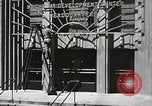
Technicians and project engineer at work in Headquarter of Wright Air Development Center and YB-52 Stratofortress aircraft in flight.
Headquarter of Wright Air Development Center (WADC) in Ohio, United States, at Wright-Patterson Air Force Base. A man on a ladder. Sign on door for WADC. An officer enters WADC. Technicians and project engineer at work in the office. Engineers seated on their office desk. Office scenes at WADC. YB-52 Stratofortress taxis and takes off. YB-52 aircraft in flight. Insignia of United States on it. YB-52 over mountainous area.
The test of F-86 Sabre with tufts installed on the wings at Wright Air Development center in Ohio, United States.
Test flight of F-86 Sabre at the Wright Air Development Center located at Wright-Patterson Air Force Base. A book entitled 'Research and Development Information Report'. A sign reads 'Danger, Only Authorized Personnel Permitted on Firing Range'. A technician test guns. Guns while being tested. A wing of F-86 Sabre with tufts installed on it. A technicians climbs up a ladder, sits in a cockpit and points to the cameras installed under canopy of aircraft. The cameras will take pictures during tufts test while aircraft is in flight. Project engineer and test pilot in cockpit of an aircraft. A pilot in the cockpit. A pilot wears helmet. F-86 taxis and takes off. F-86 aircraft going into dive at 45,000 feet. Wing of F-86E with tufts installed on it. A research engineer looks at the film taken of tuft test.
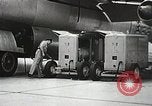
Various activities like Gun fire test, technician works on a fabricated machine at Wright Air Development Center.
Activities at Wright Air Development Center, located at Wright-Patterson Air Force Base in Ohio. Two burners under wing of B-47 Stratojet aircraft. Gun fire test on a container filled with hydraulic fluid. B-47 lands with drag parachute. Technician makes a part for aircraft C-97 Stratofreighter. A stenographer types notes. A woman takes out the printouts. Several view of various office workers. A project engineer works on a machine. A woman takes out the prints of graphs. Librarian checks out book for technician. A woman works on publications. Technicians seated at a desk and look at the project details. Various supplies kept in warehouse. A sign reads 'WADC Supply Shuttle Truck No 6'. A technician works on a fabricated machine. Instrumentation camera in operation. Theodolite camera track B-45 Tornado in flight. Technician checks the propeller. F-86 stationary. Divided frame in five sections shows F-86D Sabre, F-59 buzz camera, Matador missile launching,F-86D, Book entitled 'Nuclear Powered Aircraft' and Bell X-1 in center. Aerial view low-flying over facilites of the WADC in Ohio. A Wright Memorial. A title card reads "For us, This is Not the End."
U.S. Army Air forces pilots learn about the Republic P-47 Thunderbolt airplane
From a U.S. Army Air Force Training film, "How to Fly the P-47. Pilot Familiarization." United States pilot seated on table writes a postcard to his mother, "Mrs D.Q. Hopkins. 1024 Clay Avenue, Pelham, New York" Board in the background with 'Daily Assignment of today' written on it. Scene shifts to forward view from cockpit of a Republic P-47 aircraft flying low over the flight line at an Air Base. Momentary glimpse of the pilot and his post card in the office. Back again, to forward view from cockpit of a P-47, but this time it is on final approach to the runway. Scene shifts to ground view of a P-47 landing. It taxis to the ramp and parks. The crew chief stands on the wing as the pilot completes and signs the aircraft's Form 1 (record of any problems). Five pilots walk past the flight line. The pilot, wearing a seat pack parachute, climbs down from the cockpit. The five pilots, seen earlier, approach, and one introduces them to the P-47 pilot (Captain Hopkins). They are Lieutenants assigned to his training flight. He greets them and shakes hands with all. The group ask questions about the P-47. Then they all go to the pilots room. As Captain Hopkins takes off his flight gear he tells them the P-47 is designed to operate at high altitude. He describes the P-47, referencing a large illustration of it on the wall. (World War II; WW II; World War 2; World War Two)
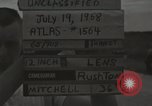
Atlas 3B Missile explodes mid flight after its launch from Cape Canaveral Air Force Station, Florida.
Atlas 3B Missile launch, test number 1564, from Patrick Air Force Base, Florida. Atlas Missile takes off from launch pad and advances upward. Missile explodes mid flight leaving black smoke in air. Missile part falls on ground. (Note: This was the first launch of an Atlas B missile and the first Atlas to have an operating sustainer engine and detachable booster section. The launch failed due to human error; ground crews accidentally left the gyroscope spin motors powered off so the missile went out of control as soon as the pitch and roll maneuver started. Range Safety sent the destruct command 56 seconds after launch. The flight was considered a partial success because all other missile systems functioned properly until destruction.)

U.S. Air Force band prepares for arrival of NASA astronaut Major Gordon Cooper
U.S. Air Force band prepares for arrival of NASA astronaut Major Gordon Cooper, soon after his successful Mercury flight in Faith 7. A view of the airport with planes standing. View of VC-137C taxi left at Andrews Air force base. People getting out of the plane.
CRITICALPAST.COM: About Us | Contact Us | FAQs - How to Order | License Agreement | My Account | My Lightboxes | Shopping Cart | Advanced Search | Featured Collections | Website Terms & Conditions | Privacy Policy ©2026 CriticalPast LLC.
License Agreement |
Terms & Conditions |
Privacy Policy
©2026 CriticalPast LLC.