


 Francais
 Deutsch
 Italiano
Refine Your Search
Vietnam Bien Hoa Air Base 1965 stock footage and images
- Showing 3229 to 3234 of 13233 results more
more Hide
Hide
Ground Procedures during pre-flight inspection of a U.S. Navy T2J-1 Buckeye trainer aircraft.
Ground Procedures during pre-flight inspection of a U.S. Navy T2J-1 Buckeye trainer aircraft. T2J-1 Buckeyes parked at an air base. A pilot and an airman approach a plane. Three airmen talk. An airman shows the pilot special check points on the aircraft. Port side of the aircraft. He inspects the canopy air bottle gauge, tank oil fuel filler, and hydraulic filler gauge. They move forward and inspect the static pressure vent and baggage compartment latches. They inspect the nose wheel assembly and nose intake duct under the nose. They move around the nose to check for any fuselage damage and the equipment door on the starboards side. They inspect the starboard wing surfaces and check the wheel brake hydraulic level gauge. Inspection of the wing tip tank, side gauge, wing aileron, flaps, and the main landing gear including tires and brake discs. They further inspect the fuselage, tail pipe, turbine section, tail surface. The men move to the portside for further inspection.
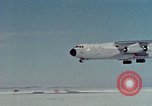
MAC C-141 aircraft transports shipments for the National Science Foundation as part of Operation Deep Freeze.
U.S. Air Force Military Airlift Command (MAC) aircraft lands in Antarctica for Operation Deep Freeze. A person enters a National Science Foundation Center. People disembark the plane. Unload the equipment. Numerous vehicles at the base. Plane takes off with the shipment to Point Mugu Naval Air Station in California. Scripps Institute of Oceanography conducts research for the National Science Foundation. Frank S Todd of the Hubbs Sea World Research Institute talks about the airlifting of penguins by C-141 used for behavioral studies.
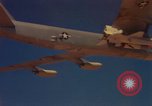
Rocket Powered Aircraft X-15A with NB-52B Stratofortress in flight.
Test flight of Rocket Powered Aircraft X-15A at Edwards Air Force Base in California. NB-52B Stratofortress in flight. NB-52B with X-15A. X-15 is attached on the right wing of NB-52B. An insignia of United States. A sign reads 'US Air Force'. Aircraft fly over clouds and mountains. Smoky trail left by NB-52B.
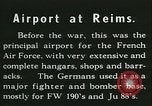
Wrecked aircraft and damaged hangars at the Reims airport after Allied bombings during World War II.
Results of air assaults by the British Royal and U.S. Eighth Air Forces over German-occupied France during Wolrd War II. The principal French airport at Reims, used by the Germans as a major fighter and bomber base mostly for FW 190s and Ju 88s. Wrecked aircraft on ground, in dispersal areas and under collapsing roofs of hangars and repair shops after the American aerial attack. Roads between installation filled with debris. Bomb smashed concrete runways and work areas lie in ruins. Allied soldiers and workers survey the rubble. Damaged hangars and equipment. Wrecked aircraft. Allied officers on a heap of debris. They inspect the damaged equipment and aircraft parts. Soldiers survey the damaged buildings.
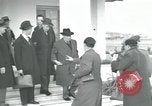
Meeting of John L. Lewis from the United Mine Workers of America, and other U.S. labor leaders
John L. Lewis, head of the United Mine Workers of America (UMWA) and other labor leaders arrive at a U.S. Air Base aboard a U.S. Air Force C-118 (4-engine transport aircraft) number 53-3229, which is assigned to the Chairman of the Joint Chief's of Staff. They are greeted by an Army Major General., After posing for photographs, they board automobiles and visit a glass factory where workers are seen blowing glass. John L Lewis talks with the workers. Among the cars seen is a 1951 Cadillac
U.S. Army forces reclaiming and salvaging damaged aircraft for reuse during World War 2.
Damaged aircraft landing during World War 2. A B-24 Liberator with non-functioning landing gear comes in for a landing and slides on a runway. A B-25 aircraft comes in for a landing and landing gear partially fails. Pilot controls plane as it skids to a stop. A B-25 bomber aircraft on runway during takeoff suddenly pitches forward and nose crashes into ground. Air Force technicians at Davis-Monthan Air Base near Tucson Arizona cannibalize and reuse serviceable parts of various aircraft They assemble airplane tails, gas tanks, oil radiators and oxygen tanks. Technicians reclaim other parts from the aircraft that can be reused.
CRITICALPAST.COM: About Us | Contact Us | FAQs - How to Order | License Agreement | My Account | My Lightboxes | Shopping Cart | Advanced Search | Featured Collections | Website Terms & Conditions | Privacy Policy ©2026 CriticalPast LLC.
License Agreement |
Terms & Conditions |
Privacy Policy
©2026 CriticalPast LLC.