


 Francais
 Deutsch
 Italiano
Refine Your Search
Vietnam Bien Hoa Air Base 1965 stock footage and images
- Showing 3397 to 3402 of 13233 results more
more Hide
Hide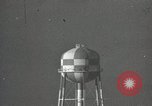
First powered flight of an X-15 Rocket Plane. Also scenes of several other X-15 powered flights.
X-15 first powered flight on Thursday, 17 September, 1959. (X-15 No. 2, tail number: 56-6671 with LR-11 engines. Scott Crossfield flew this mission at mach 2.11 and altitude 52,341 feet.) Scenes of several other X-15 powered flights are also shown. View of the water tower at Edwards Air Force Base, california. Overhead, NASA NB-52A, No. 003 and an F-100D chase plane, are seen at high altitude, with contrails behind them. The X-15, cradled under the B-52's right wing, drops clear, starts its rocket engines and begins its first independent powered flight, climbing rapidly away from the B-52. NASA camera tracks it, appearing as a moving white dot against the sky. The next sequences show later powered flights. View of NASA B-52 and three chase planes leaving contrails overhead. X-15 drops, its engines are running and falls behind the B-52, before accelerating rapidly, passing to its right, and continuing upward. Another scene shows brief glimpse of NASA B-52 overhead (no contrails). In final scene, X-15 is seen moving rapidly, leaving a long contrail behind it. Cloud then obscures the image somewhat.
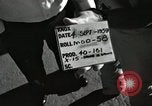
NASA B-52 taxis out for takeoff, carrying an X-15 rocket plane under its right wing
NASA NB-52A aircraft, tail number 52-003, parked at Edwards Air Force Base, with an X-15 rocket plane cradled under its right wing. Two men run across the ramp to the aircraft. One carries a ladder. The B-52 taxis out. View through windshield of a vehicle following the B-52 as it taxis.
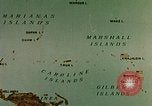
U.S. Naval Task Force 58, including USS Yorktown attacked by a Japanese Kawanishi H8K flying boat in the Pacific.
USS Yorktown CV-10 in the Pacific Theater during World War II. Early 1944: Animated map shows the Caroline Islands, Mariana Islands, Gilbert Islands and the Marshall Islands in the Pacific. The U.S. Naval fleet advances from Truk Islands towards an advanced naval base in the Marshall Islands, taken from the Japanese. U.S. ships underway around the fleet anchorage. U.S. Navy Aircraft Carriers, battleships, cruisers, fleet auxiliaries and support ships. Crew and aircraft on the flight deck of the 'Fighting Lady' CV-10. The crew members relax and enjoy themselves in the water. They dive and jump off a makeshift platforms and diving boards into the ocean, and then swim and play around large floating rafts. Sailors sort letters in the ship's post office. Some write letters back home. The crew assembled on the ship deck. Commander of the ship Rear Admiral Joseph James 'Jacko' Clark briefs the crew about their mission, designation to Task Force 58, and advance towards Tokyo. The USS Yorktown and other carriers of the Task Force underway. Sign boards for various Ready Rooms on the ship. Air Group Commanders and pilots ready on call. Rear seat gunners and radio men on call in another Ready Room nearby. They talk, relax, drink Coca-Cola and have ice cream. Flags on board. Commander of the TF 58 Admiral Marc Andrew 'Pete' Mitscher and Skipper Clark on the flight deck. A poster for the ship board movie 'Home in Indiana'. Sailors watch the movie. Planes in flight through clouds, the Task Force underway seeking the Imperial Japanese Naval fleet. New cruisers, Coast Guard cutters and Navy Transports in the Task Force. The patrol spots a Imperial Japanese Navy search plane, a Kawanishi H8K flying boat called 'Emily' by the Allies. The plane fires at the Task Force ships before being hit and sinking in the water. U.S. officers and sailors in a discussion. An animated map depicts the objective to move towards and free the Mariana Islands.
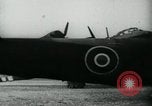
1st Allied Airborne Army troops land in Germany during Operation Varsity in World War II.
The successful airborne crossing of the Rhine river by the 1st Allied Airborne troops during World War II. Aircraft lined up at an airfield in England, United Kingdom. British 6th Airborne Division gliders, British Halifax bomber aircraft and British Sterling bomber aircraft, together with U.S. Army Air Forces C-47 and C-46 aircraft take off from an airfield in the UK. British aircraft taking off and British soldiers waving as they pass by on the airfield. British 6th Airborne Division troops in the field. Airborne troops who will be parachuting to targets are briefed by officers as they stand in a group. Soldiers synchronize their watches. Soldiers put on equipment as they prepare to take off. Airborne troops fully loaded with gear ascend stairs to board propeller aircraft. Narrator points out visible tape placed over sharp corners and protrusions on the aircraft to ensure that no parachutes or equipment are caught and damaged. Soldiers entering through doorways of C-46 aircraft. Personnel at the control tower order aircraft to take off. Aircraft and gliders take off. An aircraft taxis for take off but partially loses control, hits some wheeled carts to the side of the runway, and finally comes to a rest off the runway without severe crash damage. Aerial views of aircraft in flight. Narrator notes that the forces flying from the British airfields are merging south of Brussels with similar Allied forces taking off from bases in France. Troops aboard an airborne aircraft. Allied paratrooper soldiers jump from both doors of C-36 aircraft and their parachutes are seen descending. View of pilot in a towing aircraft as he pulls back lever to cut his towed glider loose. A glider coming to rest in a field on landing. An allied aircraft falling to the ground in flames after being hit by German antiaircraft flak fire. Another allied aircraft is seen exploding upon crashing (with farm barn buildings in foreground partially blocking the view.) Troops in prone position beside gliders after landing, as they secure areas and regroup. Allied British and American Army soldiers enter a village and take German prisoners. Lines of Allied soldiers and equipment advancing near the Rhine.
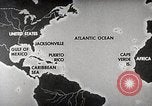
Early Warning Squadron Four take off to detect the occurrence of hurricane in the United States.
The role of Airborne Early Warning Squadron Four in the United States. Animated map depicts the regions susceptible to hurricanes including the Gulf of Mexico, Caribbean region. Hurricane Hunter aircraft in flight over an air base. Crew members gather near the aircraft. Crew members being briefed about the mission. Crew members in the cockpit of the aircraft. Weather team records meteorological data aboard an airborne aircraft. Radar team at work as they detect the chances of occurrence of a hurricane. A crew member prepares food aboard the aircraft. Crew members relax and read. A radar screen depicts the occurrence of a hurricane. Weather team checks the sighting. A barometer reading. Meteorological experts work on weather maps.
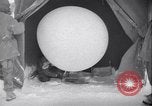
Man attaches radiosonde to weather balloon and releases it in Greenland.
Man fills balloon with calcium-hydride gas in weather balloon during U.S. Army coordinated test near Thule Air Base, Greenland. Another man operates Radar Antenna. Man walks out of igloo, attaches radiosonde to the balloon and releases it. The balloon moves upward. Man positions Radar Antenna.
CRITICALPAST.COM: About Us | Contact Us | FAQs - How to Order | License Agreement | My Account | My Lightboxes | Shopping Cart | Advanced Search | Featured Collections | Website Terms & Conditions | Privacy Policy ©2026 CriticalPast LLC.
License Agreement |
Terms & Conditions |
Privacy Policy
©2026 CriticalPast LLC.