


 Francais
 Deutsch
 Italiano
Refine Your Search
Vietnam Bien Hoa Air Base 1968 stock footage and images
- Showing 5995 to 6000 of 13286 results more
more Hide
Hide
German zeppelin Hindenburg lands at Lakehurst Naval Air Station, New Jersey and people flock to watch it.
German zeppelin Hindenburg lands at Lakehurst Naval Air Station, New Jersey on the morning of 9 May 1936, after the airship's maiden voyage across the North Atlantic Ocean. People gather to watch the zeppelin after a successful transatlantic flight in 60 hours. The zeppelin enters a waiting hangar as a huge crowd gathers to watch. A Nazi swastika on the airship. Dr. Hugo Eckener thanks American government for their cooperation and talks about the successful flight across the North Atlantic. (This is the only portion of the clip that includes audio). People look at the zeppelin in the hangar.
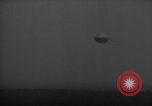
The German Zeppelin LZ 129 Hindenburg at Lakehurst Naval Air Station in New Jersey.
Hindenburg LZ 129 airship in flight near Lakehurst Naval Air Station, New Jersey, arriving on its first flight to the United States. The Hindenburg being moored at Lakehurst. Ground crew under the airship's huge tail fin. Nazi swastika emblem on tail fins. Distant view of the airship from different angles.
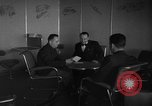
Captain Ernst Lehman is interviewed aboard zeppelin Hindenburg at Lakehurst Naval Air Station, New Jersey
Interiors of airship LZ 129 Hindenburg while moored at Lakehurst Naval Air Station. In the reading and writing room, the airship's Captain Ernst Lehman answers questions from an interviewer about their flight to Frankfurt, Germany and future flights planned for the Hindenburg. View of dining room with chairs and tables and open window. In a staged scene, two men look out the observation windows and talk of seeing America outside. A man walks up staircase from B-deck. A little girl is seated on a dining room chair at the observation windows. She smiles, gets up, and demonstrates that the chair is so light that she can pick it up with one hand.
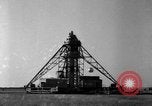
Zeppelin LZ 129 Hindenburg lands at Lakehurst Naval Air Station, New Jersey. Passengers disembark with difficulty
View of approaching zeppelin Hindenburg (LZ-129), as seen through framework of mooring mast at Lakehurst Naval Air Station in New Jersey. The Hindenburg approaching landing field drops securing lines to the ground, where ground crews seize them to stabilize the zeppelin. Wheel under control gondola of Hindenburg. Ground crewmen surround the control gondola to stabilize movement as the zeppelin settles. Passengers looking out of the observation windows of the airship. U.S. Navy team secures the Hindenburg to mooring mast. Officer speaks on megaphone from mooring tower. Propeller on side of Hindenburg. Ground crewmen secure tail of the Hindenburg to a tractor for maneuvering. Several passengers disembark, with difficulty,while the Hindenburg is still moving from side to side in gusts of wind.
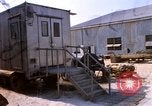
Ground crews load rockets on F-8E aircraft. Marine pilots man their aircraft. F-8E takes off. C-47 takes off.
F-8E Crusader of the U.S. Marine Corps Squadron, VMF (AW) 232 (Red Devils) at Da Nang Airbase, Vietnam, being armed with rockets. A ground crewman wearing noise suppressor headset, gives hand and arm signals. The wing of the F-8E is raised to maximum lift position. Ground crewman enters under the tilted wing of F-8 and checks it. Pilots leave ready room in trailer and proceed to their aircraft. An F-8C Crusader takes off. A C-117 USMC transport plane takes off. (Vietnam War period).
Two F-8E Crusader aircraft of U.S. Marine Fighter Squadron VMF (AW) 232 (Red Devils) prepare for takeoff on a mission
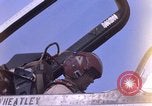
United States Marine Corps pilot of Squadron VMF (AW) 232 (Red Devils), wearing flight suit and a red helmet, sits in the cockpit of an F-8E Crusader aircraft in Da Nang Vietnam. The name "Wheatley" is stenciled below the cockpit. The pilot raises two fingers to indicate start engine. Ground crewman wearing noise suppressor headset acknowledges with two fingers.Ground crewman collects gear pins. Another ground crewman pulls chocks, hangs them on a rocket tube, and signals for the pilot to taxi. He pulls the chocks off the rocket tube as the aircraft taxis past, with its wings folded. The pilot, Major Cronkrite, unfolds wings and taxis to join the other F-8E, piloted by Wheatley, on the active runway. (Note: On June 20, 1967 Major Charles Ligon Cronkrite experienced mechanical problems during a mission and ejected over water. He did not survive.) (Vietnam War period).
CRITICALPAST.COM: About Us | Contact Us | FAQs - How to Order | License Agreement | My Account | My Lightboxes | Shopping Cart | Advanced Search | Featured Collections | Website Terms & Conditions | Privacy Policy ©2026 CriticalPast LLC.
License Agreement |
Terms & Conditions |
Privacy Policy
©2026 CriticalPast LLC.