


 Francais
 Deutsch
 Italiano
Refine Your Search
Vietnam Bien Hoa Air Base 1968 stock footage and images
- Showing 6193 to 6198 of 13286 results more
more Hide
Hide
Injured American soldiers board a Japanese ambulance for airlift. U.S. Army Air Forces transport planes operate from Japanese airfield.
Tachikawa Airfield in Japan after the end of World War II. Opening scene shows a U.S. Army Air Force flyer's A-3 equipment bag with logo of the 5th Air Force on it. A Japanese ambulance is seen, next, with Japanese attendants. Injured American soldiers are helped aboard the ambulance. One, with his arm heavily bandaged, waits to board. An Army Air Forces C-54 transport aircraft makes a long takeoff roll before climbing out from the airfield. Several views from an empty hangar of a C-54 taxiing past on the airfield ramp. In background C-54 aircraft are seen taxiing in various parts of the airfield. Some jeeps drive and a soldier walks past the hangar as a C-47 starts a takeoff roll in the background. View of hills and clouds.
Transcontinental Air Transport (TAT) carrying passengers from St. Louis to Waynoka, Oklahoma, on coast-to-coast trip from New York
Transcontinental Air Transport (TAT) company's coast-to-coast passengers proceed on their flight legs from Saint Louis, Missouri to Waynoka, Oklahoma. TAT employee closes door on Ford 5-AT-B tri-motor passenger airplane, at St. Louis airport. Ground crewman plugs in compressed air hose to assist start of engine number three. TAT logo seen on side of the airplane. Next, the airplane taxis and takes off on plowed runway of snow-covered field. Animated map shows airplane heading to Kansas City, Missouri. View of cockpit as co-pilot shows weather report to pilot. Shift to a TAT weather station where meteorologists launch a weather balloon to check winds aloft. Closeup of the pilot's weather report being prepared. TAT officer serving lunch food to passengers in the aircraft. View from airplane of Kansas City, and then aerial view as it descends to Wichita, Kansas. Pilots in cockpit. Copilot radios Wichita. View of TAT radio operator responding and saying they should lookout for Lindbergh who is flying the route today. Next, Colonel Charles A. Lindbergh is seen flying past the Ford Tri-motor in his Curtiss Falcon biplane. Passengers look out to see him. View from the passenger plane descending over the city of Wichita, Kansas. Animated map shows next stop as Waynoka, Oklahoma. View from the air of numerous oil derricks in Oklahoma. Passengers leaving the airplane and boarding a trailer-bus at Waynoka. Closeup of flowers and sign on restaurant table, reading, "TAT, Reserved for TAT travelers." Passengers dining.
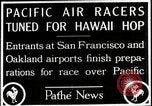
Scenes from the Dole Derby or Dole Air Race from California to Hawaii in August, 1927
Opening scene shows several aircraft and aircrews on an Airfield in Oakland, California, readying for the Dole Air Race to Hawaii. A modified Travel Air 5000 aircraft, NX869, named "Woolaroc," is seen in the near foreground. Behind it is another Travel Air 5000, named "Oklahoma." Next, the "Oklahoma" and the "Aloha"(NX914), a Breese-Wilde 5 Monoplane are seen with engines running and taxiing. The "Aloha" takes off and climbs sharply after gaining airspeed. Several Wickes-class destroyers are seen steaming underway. (Slate reports they patrol the course to be flown over the Pacific.) Scene shifts to wreckage of the "Angel of Los Angeles" a twin engine Bryant Monoplane, which crashed on a test flight at Montebello, California. (Pilot, Arthur V. Rogers, bailed out at the last minute but his parachute didn't fully open and he was killed.) Next is shown the wreckage of the "Pride of Los Angeles," an International CF-10 Triplane, after crashing into San Francisco Bay on August 11th. Pilots J. L. Giffin and Theodore S. Lundgren are seen stepping from the water, unhurt. A crane, on a barge, lifts the wreckage from the shallow water.
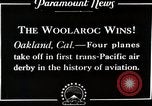
Scenes from the Dole Trans-Pacific Air Derby of 1927
Aerial view of airfield at Oakland, California. Pilot, Bennett Griffin, is seen with his wife and child, standing beside his Travel Air 5000 airplane,"Oklahoma." Registration number:"N-X 911" is stenciled on its tail. Pilot Martin Jensen, saying farewell to members of his family in front of his airplane,"Aloha" (that finished second in the race). Aircraft being readied for takeoff. Starter with checkered flag stands ready as nine men push the Travel Air 5000 "Oklahoma, the first to take off, forward into starting position, with engine running. Next scene shows starter holding stopwatch and flag. He signals start with the flag. Scene shifts to the second aircraft to take off, the Goddard Special metal monoplane, NX5074, "El Encanto." Camera tracks as the airplane has difficulty breaking ground, skipping several times in a long ground roll. Suddenly, it veers off the the right in a crab, wiping out its landing gear and breaking part of its right wing as it flips over in a crash leaving it tilted on its left wing facing backwards. Some smoke is seen but quickly disappears. Men and rescue personnel rush to the scene. (Reportedly the crew was unhurt.) Next, the prototype Lockheed Vega 1 monoplane, NX913, "Golden Eagle," is making smooth takeoff. Navigator Gordon Scott waves to spectators below as the plane climbs out. Aerial view of the plane in flight. The "Miss Doran," a Buhl CA-5 Air Sedan, number NC2915, is seen next on takeoff, past photographers and spectators, and then airborne. Next, the Breese-Wilde 5 Monoplane, NX914, "Aloha" is seen taking off. It climbs out very slowly. Navigator Paul Schluter waves as they depart. Pilot Arthur C. Goebel and navigator, Willian V. Davis Jr. are seen next by their plane "Woolaroc." A woman wishes them good luck, with a bouquet of flowers. Next, men are seen pushing the "Woolaroc" and it takes off and climbs. Pre-departure footage of Pilot Gordon Scott and navigator John W. Frost, with friends, near their airplane, "Golden Eagle." (Their aircraft vanished in the Pacific.) Pre-departure footage of pilot John Augie Pedlar, navigator Lieutenant Vilas R. Knopie, and their passenger, Mildred Doran, whose aircraft, "Miss Doran," was also lost in the Pacific.

The Air Force Academy Falcons beat Stanford University in a college football game in Palo Alto, California.
An American college football game between the Air Force Academy Falcons and Stanford in Palo Alto, California. The game underway. A large crowd cheers and applauds. The Air Force Academy cadets watch the game and cheer for their team. The Air Force Academy Falcons hold Stanford scoreless and win the game.
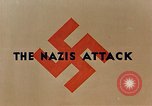
German air raid on Bone in Algeria, North Africa, during World War II.
Shows an air raid by German Messerschmitt bf 109 and Junkers 88 bombers on Bone in Algeria, North Africa, during World War 2. Allied forces counterattack and fire tracer bullets. Air raid sirens sound and people in streets flee for cover. Anti aircraft (AA) gun crew fires at German planes. British Supermarine Spitfire takes off from an Allied airfield in Bone. U.S. P-38s in the skies. RAF Spitfires and USAAF P-38s engage German Me-109 and Junkers 88. Burning wreckage of a downed Messerschmitt. Scenes of air battle at night. Several burning wreckages of downed Nazi planes. Parachute flares dropped from a German plane are hit by tracer bullets. Junkers 88 burns at night. Bombed buildings in Bone and people on the streets with their belongings. Local people signal ' V ' for their victory over the Germans. Wreckage of downed German planes such as Messerschmitts, Dornier DO-17s and Heinkel 111s scattered across a countryside field. Tail section of Messerschmitt with swastika symbol. (November 1942-December 1942)
CRITICALPAST.COM: About Us | Contact Us | FAQs - How to Order | License Agreement | My Account | My Lightboxes | Shopping Cart | Advanced Search | Featured Collections | Website Terms & Conditions | Privacy Policy ©2026 CriticalPast LLC.
License Agreement |
Terms & Conditions |
Privacy Policy
©2026 CriticalPast LLC.