


 Francais
 Deutsch
 Italiano
Refine Your Search
Vietnam Bien Hoa Air Base 1968 stock footage and images
- Showing 6811 to 6816 of 13286 results more
more Hide
Hide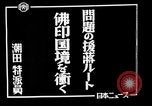
Japanese forces occupy Vichy French Indochina in the Second Sino Japanese War (WW2)
Japanese forces occupy part of Vichy French Indochina during 2nd Sino Japanese War and World War II. Animated map shows Leizhou (luichow) Peninsula and Hainan Island of China opposite the North Central coast of North Vietnam, centered at Haiphong harbor. Lines appear showing the path of Japanese troops occupying North Vietnam from Haiphong, in two sweeps to Northeast and Northwest and circling towards Hanoi. Mountainous terrain of the region is shown. Camera pans down a sheer cliffside in the mountains. Narrow roads are shown carved in the mountains and hills. A Japanese sentry stands at a sandbagged outpost, displaying the Japanese flag. A solitary building sits atop a hilltop in the background. A concrete marker indicates distance of 171 km to Hanoi. Several Japanese engineers make their way to the top of a mountain, accompanied by soldiers. An abandoned French heavy gun is seen in a concrete emplacement. View of Japanese soldiers looking out from the hilltop. A sign along a mountain road reading "Keep to the right," in French, English, and Japanese. Soldiers gather around a large tree fallen across the mountain road. They pose for the camera next to the tree. Japanese officers walking through an archway, from a large building in background. Closeup of barrel containing portland cement, followed by view of many such barrels being examined by Japanese engineer.
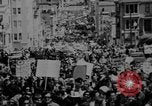
A large crowd of Pacifists marches on streets and proceeds to Kezar Stadium for a mass assembly in San Francisco, California.
A peace demonstration in San Francisco, California during the Vietnam War. A large crowd of pacifists, hippies, and anti-war activists march on streets holding banners. They proceed to Kezar Stadium for a mass assembly. Scuffle is shown between anti-war activists and some members of a group supporting the war in Vietnam.
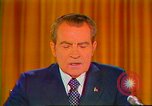
U.S. President Nixon speaks about inflation and federal budget during his address from the White House in Washington DC.
Television broadcast of U.S. President Richard Nixon's speech from the White House in Washington DC, United States on the withdrawal of the remaining U.S. troops from Vietnam on 29th March 1973 during the Vietnam War. President Nixon talks about prosperity in the United States without war abroad and without inflation at home. He says that inflation is a terrible cost of war with which the United States is battling at home presently. He speaks about cutting the rate of inflation by controlling meat prices. He says that the U.S. has increased imports from abroad and production at home which will increase meat supply and he has ordered Council of Cost to impose ceiling of prices so that the meat price does not increase any higher. President Nixon says he has submitted 268 billion dollars of federal budget to the Congress this year and if this budget increases as proposed by the Congress then that would mean an increase in taxes by 15% or an increase in the prices. He says he shall veto bills which will break the federal budget he has submitted.
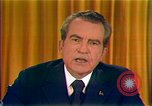
U.S. President Nixon speaks urging action from the Congress to fight inflation in the United States.
Speech by U.S. President Richard Nixon from the Oval Office of the White House in Washington DC, United States about inflation in the country. President Nixon speaks about battle against inflation. He states that the Congress can only hold down cost of living by holding down cost of the government. He says he would continue to veto spending bills which the country cannot afford. President Nixon urges the Congress to reduce tariffs and increase the supply of scarce goods. The President says the Congress should give him authority to move ahead with the Alaska Pipeline for oil to meet the shortage of oil and gas during energy crisis. He urges high production for farm industries. President Nixon speaks about peace in Vietnam and that all American prisoners have returned back. He talks about his summit meeting with General Secretary of the Communist Party of the Soviet Union Leonid Brezhnev which would take place a week later in Washington. President Nixon talks about achieving full prosperity without war and inflation. (Vietnam War period).
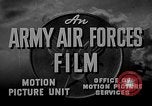
U.S. Post World War II film, called "Conquest by Air", promoting Air Power
Scenes of trench warfare in World War I, when airpower was limited. In contrast, postwar low level aerial views show total destruction in Germany cities from aircraft bombing, alone, during World War 2. A montage of various U.S. warplanes in flight on bombing run and bombs away views with bombs falling toward targets. Planes shown include P-38, B-17, and B-26. A formation of P-38s. A formation of B-26s. A B-26 in D-Day stripes. Bombs striking ground targets. B-17s in high altitude formations with contrails.
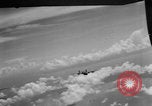
U.S. Army Air Force air strip bombings and aviation in the Pacific Theatre during World War II.
World War 2 aerial footage of multiple U.S. Consolidated B-24 Liberator bomber aircraft flying with another squadron of unidentified aircraft in the distance. Closeup Aerial shot of another American Consolidated B-24 Liberator. A short clip of a coastline off in the distance with a single airstrip visible perpendicular to the coast line. Distant but clear footage of a single Lockheed P-38 Lightning airplane. Footage of the airstrip with smoke from numerous bomb impacts. Distant footage of two Lockheed P-38 Lightning airplanes. Excellent closeup footage of an American Lockheed P-38 Lightning with the pilot visible in flight. The numbers 370 can be seen on its nose. Two P-38s flying close to one another. Distant shots of the smoking airstrip. View of multiple bombs being dropped, possibly on the airstrip. Airstrip littered with craters from it's many bombings. Bomb impacts are seen in the ocean beyond the airsrip. Smoke rising from the runway and an additional shot of the two P-38s. Shaky shots of an aircraft smoking from it's engine (most likely a B-24 Liberator). It is seen in a nose dive before crashing into the water below.
CRITICALPAST.COM: About Us | Contact Us | FAQs - How to Order | License Agreement | My Account | My Lightboxes | Shopping Cart | Advanced Search | Featured Collections | Website Terms & Conditions | Privacy Policy ©2026 CriticalPast LLC.
License Agreement |
Terms & Conditions |
Privacy Policy
©2026 CriticalPast LLC.