


 Francais
 Deutsch
 Italiano
Refine Your Search
Vietnam Bien Hoa Air Base 1968 stock footage and images
- Showing 7303 to 7308 of 13286 results more
more Hide
Hide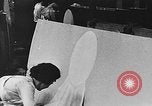
United States Air Force insignia being applied on wings at an aircraft factory in United States
Aircraft manufacture in United States during World War I. Women use transfer ink to apply United States Air Force insignia on the wings of an aircraft. A woman places a paper, applies ink on it and then removes it. Paper placed on the remaining portion to complete the insignia.
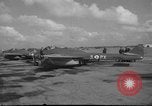
Norwegian air crews and their de Havilland Vampire jet aircraft pose for pictures at an Airfield in the Netherlands
Project Cirrus, in the Netherlands, 1951. Film is devoted to views of Norwegian air crews and their de Havilland Vampire jet aircraft, posing where they are encamped at an airfield in the Netherlands. Camera pans over parked aircraft an shows closeup of markings of Norwegian Squadron 336 on aircraft fuselage. A pilot poses, looking skyward, in opened cockpit of his plane. He wears a helmet with goggles raised atop it and his oxygen mask dangling below it. Closeup of Norwegian airman with "Norway" displayed on his left shoulder patch. He wears glasses and looks skyward. White clouds fill the sky in the background throughout the film. Two Norwegian fliers in flight suits pose looking away from the camera (in profiles). A vampire jet begins a takeoff roll as the film ends.
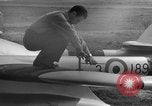
Refuelling Italian Air Force Vampire jet aircraft at Wiesbaden Airfield, Germany
Italian Air Force Vampire jet planes (de Havilland DH.100 design) parked at Wiesbaden Airfield, Germany. Closeup of Italian ground crewman on the wing of one. He uses a wrench to loosen and remove a fuel tank cap. Next, he uses a hose to refuel the tank in one wing of the aircraft while another man is handed a hose and refuels the tank on the other wing, where he is standing.
General Eisenhower makes inspection tour of Italian and American Air Force units at Wiesbaden Airfield, Germany
Operation Jupiter, Wiesbaden Germany. A motorcade of U.S. Army staff cars drives along the edge of the Airbase at wiesbaden, Germany. A USAF C-47 aircraft is parked nearby. Next, military officers are seen, from behind, walking toward large white tents pitched on the airfield grounds. General Dwight D. Eisenhower is recognizable, walking rapidly, with American and Italian officers. The most senior American officer in the accompanying group is USAF Major General Truman H. Landon, Deputy commander-in-chief and chief of staff for U.S. Air Forces Europe (USAFE). He seems content to stay pretty much in the background during the tour. Three Italian fliers are seen in closeup, standing in front of an Italian de Havilland DH-100 Vampire aircraft. They come to attention as General Eisenhower approaches. He shakes their hands and speaks with them. Italian and American officers huddle around him as he continues speaking with the Italian fliers. Eisenhower and his entourage walk through a line of parked Italian DH-100s and he speaks with several more Italian aircrews. Still moving at a brisk pace, Eisenhower crosses to a bivouac area of large brown tents, that he inspects. His principal tour guide from this point on is USAF Colonel George Laven, Commander, of the 86th Fighter-Bomber Wing. The group then crosses to an area paved with Marsden matting (Pierced steel planking) where several F-84E aircraft of the USAF 527th Fighter-Bomber Squadron (86th Fighter-Bomber Wing) are parked. Eisenhower stops to speak with a pilot and two airmen standing in front of one of the planes and continues on to meet several more.
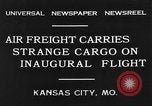
A Poland China pig sent as cargo in the inaugural flight of Air Freight plane, Kansas City, Missouri.
An Air Freight plane in Kansas City, Missouri. A man load crates of chicken and eggs into the plane. Men open a cage and a Poland China pig comes out from the cage. Pig fed before sent as a cargo in the plane. Man loads crates onto a vehicle and it pulls away from the plane.
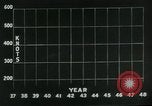
Various tests conducted at Wright Air Development Center in Ohio, United States.
A graph shows an ever increasing speed of aircraft year after year. In 1937 speed was 250 Knots and it rises to 600 Knots in 1948. United States F-84 undergoes some tests in a wind tunnel at Wright air Development Center in Ohio, United States. Main control panel inside the wind tunnel. A man wearing headset works on throttles. An engineer checks the main test panel. Engine fire test conducted as flames start to pour through ports.
CRITICALPAST.COM: About Us | Contact Us | FAQs - How to Order | License Agreement | My Account | My Lightboxes | Shopping Cart | Advanced Search | Featured Collections | Website Terms & Conditions | Privacy Policy ©2026 CriticalPast LLC.
License Agreement |
Terms & Conditions |
Privacy Policy
©2026 CriticalPast LLC.