


 Francais
 Deutsch
 Italiano
Refine Your Search
Vietnam Bien Hoa Air Base 1968 stock footage and images
- Showing 8719 to 8724 of 13286 results more
more Hide
Hide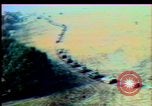
Soviet Army and Air Force in practice ranges prepare to intervene and march in to Poland border, during Poland Crisis.
Crisis in Poland around time of imposition of Martial Law by its Military Government. Large convoy of Soviet military bombers advances on countryside roads towards border of Poland. Soviet warplanes and helicopters strafe targets. A Soviet missile launched destroys its targets accurately. Tanks and Soviet amphibious vehicles cross a river. Infantry soldiers on alert at their posts along the Soviet-Polish border. Soldiers watch the border with binoculars.
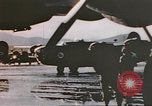
U.S. Air operations from Adak, and views of.the island's defenses during the Aleutians campaign of World War II.
As film begins, two U.S. B-24 bombers are seen taxiing across the Adak airfield to takeoff on a bombing run against the Japanese airfield at Kiska Island. Closeup of B-24 with engines running. About an inch of water covers the ramp. The two bombers take off (followed by others unseen). Airmen on the ground watch them depart. Scene shifts to the port of Adak. A cargo ship and a tugboat moving a barge are seen in the water. Trucks drive along the beachfront. Mountains loom in the background. Military supplies, including munitions are seen piled along the beach. Soldiers carry some goods over their shoulders. Closeup of items piled on the beach. A dog trots along with soldiers walking the beach. Change of scene highlights guns installed as coastal defense on the island, including fixed heavy guns, anti-aircraft guns and machine guns. A sailor viewed through a life safer buoy, paints part of a warship. A Navy PBY Catalina on patrol is seen overhead. U.S. gunboats patrol the harbor. Crew members are seen aboard a U.S. destroyer patrolling deep waters off Adak. They exchange blinker light messages with a Bancroft-class (four-stacker) destroyer. Glimpse of the Bancroft-class destroyer flashing blinkers lights. Sailors on a destroyer respond to alarm of sonar sound contacts and man battle stations. Closeup of a Bancroft-class destroyer, followed by views of depth charges being launched from a destroyer underway. Exchanges of blinker light messages between camera destroyer and a Bancroft-class destroyer.

Scenes of U.S. Army Air forces operations on Adak Island during the Aleutian Islands Campaign of World War II
As film begins, organ music is heard. Camera pans across tops of tents showing sky above. Scene shifts to a Chaplain conducting Sunday services in the open. A soldier plays a field organ as soldiers and airmen participate in the service. Closeup of the Chaplain kneeling before a makeshift altar where objects are placed to facilitate communion in a mass or service. Complete change of scene shows airmen arranging bombs for loading aboard an open truck that then backs up to an airplane, into which they are loaded. Narrator notes that these are all purpose bombs weighing 250, 500, and 1000 lbs, respectively. Closeup of a 1000 lb bomb in foreground marked "GP 1000 lb AN-M44." Airmen arnorers install fins and fuses before loading the bombs aboard the aircraft. An airman loads belts of machine gun ammunition at a gun turret of the airplane. others load guns elsewhere on the aircraft. Closeup of pilots being given final briefing about the mission, before departure. Narrator notes that the mission will involve two flights of B-24s and one of B-17s. Planned altitudes and routes of the bombers are drawn on a map in colors. They are to attack a Japanese installation on Kiska Island. Fighter support is described. A Flight crew assembles near their B-24 Liberator bomber. Closeups of individual crew members waiting on the airfield ramp. Scene shifts to fighter pilots who will be accompanying the bombers. They converse in front of a row of fighter aircraft. They are wearing flotation gear over their flight suits. The area is paved with Marsden matting (pierced steel planking). Closeups of men in the group, including: Lieutenant George I. Rudell, Lieutenant Holy P. Mail, Lieutenant Lial A. Bean, Major Willson Aston, Lieutenant Henry J. Strencops and Colonel Jackson.
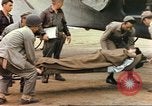
Wounded Marines are air evacuated in Iwo Jima, Japan during World War II.
Allied invasion of Iwo Jima, Japan during World War II. Wounded Marines lying on stretchers are loaded aboard an aircraft. A walking wounded is helped to board an aircraft. A soldier loads shells in an 81 mm mortar. The mortar being fired. U.S. Navy F4F Wildcat and TBM Avenger aircraft strafe Iwo Jima. Litter patients being loaded onto an aircraft for evacuation.
A NAM meeting and U.S. naval and air forces advance in preparation for World War II.
The United States on alert in the beginning of World War II. A National Association of Manufacturers (NAM) meeting. The NAM President talks addresses the group. He talks about the national defense requirements and ways to meet the mass production. The Pratt & Whitney aircraft engine plant in Hartford, Connecticut. Workers in line arrive for work. Men work to manufacture engines for American bomber and fighter aircraft. Manufactured engine parts stacked in stands. U.S. Navy Curtiss-Wright CW-22Bs in flight. A naval task force underway at sea below. The ships advance amidst explosions.
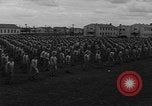
U.S. Army Air Forces Aviation Cadets in basic training..
In opening scene, hundreds of Army Aviation Cadet candidates are seen running in formations.This consumes most of the film. Next, they are seen lined up outside their quarters and practicing Judo throws, in pairs. Later, some run on a track around the field as others gather in the center of the field and play football.
CRITICALPAST.COM: About Us | Contact Us | FAQs - How to Order | License Agreement | My Account | My Lightboxes | Shopping Cart | Advanced Search | Featured Collections | Website Terms & Conditions | Privacy Policy ©2026 CriticalPast LLC.
License Agreement |
Terms & Conditions |
Privacy Policy
©2026 CriticalPast LLC.