


 Francais
 Deutsch
 Italiano
Refine Your Search
Vietnam Bien Hoa Air Base 1968 stock footage and images
- Showing 9997 to 10002 of 13286 results more
more Hide
Hide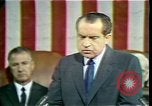
U.S. President Richard M Nixon in his State of the Union Message to the Congress speaks about environmental pollution.
President Nixon addresses the congress from the speaker's podium in the U.S. Capitol during his 1970 State of the Union address. He speaks about pollution and damage done to the environment by human race. He talks of the need to make reparations for the damage we have done to our land, air, and water. He notes that this is a particular concern of young people, "because they more than we will reap the grim consequences of our failure to act on programs which are needed now, if we are to prevent disaster later." (Foreshadows global warming.) President Nixon proposes a 10 billion dollar clean water program. Congressmen in the house applaud. He discusses the importance of purchasing and preserving open spaces and park lands. He discusses the need to make automobile emissions cleaner. He talks about pricing goods to cover not only their production but also their disposal without damage to the environment. He asks that citizens consider air and water not as free resources but as scarce resources to be protected. The Joint Chiefs of Staff among the Congressmen listen to the speech. Nixon talks about rural areas becoming less populated with migration to urban city centers. He calls on America to become a pioneer in environmental research and leadership. Vice President Spiro Agnew and the Congress Speaker sit on seats behind podium. Nixon concludes his speech and shakes hands with Speaker and other Congressmen who admire and applaud.
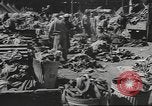
Numerous scenes of U.S. Army Quartermaster salvage operations in Italy during World War II; also brief aircraft crash scene.
U.S. soldiers in the textile repair section of a Quartermaster Salvage Depot, are seen sorting military clothing of all types to be recycled an reissued, or otherwise used as rags for cleaning purposes. Workers from the local populace are hired as paid employees in these salvage operations. A woman removes bundles of used army uniforms from a horse drawn cart and gives them to children who carry them to other women and children who are seen working on various levels of a building, where they mend and otherwise repair and restore the garments. A man works at a sewing machine on the ground floor of the building. But the women and girls seen are all engaged in hand sewing. Scene shifts to a section of the depot yard where tents are being examined, sorted and repaired. Large tents are suspended from a crane to facilitate inspection. The next scene shows interior of a mobile repair shop designed for the Signal Corps, where soldier technicians work on electrical and electronic equipment. A soldier repairs an SCR 536 (better known as handy talky) and an Army Technician fourth grade (T/4) works on an SCR-508 mobile Signal Corps Radio. He tests each tube and connection. A Staff Sergeant removes parts from a BD 72 field switchboard. Outside, several local civilian men employed by the Depot, are physically salvaging useful items, such as brass knuckle joints from metal tubing. Another pulls worn copper wire from an armature. Elswhere in the yard, soldiers and local helpers salvage lead plates from old storage batteries, where they are melted down over a fire and poured into old army helmets, serving as improvised ingot molds. A huge collection of spent artillery shells covers a vast area in the depot. They are loaded aboard barges and brought to ships for transport back to the U.S where they will be repacked and reused. Soldiers collect unserviceable tires for reshipment back to the U.S. Soldiers inspecting a pile of tires. Soldiers inspecting rubber tubes and checking them for leaks. A pile of inflated tire tubes left to sit awhile before being inspected. Outside the infantry too repair shop, soldiers repaint pick mattocks and set them out to dry. Using tools they invented, two soldiers remove wooden handles from shovel blades and from ax handles, in the infantry shovel repair department. Inside the building, soldiers are seen repairing stoves in the stove repair department. One ignites a stove and checks its flame. In a corner of the shop, a worker repairs gasoline lamps. Several are seen illuminated. Soldiers hammer out dents in mess kits and use compressed air and stone molds to take dents out of canteens. One disinfects mess gear by dipping in a lye bath and then in water and repeating that procedure again. He hangs them in the sun to dry. At one spot (where no smoking is written on the wall in Italian) a soldier works repairing 5 gallon (Jerry) gasoline cans using air pressure and water immersion to detect any holes. A jerry can is brazed by a worker using an acetelyn torch and rod. A warplane is seen crashing in flames. Signs advertising salvage as savings, are seen in various places. Salvage trucks and cranes are seen along with glimpses of salvage crews at work. A cartoon sign by a destroyed building shows a GI with ax holding Hitler's head. It reads: "Behead Hitler. Turn in Salvage." Another cartoon sign shows a girl and reads: "You will bet back to me sooner, if you turn in your salvage." A GI whistles in admiration as he passes the sign to pick up two discarded jerry cans. He salutes the sign as he walks away.
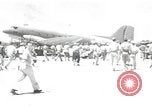
American entertainers Bob Hope and Jerry Colonna at Hickam Field in Hawaii, United States during World War II.
American entertainers in Hawaii, United States during World War II. Servicemen rush towards U.S. Army Air Forces C-47 Skytrain aircraft at Hickam Field. Singer Frances Langford and Patty Thomas in the top hatch of a USAAF B-24 Liberator aircraft. They wave and smile. Comedian Bob Hope shakes hands with island commander General Tenney. Italian-American comedian Jerry Colonna at the air field. Langford and Patty Thomas smile.
USAAF P-47 Thunderbolt aircraft arrive in England and are tested during World War II.
A film about the role U.S. Army Air Forces ( USAAF) P-47 Thunderbolt aircraft in air strikes over Germany during World War II. P-47 aircraft in formation flight. The aircraft peel off one by one. Aircraft in a hangar. Mechanics work on the aircraft. P-47 Thunderbolts being unloaded at a port in England. Jeeps and trailers tow the aircraft to the hangar. British mechanics work on aircraft as they assemble parts. Aircraft being fueled. Propellers rotate and an aircraft taxis during a test. A pilot comes out from a building. A sign on the building reads 'Test pilots'. P-47 aircraft in flight.
German aircraft are shot down after attacking British Merchant Shipping vessels in the English Channel during World War 2
German air attack on British ships in the English Channel during Battle of Britain in World War II. British ships underway in the English Channel. German Stukas in flight. Explosions occur at sea as German aircraft bombard a British merchant convoy. British Royal Air Force Hurricane aircraft fly across camera. Vapor trails in the sky. RAF Hurricane aircraft being shot down. British soldiers look at a wrecked German Junkers 88 dive bomber aircraft.
General Arnold decorates 25 fliers at Bolling Field in Washington DC, during World War Il
U.S. Army Air Force fliers being decorated at Bolling Field in Washington DC, United States. Commanding General of the U.S. Army Air Forces, Lieutenant General Henry H (Hap) Arnold, decorates aircrew members who took part in the Doolittle Raid against the Japanese in World War 2. Lt. Gen. Arnold pins the Distinguished Flying Crosses on the airmen. A flier with his wife after receiving the medal.
CRITICALPAST.COM: About Us | Contact Us | FAQs - How to Order | License Agreement | My Account | My Lightboxes | Shopping Cart | Advanced Search | Featured Collections | Website Terms & Conditions | Privacy Policy ©2026 CriticalPast LLC.
License Agreement |
Terms & Conditions |
Privacy Policy
©2026 CriticalPast LLC.