


 Francais
 Deutsch
 Italiano
Refine Your Search
Vietnam Bien Hoa Air Base 1968 stock footage and images
- Showing 10159 to 10164 of 13286 results more
more Hide
Hide
USAAF B-29 Superfortress bombers drop bombs over industrial targets in Tokyo, Japan during World War II.
Bombings in Tokyo, Japan during World War II. A bomb truck backs up to a United States Army Air Force ( USAAF ) B-29 Superfortress heavy bomber at an airfield on Saipan, Mariana Islands during the preparations for Tokyo bombing. A soldier writes 'Only the Beginning' on a bomb. The soldier wheeling a bomb cart to the underside of the aircraft. An airman on the top of the aircraft. A Commandant briefing the members of the 21st Bombing Command. Mission leader United States Air Force Brigadier General Emmett O'Donnell and Commanding General of 21st Bombing Command Brigadier General Haywood Hansell, Jr., look at a document and discuss on the airfield. USAAF pilot Robert Morgan, who piloted B-29 Dauntless Dotty, with another crew member. The men beside the B-29 Dauntless Dotty which would lead the team. B-29s lined up on a runway. B-29 Dauntless Dotty takes off. Several men on the airfield watch. A man beside a camera mounted on a tripod takes pictures. The B-29s take off one after the other. They head towards Tokyo. A map shows the flight path from Saipan island to Tokyo, Japan over the Pacific Ocean. Aerial view of Tokyo. The B-29s drop bombs over target areas. Explosions occur in the bombed areas. The B-29s drop more bombs over industrial targets. Explosions occur. The B-29s head back to Saipan after the bombardment. U.S. Army tents in Saipan. Japanese aircraft drop bombs over an airfield in Saipan. Thick clouds of smoke rise from the bombed areas. Wrecked B-29s in view. Flames and smoke rising from the bombed areas. Wreckage of the Japanese aircraft shot down in the raid. Men extinguishing fire. A B-29 taking off from the airfield.

Target areas are bombed by United States aircraft and smoke rises in Tokyo, Japan during World War II.
Tokyo bombings during World War II. Flames rise from a target area in Tokyo, Japan after bombings by U.S. aircraft. A truck on fire. A burning aircraft. A field with a few trees. Thick smoke rises into the air in the background. Smoke rising from bombed areas. A road in view. Smoke rising from areas on one side of the road. A burning aircraft on an airstrip and thick black smoke rising into the air. Parts of the aflame aircraft strewn on the airstrip.
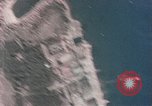
USAAF B-26 Marauder medium bombers drop bombs over target areas in Italy during the Italian Campaign of World War II.
United States Army Air Force medium bombers in Italy during the Italian Campaign of World War 3. Aerial view of an Italian city along a coastline. The control panel of a USAAF B-25 Mitchell medium bomber. A few USAAF B-26 Marauder medium bombers in a formation flight. Bombs dropped from the aircraft hit target areas in the city. Smoke rises after explosions in the bombed areas. Smoke mushrooming into the air from several target areas. Several B-26 aircraft in a formation flight.
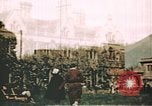
Wounded American airmen at a rehabilitation center in English countryside during World War II.
Wounded American airman, accompanied by uniformed nurses on the grounds of a rehabilitation center in England during World War 2. One airman picks a tulip for U.S. Army lieutenant (Nurse) accompanying him at the infirmary. Several recovering wounded are seen fishing from the bank of a stream on the grounds. One catches an eel. U.S. Air Force Captain Clark Gable, a Hollywood movie star, visits one of the recovering wounded 8th Air Force B-17 pilots to see how he is.They discuss the events surrounding his wounding. Captain Gable asks his opinion of the B-17 aircraft. The pilot responds that it is the "best in the world."
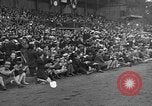
French military hold a track event in a stadium in France, with some American participation, in World War I
French civilian spectators fill a grandstand and ground in front of it to watch a French military track meet (with some American participation) during World War 1. Longer distance runners are cheered by some spectators as they cross the finish line, one by one, in front of the grandstand. contestants run a shorter race with a close finish. The winner is congratulated by a French military officer. Scene shifts to closeup of Lieutenant Paul Rene Fonk, French Air Ace credited with over 59 enemy planes. He stands in center of stadium, being recognized by the crowd. An American officer is seen standing behind him. Next, a large group of youths perform calisthentics in unison for the crowd. Lieutenant Leonard, of the U.S. Air Service (in athletic garb) converses with Lieutenant Fonk. Other athletes, another U.S. flyer, and a French civilian official stand with them. As they move away, Lieutenant Fonk and other French officers remain to confer with the French civilian official. Another race is seen, next, as runners come past in single file around the track.
Information about unidentified airplanes is transmitted in the United States.
A public television program by the U.S. Army entitled 'The Big Picture.' U.S. troops are seen hunkered down and looking through binoculars in a defensive position in Korea, during the Korean War. American soldiers riding atop a Sherman tank on a city street in Germany, during World War II. Ski troops moving across snowy hill in Alaska. U.S. Army amphibious assault training on a beach in Puerto Rico. Army Master Sergeant Stuart Queen, narrator, speaks about America's defense against threat of atomic attack in these times of lukewarm peace. View of mountainous region in Alaska. A cluster of Cup'it Eskimo dwellings is seen on Nunivak Island, in the Bering Sea. Several of the local inhabitants are fishing through holes cut in the ice. Vapor trails are seen from Soviet aircraft flying at high altitude. A sign on a tarpaulin displaying logo of the Army Signal Corps, reads,"Alaska Communication System, Long Distance Commercial Telephone-Telegraph." A tracked vehicle carries a soldier to a facility posting a sign reading, "Alaska Communications System Receiver Station." Several tall antennas loom above the site. The soldier, dressed in arctic gear, steps from the tracked vehicle and walks past several snow shoes, standing upright in the snow, to enter a white wooden building. Inside, a man in civilian clothes works at a battery of telecomunications equipment. He transmits a message about the aircraft sighting, to the Alaska Communication System facility in Fairbanks Alaska (briefly shown) by means of a telegraph key. From there it is relayed to a Signal Corps facility, shown, in Washington, DC. A soldier is seen Inside that facility, in a room filled with computers and telecommunications equipment. A Sergeant handles paper tape messages being sent and received by teletype. Another soldier plugs connections into a communications switchboard. Next, the camera pans over the entrance to the Office of the Secretary of Defense, in the Pentagon. More views of soldiers attending banks of teletype machines. Animated map displays paths of orders being transmitted to U.S. Air Defense Centers in San Francisco, Chicago, Seattle, New York, and Atlanta. View from control room, of several U.S. Air Force F-94 Fighter Interceptor aircraft on an airfield ramp. A controller activates a Klaxon horn and pilots on alert, in the Fighter Interceptor Squadron ready room, jump up and scramble to their aircraft. A pair of F-94s taking off. One is number 51-5385. Next, a U.S. Navy F-9 fighter plane is seen taking off from an airfield. It displays tail code AE. It is followed by another F-9 aircraft.
CRITICALPAST.COM: About Us | Contact Us | FAQs - How to Order | License Agreement | My Account | My Lightboxes | Shopping Cart | Advanced Search | Featured Collections | Website Terms & Conditions | Privacy Policy ©2026 CriticalPast LLC.
License Agreement |
Terms & Conditions |
Privacy Policy
©2026 CriticalPast LLC.