


 Francais
 Deutsch
 Italiano
Refine Your Search
Vietnam Bien Hoa Air Base 1968 stock footage and images
- Showing 10231 to 10236 of 13286 results more
more Hide
Hide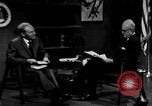
Lieutenant General Ira Eaker talks about his most interesting and satisfying assignments during an interview in the U.S.
An interview of United States Air Force Lieutenant General Ira Eaker conducted by Dr. Maurer in the United States. General Eaker is asked about his most interesting and satisfying assignments. He speaks about the command of the 20th Pursuit Group. He was there on duty with USAF General Henry Arnold. He talks about the officers who served and contributed with him in the Air Force. He speaks about his experiences while working with the officers.
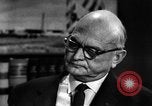
Lieutenant General Ira Eaker talks about the Casablanca Conference during an interview in the United States.
An interview of United States Air Force Lieutenant General Ira Eaker conducted by Dr. Maurer in the United States. General Eaker talks about his experiences in the Air Force. He talks about the Casablanca Conference. He says that U.S. Army General Henry Arnold told them about the President's decision to discontinue the bombardment at daytime and join the British bombers in the night bombing. He told General Arnold that it was not possible as they were not ready for the night bombing, nor their crews were trained for night bombing. He advised to continue the daylight bombing. He presented a number of reasons for the same. They were then allowed to continue with the daylight bombing.
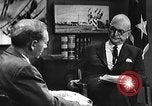
During an interview in the US, Lt. Gen. Ira Eaker talks about daylight precision bombing and B-17 Flying Fortress aircraft.
An interview of United States Air Force Lieutenant General Ira Eaker conducted by Dr. Maurer in the United States. General Eaker talks about daylight precision bombing, British and U.S. night and daylight bombing. He says that a few United States Army Air Force B-17 Flying Fortresses Could survive against several German aircraft. He further states that if they reduced the number of these aircraft by razing factories, then they didn't have to worry about German bombers.

USAFE precision flying demonstration team, the "Skyblazers" perform. Various aircraft involved in crashes in Europe
A documentary titled: 'No Sweat' on accidents of USAFE (United States Air Force in Europe ) aircraft. USAFE precision flying demonstration team, the Skyblazers, perform a formation takeoff in their F-86 F Sabre aircraft. They maneuver in close formation. The airplanes leave smoke trails behind. View of an airplane diving into the ground and crashing. Views of crashed U.S. Air Force aircraft in Europe, involving a variety of airplanes, including F-86, T-33, C-119, C-47, and numerous other aircraft, some completely destroyed so as to be unrecognizable.
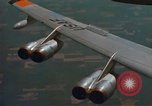
A B-52 H aircraft with turbo fan engines in flight overhead in Kansas, United States.
The coverage of the Boeing 1960 Progress Report covering the development and production of U.S. Air Force B-52 Stratofortress G and H models. A B-52 H model in flight over an air field in Kansas, United States. It is equipped with a turbo fan engine. The aircraft taxis on a runway and takes off. The airplane in flight overhead. Aerial view of the flight. Average Pacific range improvement of the aircraft due to turbo fan engines.
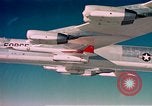
B-52G aircraft , capable of launching three different types of missiles, in flight over an area in Kansas, U.S.
The Boeing 1960 Progress Report covering the development and production of U.S. Air Force B-52 Stratofortress G and H models. A B-52G aircraft in flight overhead in Kansas, United States. The aircraft is capable of launching three different types of missiles. The aircraft can confuse the enemy radars and air defense systems. A man working at Boeing plant in Wichita, Kansas. He makes modifications in the model.
CRITICALPAST.COM: About Us | Contact Us | FAQs - How to Order | License Agreement | My Account | My Lightboxes | Shopping Cart | Advanced Search | Featured Collections | Website Terms & Conditions | Privacy Policy ©2026 CriticalPast LLC.
License Agreement |
Terms & Conditions |
Privacy Policy
©2026 CriticalPast LLC.