


 Francais
 Deutsch
 Italiano
Refine Your Search
Vietnam Bien Hoa Air Base 1968 stock footage and images
- Showing 11029 to 11034 of 13286 results more
more Hide
Hide
Two aircrafts tow gliders in Aparri, Philippines
Two American aircrafts tow two gliders as they fly across the sky in Aparri, Philippines. Aircrafts land at the air strip.
United States Army 511th Parachute Regiment paratroopers jump from C-47 plane in Luzon, Philippines during World War 2
United States 511th Parachute Infantry paratroopers jump from C-47 aircrafts in Luzon, Philippines. Mass paratroopers drop from air over fields.
Battle of Midway between America and Japan in Pacific Theater during World War 2
Barrage balloons fly as anti air craft guns are fired from a destroyer in the Battle of Midway in Pacific Theater during World War II. Tracers fired as antiaircraft guns burst barrage balloons. Japanese plane comes in for attack. 5"guns aboard a destroyer fired. Japanese plane crashes. United States Navy SBD dauntless makes a landing on the flight deck of Yorktown, an aircraft carrier. F4F coming in for landing.

The Philippines gains independence from the United States on July 4, 1946; also scenes from 1941 Japanese invasion WW2
The Philippines are established as an independent nation. Crowds of Filipinos gathered at Rizal Park (Luneta Park) in Manila on the July 4, 1946. View of Independence Grandstand (a temporary structure built in front of the Rizal Monument) with American flag and Philippine flags on tall flag poles.. View looking down on General Douglas MacArthur at a podium, speaking into microphones. Camera pans over various segments of the audience. A map shows the Philippine Islands in context of its neighbors in the Pacific Ocean. Camera pans closeup across faces of many Filipinos gathered at the independence event. View of the Jones Bridge over the Pasig River in downtown Manila. Heacock’s Department Store on the Escolta. The Legislative Building. (later the National Museum of the Philippines). Ocean going ships in a harbor. Cargo being offloaded from a ship onto smaller boat. An industrial complex with eight tall smoke stacks emitting smoke. Steel and petroleum plants. Filipino workers in an assembly plant. The Legislative building with people coming and going. Air raid sirens sounding and people running in streets of Manila at onset of Japanese invasion of the Philippines in December, 1941, at start of World War 2, in the Pacific. People running across the Jones Bridge, seeking shelter. Others boarding a bus. Smoke rising from Japanese bombing. Glimpse of Japanese tanks entering Manila during attack and invasion. Japanese infantry climbing a hill. Bodies of persons killed during the Japanese invasion. Glimpse of Japanese troops occupying Corregidor. U.S. General Wainwright negotiating the surrender of Corregidor with Japanese General Homma. View of an American warship firing during the U.S. campaign to defeat the Japanese on islands in the Pacific. An American landing ship carrying U.S. troops who storm ashore. General Douglas MacArthur striding ashore with a retinue of officers, at Leyte, Philippines, on October 20, 1944. as he keeps his promise to return to the Philippines. Views, back again, to MacArthur speaking at the Independence Day ceremony in Manila on July 4, 1946. Also seen at the ceremony are: U.S. Senator Millard Tydings, (co-sponsor of the 1934 Tydings–McDuffie Act, which provided independence to the Philippines after a 10-year transition under a limited autonomy), and Paul V. McNutt, U.S. High Commissioner of the Philippines, who read President Truman's proclamation of Philippine Independence to the assembly. Camera pans over the gathering which includes many U.S. Service personnel in uniform. The oath of office is administered to the elected President of the Philippines, Manuel Roxas. At the conclusion, the American flag is lowered by Paul McNutt, as President Roxas raises that of the Republic of the Philippines. A celebratory parade in Manila includes a float with signs reading: "Let's Produce and Rebuild," among other things. Other floats represent "Mountain Province," and "The City of Manila," "The University of the Philippines," and "The Division of City Schools." One float, sponsored by the Chamber of Commerce, contains a huge replica machine gear, and models of an aircraft and a ship. It's message is about turning the gear that helps make the nation great. American and Filipino soldiers march, carrying their respective national flags. A white-helmeted military band plays for the marchers. Final scene shows large loose formation of military aircraft in flight very high above the Independence Grandstand, at Rizal Park.
B-17 and B-24 bomber drop bombs over Japanese positions in Aleutian Islands, Alaska
United States B-17 and B-24 bombers loaded with bombs to be dropped over Japanese position in Aleutian Island during World War II. Planes take off and drop bombs over Japanese position and return after the air strike.
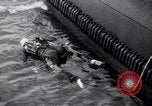
Aftermath of Japanese attack on Pearl Harbor in World War 2; Recovery of Japanese B5N2 torpedo bomber and one Japanese crewman
Aftermath of Japanese attack on Pearl Harbor in Hawaii during World War II. Approximately one week after the December 7, 1941 attack, this is a view of a Japanese crewmember from his torpedo bomber floating face down in the water. He was the radioman (gunner) on the aircraft which was downed in Southeast Loch by antiaircraft fire: Nito Hiko Heiso (Petty Officer Second Class) Yoshiharu Machimoto. Prior to this opening image, a U.S. diver had cut the harness from Machimoto in the still submerged aircraft, and his body had risen to the surface, losing his boots in the process. The mangled wreckage of the recovered Japanese torpedo bomber, a Nakajima B5N2 "Kate" (AII-356 serial 3178) from the Japanese aircraft carrier Kaga, is seen hoisted on a crane, dangling in the air.
CRITICALPAST.COM: About Us | Contact Us | FAQs - How to Order | License Agreement | My Account | My Lightboxes | Shopping Cart | Advanced Search | Featured Collections | Website Terms & Conditions | Privacy Policy ©2026 CriticalPast LLC.
License Agreement |
Terms & Conditions |
Privacy Policy
©2026 CriticalPast LLC.