


 Francais
 Deutsch
 Italiano
Refine Your Search
Vietnam Bien Hoa Air Base 1968 stock footage and images
- Showing 11365 to 11370 of 13286 results more
more Hide
Hide
German float planes interdict ships at sea. German officer boards a ship to examine papers, in World War II
Two German Heinkel He 60 Naval float planes take off from the water, in formation. Next, a Heinkel HE-59 float plane is seen through turning propeller of another in formation. Two aviators in cockpit of the HE-59. View from gunner's cockpit of his machine gun and sight, as the plane tracks a ship in the water below. View of the gunner firing his machine gun. Closeup of the ship from the aircraft as it passes overhead. The ship has "Nordborg-Danmark" and Danish flag painted clearly on its side. Scene shifts to gunner, on an HE-59 float plane, throwing a message to a ship below. View from a Norwegian steamer stopped at sea, as the German HE-59 float plane descends nearby. The aircraft makes a water landing. View of the ship from the float plane. A German officer boarding an intercepted ship, exchanges salutes with the ship's captain. Accompanied by a soldier, carrying a camera, He is escorted to the Captain's quarters where he examines the ship's papers. Change of scene shows several Swedish Air Force Gloster Gladiator aircraft taking off. View from one in a formation of them flying over area of snow, ice, and water. (World War II; WW II; World War 2; World War Two)

People shop at a market in German-occupied Ukraine.
Views of a market in Ukraine during World War 2. Film opens with glimpse of a man splitting firewood, and continues with scenes of various vendors and numerous customers in an open air market on a pleasant day. . People purchase food and clothing. A group of men seen conversing.. A man plays a balalaika. A German soldier is seen briefly with a group of civilians.
The launching of the first pilot-less aerial torpedo at Carlson Field in Arcadia, Florida.
A review of research and development in guided missiles by the United States Air Force from 1919 to 1948. A civilian technician assembles first pilot-less aerial torpedo at Carlson Field, in Arcadia Florida. A launching track and gear. Technicians work on the missile beneath camouflaged netting. Attempted launching of the missile results in a crash due to track failure. The missile is launched and takes off. First successful launching of the aerial torpedo on October 24, 1919. The missile crashes immediately after the take off. First successful flight on October 2. Aerial view of hangars and airstrips of Wright Field in Ohio during early 1940s.

Take off of the General Motors GM A-1 'Bug' missile from a launching automobile in Muroc, California.
A review of research and development in guided missiles by the United States Air Force from 1919 to 1948. General Motors power-driven bomb (GM A-1 Bug), number 9 on tail, in Muroc, California. Technicians work on the same. The bomb is raised into position for attaching to the launching automobile by means of a hoist on a truck. The missile is nick named the 'Bug'. Technicians work at the automobile being driven beneath the suspended missile. The missile is radio controlled. The automobile specifically built for the launch of the missile is powered by two 165 HP Cadillac engines attached to a single drive shaft. Attaching the 'bug' missile to the launching car. The tractor and the hoist are removed. The automobile is driven across terrain at Muroc. A testing station for testing radio control section of aircraft during test. A technician checks over the radio equipment and shows television camera and equipment used for test. The automobile start at a high speed across the launching strip. Take off of the missile from the automobile. 'Bug' missile in flight. Views from a control aircraft beside the GM A-1 Bug while the Bug is in flight. (World War II period).
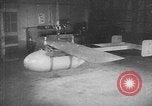
A GB-1 bomb is dropped from a B-17 and the launch of a GB-8 missile in the United States.
A review of research and development in guided missiles by the United States Air Force from 1919 to 1948. A GB-1 bomb is suspended from a chain hoist in the interior of a laboratory. This is a preset glide bomb. A B-17 with GB-1 attached, takes off. The B-17 in flight with GB-1s attached to the bottom of the aircraft. Aerial launching of the GB-1 from the B-17. Side view of a GB-8. Flares attached to the tail section of the GB-8. This is a radio-controlled missile, flares are used to assist in guiding the missile to target area. The GB-8 descends. Smoke trails behind. The GB-8 hits a flat open desert terrain. (World War II period).
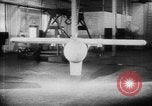
A television controlled GB-4 missile is dropped from a B-17 aircraft in the United States.
A review of research and development in guided missiles by the United States Air Force from 1919 to 1948. A GB-4 radio controlled bomb is suspended from a chain hoist in a work laboratory. This is a television controlled missile. Attaching television equipment to the bottom of missile. A B-17 takes off and is directly overhead. The B-17 in flight, GB-4 attached to its bottom. Interior of the aircraft shows television equipment as a bombardier prepares to drop a missile. The television equipment being put into operation. The B-17 drops the GB-4 missile. Interior of the aircraft shows the bombardier following the course of missile on the television equipment. GB-4 missile dives down towards a train. The locomotive moves across a flat open terrain. The missile hits the target area. The GB-4 missile dives towards a target building. It strikes the ground directly in front of the same and crashes through the building. (World War II period).
CRITICALPAST.COM: About Us | Contact Us | FAQs - How to Order | License Agreement | My Account | My Lightboxes | Shopping Cart | Advanced Search | Featured Collections | Website Terms & Conditions | Privacy Policy ©2026 CriticalPast LLC.
License Agreement |
Terms & Conditions |
Privacy Policy
©2026 CriticalPast LLC.